Letters from a Grand Tour of Europe, 1870-1871

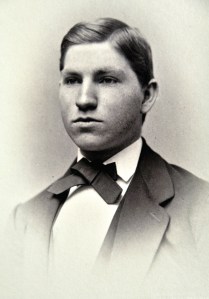
Roger W. Swaim (1848-1872)

Here in Vermont, the autumn leaves have faded and gone and the sky is a dull gray. Driving home from work last week, there was a fierce wind blowing snowflakes onto my windshield, so it seems that winter has come early to New England this year. I’ve lit the fireplace and settled in with a cup of coffee and a good book, but the cold weather has me longing for a balmy Italian summer.

To get me through the next few months, I’ve been reading and transcribing a set of long letters written by a young Harvard grad in the 1870s while on “The Grand Tour” of Europe and the Holy Lands. They are a travelogue from a different age, filled with lush details and wide-eyed observations, as well as some boisterous merrymaking over few pints of beer in Munich. When I think of my own tramps across Europe through the years, I’m struck not by the differences, but by just how little has changed…

Enjoy!
DLG


ABOUT THE AUTHOR

ROGER WILLIAMS SWAIM, son of Samuel B. and Aurora D. (Skinner) Swaim, was born in Worcester, Mass., July 12, 1848. He was fitted for college at the Cambridge High School, and entered with the Class in 1866; after graduation, in order to restore his health, which was quite poor, he started, in July, 1870, for a tour abroad, and for fifteen months travelled in Europe, Egypt, and the Holy Land, arriving in Berlin in September, 1871, where, as a member of the University, he studied during the winter. In March, 1872, while in Italy, he was taken sick, and died in Florence, on April 1 [1872], of congestion of the brain, aged twenty-three years and nine months. He had selected the ministry as his profession.

Source: Harvard College Class of 1870, Third Triennial Report of the Secretary, page 26.

August 2, 1870

I wonder if base-ball playing agrees with you as well as sight-seeing & parley-vousing does with me…

Asniers, Aug 2, 1870

Dear Perrin,

I wonder if base-ball playing agrees with you as well as sight-seeing & parley-vousing does with me. Except on sea travelling, [it] suits me perfectly. I walk regularly on my tramps around the city [of Paris] four, five, or six miles a day, searching both for what is in the guide book & what is not. I am afraid I shall be in the condition of Rev. Mr. Channing whose lectures I once attended, whom [William Master] Spackman, I believe, once said had learned more than he could systematize & comprehend.

You will take notice that this felicitous state of being is obtained only on land. On sea, it is a little different. I remember how beautiful to me once was the expression “rocked to sleep in the bosom of the billow.” I should like to see the man that uttered such a sentiment & either talk to him or take him or a voyage. I can no longer regard the sea as a sublime deity, throwing up its mighty waves & opening vast caverns disclosing the yellow sands beneath (Virgil). Now I look upon it as a mean sort of element which continually tips one this way & that way, forward & backward, from one side to the other, giving no peace to his brain, nor quiet digestion to his stomach. The whole voyage was just like this. The sea never rolled in such vast billows, or plunged with such force, that one could enter into the spirit of its fury & partake of the impulse, but heaving & swaying just enough & a little more than enough to make everybody feel like turning himself inside out. Poor passengers. Often have I seen ye stagger to the ship’s side & make libation after libation after libation to the sea, thus frightening away all the mermaids &c, or while promenading on the deck, dreadful warnings have filled the ship as some poor wretch in his extremity tried to relieve himself. But below in the cabin, what a noise. Squalls of infants, heart-rending bellowings, deep groans, followed by the noise of a rushing flood thrice repeated. After all there was considerable amusement. Many French people were aboard & the Americans who were abroad also affected the language so that I had a foretaste of La France. Many odd characters displayed themselves & Rich occupied a good part of his time in sketching them. Some of his drawings were very fine. He is now at the Hotel Mirabeau with his Father’s family. In a week or two he will go to Switzerland & return to Boston in the fall as he will study architecture in some office there.

We had a jolly time at Brest. Its magnificent fortifications, fine harbor filled with Monitors & ships of war, its narrow streets, funny shops & comical people, women with their white caps, peasants in their blouses & wooden shoes, soldiers & sailors in great numbers everywhere. We rambled about the town until evening, took the night train for Paris & arrived at the city at four o’clock in the afternoon of the next day, passing on the way the grand Cathedral at Chartres, which I purpose to visit after leaving Paris.

cdv-paris2We rode rapidly to the Hotel Mirabeau, passing by the Hotel des Invalides, with its gilded dome, beneath which the remains of Napoleon are entombed, then down the long esplanade, past the Corps Legislatif, over the Seine in the direction of whose length can be seen the towers of Notre Dame (by the way, I shall perhaps send home a few pictures of Paris by Rich, so if you call after his return, Mother will show them to you), then into the Place de la Concorde. These two places, the Tomb of Napoleon & this square are to me the crowning sights of Paris. I do not except even the Louvre, famous & glorious picture gallery though it may be, for stand here in the centre of the Place. Nearby is the famous Obelisk of Luxor over 3,000 years old telling of Egypt’s greatest sovereign, Sesostris. On each side are two magnificent fountains. All around are colossal images representing the different cities of France. Candelabra with designs representing the ancient galleys. Around is a broad grand avenue paved with concrete, while a wide side walk runs around the whole square. Add to this the size of the Square itself. Still more, on one side you look into the gardens of the Tuileries with its grand forest, on the other stretches away in the distance the Champs Elysees, a magnificent avenue with parks on both sides, at last ascending to the Arc de Triumphe. Then remember that in this place stood the guillotine of 1793. To this square hurried the fierce mob from the Faubourg St. Antoine to see the King, Louis XVI, die. Hither came from the Conciergerie, whose towers still remain, Marie Antoinette. Here continually came up the carts laden with the proscribed of Robespierre, Danton & Marat. The whole Revolution again comes up before the mind & one scene of history becomes realized.

cdv-paris1In the distance is the gilded dome of Napoleon’s tomb. One enters into what appears to be a vestibule above the great dome, with its frescoes below & just in front is a balustrade. You approach. It surrounds a crypt in which is The Tomb. It is an immense sarcophagus, magnificently polished & resting upon a rectangular mass of dark green stone in a cavity in which lies the body. Around in the pavement is a mosaic-like wreath of bay or laurel from which stream out rays of light. Around are images like Caryatides finely executed. Farther back is a shrine dedicated to Saint-Louis in the shape of a canopy, beneath which is an image of Christ on the cross. I need not say that in such a place as this, one can spend hours. Here one can realize another scene, or group of scenes, & becomes in some sense a hero worshiper. Right or wrong, one cannot but do homage in this place to a man who gave France a national sentiment, an idea of a foremost nationality. Perhaps someday we shall have a treatise with this title, “The Central Idea of the Napoleonic Dynasty.” It would be a grand study, that of this epoch. Perhaps this is nonsense.

Write soon, your friend,
R.W. Swaim

The rates of postage via Havre & via England, I have been told, are different. I have been told via England is best.

R.W. Swaim, Paris, France
Care of John Munroe & Co.
7 Rue Scribe

September 28, 1870

Now the road led me on past fields where women were out working, the men meeting, an old dame with rugged face & white cap like a sugar cone, seated in her lip-cart & driving a horse of immense proportions past huts thatched with straw, walled with stone & moss covered. Among these led little lanes in which men, women, boys & girls & infants all stared at the pilgrim…

Bordeaux, September 28, 1870

Dear Perrin,

My head is full of the jumble & Babel which assails my ears incessantly. Parisian French has ceased to be spoken & now uncouth, harsh sounds are heard on every side, poured forth with frightful volubility. Yet if I address them in book French, they immediately reply so that I can understand them & immediately return to their patios.

Possessed with an insane desire to see everything, I came to this little village, or hamlet, filled like all the other towns at present with the garde mobile, in order to visit the Druidic monuments. The distance between the stones, however, & Auray is eight miles & to Loch Maria Ker ten miles, & when one has reached the place it requires two or three miles more of walking or boating to visit them all, so scattered are they & so extensive. Behold me starting off at eight o’clock in the morning while the bell for mass was ringing. This mass is said everywhere for the French army. People were just coming with prayer books in hand, out of the houses. The road led for some distance between gardens completely enclosed by high stone walls, sometimes with a fierce & terrible aspect caused by the bits of glass stuck in the mortar at the top. The stone breakers & ditches, called here “cantonniers,” were just commencing their work for the day. In the forest, woodcutters were lopping off limbs, by no means dropping down trees in the wholesale way we have at home, but here a twig & there a branch. Everywhere the pine trees present this disfigured mutilated appearance. Great wounds on the trunk while atop the foliage is left to grow. Along the Loire, the willow trees are completely trimmed as fast as a new crop has grown & instead of beautiful waving willows there is only a succession of stumps.

Boys & girls now began to drive their little black & white cows to pasture, where little grass grew in the midst of much heath. Great heaps of fertilization showed themselves in the fields around which women in red skirts of diminutive length, barefoot, were working with fork & shovel. Here an old woman was cutting off the tops of potato vines, & yonder men & women were busily putting the potatoes into large sacks. At intervals along the road, old crones sat on the stone wall & watched a cow or black sheep, all the while knitting unceasingly black thunder clouds of stockings, one of the things which make the landscape of Brittany so dark & somber.

A windmill on every little eminence, at present their sails folded & only presenting an array of bare, rough sticks. I had a most curious sight of these from the summit of a hill near Dol. I could count eighteen of these madmen along the seacoast & on the ridge of hills extending around all jollily waving their arms & seeming to be in an ecstasy, sometime two close by each other would turn in opposite directions as if whacking each other in good earnest. It makes me laugh to see these old fellows go at each other in that way, each with a prop to his back. Every little while a crucifix lifted itself up by the wayside on pedestals, all in the coarse stone of the country, sometimes with rude attempts at carving a rough outline of a figure. In this respect, I fancy I find a difference between Normandy & Brittany—for in Normandy, the Calvary as it [is] called or in French “Calvaire” is of wood with a carved image of the same material & sometimes a spear & rod with a sponge at the end crossing below each other, but in Brittany usually only a stone crucifix.

Now I met the postman trudging along with mailbag on his back, or a lip-cart packed with women in white caps, black dresses & red cheeks, who stared vehemently at the stranger. All along the sides of the road, except where cultivated, grew this thorny heath, now become of a dully brown color & the nearer I approached the sea the more this covered the ground. Now & then little dolmens showed themselves. I turned aside to see three & had just got into a field to look at another when I saw a lot of girls leaning against it, which frightened me away. An old priest directed me to a long heath covered mound at the eastern extremity of which was an immense dolmen called “Table des Marchands.” An enormous block of stone formed the roof of a chamber, partially underground. The end of this chamber was formed by a large cone shaped column or boulder, the point of which supported the ends of the roof-boulder. At the opposite side an alley of stones commenced partially roofed & gradually narrowing down. The sides, or “parois,” were stones of a rude, rectangular shape, sometimes almost shapeless, but all destitute of any nicely marked angles. I could easily stand upright in it. The boulder forming the end of the chamber was entirely covered with figures, like pot-hooks, “par example” [an ink sketch is drawn here]. On the roof, a rude hatchet-shaped figure. On the sides, figures called “Caltae,” thus. But one marvel was the immensity of the stone which formed the roof, its underside convex, its upper surface almost perfectly level. The whole was supported on three points. A fragment large enough to make a second dolmen had been removed by some means to the other end of the mound. Very near this were the pieces of a huge Menhir, three facing toward the village, the remaining fragment being at right angles. Each of the pieces were enormous by themselves, when forming a whole one cannot estimate the strength required to lift such a mass into the air. It is the bulk, the mass, the density, combined with its size which impresses so forcibly the spectator. There one gets an idea of weight, of gravity, which is wanting in all polylithic structures. The stones were ten or twelve f[ee]t wide and six feet thick & all together the height over fifty feet. The material is surprising since it differs so much from the common stone or the country. The crystals are very large & the grain very coarse, resembling very much our Concord [Massachusetts] granite.

A gentleman in the cars gave me as his opinion that the stones were brought from Egypt. I should put an emphatic interrogation mark after that sentiment. The guide bade me stand at one end & put my ear to the stone while he tapped lightly on the end with the other & a sound otherwise hardly sensible became thus a clear, ringing note. Nearby were two smaller monuments, a dolmen & broken menhir. The guide then took me to the remains of [a] Roman circus. It was simply a stone wall with square stones on the exterior & where this had broken away, great masses of mortar & tile appeared. Everywhere in this region this tile shows itself sometimes in large fragments, usually in small bits.

The radius of the circus I should judge to have been fifty feet or more, but both that & the height I could not determine because a great part had been broken away by two roads of which it formed the angle & also a graveyard with an ossuary filled up its interior. For I was now in the country of the Veneti & it was in these morasses of the sea that Caesar found such resistance. It was at Vannes, the ancient Dariorlk, that the great sea fight took place. This whole region goes by the name of Mor-Bihan.

After obtaining a drink of cider at a café in the village, I secured two boatmen to row me over to Gavi’ Mnis [Gavrinis], an island about two or three miles away. They pulled hard against the tide, taking a circuitous course among the islands which they told me equaled in number the days of the year. All around, fishing boats, windmills & now retiring into the distance the little town of Loch Maria Ker. A great heap of stones forming a rude mound now arose before us & a little distance from it a farmhouse with apple trees around. The fishermen landed me on the opposite side just in an angle formed by the island & the ebb tide which now shot past on its way to the sea. After obtaining the key from the farmhouse & a stump of a candle & making a vain attempt to get some more cider, we returned to the mound in the side of which we found a little iron door to which several steps descended. This opened, showed a long low, narrow gallery or alley ending in a small square chamber. The floor was made up of rough stones forming in rude, clumsy way an ascent of several steps towards the chamber. The sides were slabs or stones somewhat rectangular & supported a roof of boulders. They were evenly arranged & the surface more regular than I had noticed in the others & all were carved in a most strange way. Generally in the centre would be a series of concentric circles & around the outer ring concentric half circles covering thus the whole surface & scattered here & there sculptures like Celtare—columns of Greek Lambdas, serpent like figures & hatchets visible here & there. On one of the stones, the carvings seemed to take the form of a human skeleton, but perhaps it was only a fancy natural to my underground situation. From one rock projected two handles like those of an urn, formed partly also by cutting out the material behind. As yet no one knows the meaning of these marks or whether they have any meaning at all, but are only decorations of the tomb.

On emerging from this cavern & ascending the summit of the tumulus, a beautiful view disclosed itself. The islands, just separated from each other by narrow strips of sea flowing between, while on some were to be seen other tumuli similar to the one on Gavi’ Mnis. From the open sea, visible in the distance, to all around was the Morbihan where the hardy Veneti had their haunts. Scattered over the calm surface were the rough boats of the fishermen. Little villages were scattered along the shore & the coast gave a comfortable, cozy aspect to the view by its brown heath.

Another pull thro’ the winding channel & we landed at a point of land a short ways from the village where an officer of the coast guard was stationed who must have a look at my passport. Being more easily satisfied than some other officials I have met, he did not detain me long & with the fishermen I went into a café & gave them each a cents worth of cider & plenty at that, which they enjoyed hugely. On my rising to depart they were so moved that they took off their hats & shook hands most cordially, wishing me a hearty “bon voyage.”

On going thro’ the village, I peeped into an ossuary in the old church-yard, a mere rough shed with slats on one side, like a prison house, allowing one to see the little coffin like boxes which contain the bones of those who have died. For the Bretons after a certain time (on one box I made out ten years) open the graves of their relatives, carefully disintegrate them & pack in small boxes which they deposit in a house or shed in the graveyard. Some of them had broken open & on the ground I saw some bones & [a]skull which grinned horribly. You may guess that I enjoyed my dinner that day.

Another trip was taken to Carnac to visit the stone phalanxes there at a distance of about eight miles. There are three eminences & each has its array of Menhirs. I found a ragged little [man] seated in the top of one whom I hired for ten cents to show me the groups. He first led me a long distance thro’ the woods & meadows to a group forming the Eastern extremity. At first very small, with scarcely any regularity, the stones gradually come into line at the same time growing larger & larger until they end in eleven or twelve huge boulders, twelve to eighteen feet high, each forming the head of a column. They form also one side of a rectangle which terminates the group. A tumulus forms the North side & menhirs the remaining sides.

Now retracing our steps, we came to a windmill “moulin a vent,” remarking all the way stones scattered here & there without any order. From the windmill, another group begins to form in the same way. From disorder & from little rocks, lines of mighty stones developing—rudely aiming at a conical shape as it seems, covered with moss & almost looking like some of the old Druids, petrified while marching in solemn procession. Some are fallen as if conquered in the Cadmean strife. There they are arrayed in order, but waiting as if for the return of those who were to guide them, but who have forsaken them. They stand there unable, as it were, to move or to speak, meaning something, but unable or forbidden to reveal it. At the head of this column was a Dolmen.

Crossing now the road between Carnac & Auray, soon another row appeared forming in similar manner & now terminating on a circular enclosure in which little cottages have been erected. The whole distance that we had traversed was about two miles. From this hill or rising ground, one could look back upon the long rows stretching away back over hill & valley & along the meadows, like great stone armies, their arrangement due to no glacier movement, but their bulky parts disposed by men if by main strength then with Titan toil & gigantic strength or if by artificial means then with awls & more of our modern implements.

Alas, among this people, no legend, such as Greece or Rome would have devised, is thrown around these remains. No gods or mighty heroes have people this land. They have never ascended higher than man, and instead of a golden age, nothing remains but these memorials of a hard, stern, cruel, rocky age. Yet on such a coast whose pasture is thorn & heath, where the sea extends its barren surface, extends into all manner of nooks & openings, making mere morsels of land whose whole coast is a graveyard, where fog, rain & terrible winters rule, all sentiment & romance must be washed out, or frozen out. Here stand these monuments, huge [and] hoary with age, the pendant moss bespeaking veneration & reverence, but silent, horribly silent—a silence which repels & terrifies. Is it that they dare not tell of the barbarities & cruelties of their savage antiquity, that of the shadows cast upon their surface by worshippers or revelers, all is too terrible for revelation? No romance, no glowing tale or love or valor, no legend of fairy power or hero’s might. Nothing but rough, shapeless masses on a bleak, gloomy, heath-covered coast. This mystery is not delightful.

But such a jolly time as I have had travelling in Normandy. I visited it just in the right time & obtained the first I could possibly eat & cider. If it does not flow in the streets, it was because such a tremendous absorbent as myself was found. But such landscapes as one finds in Normandy. I spent three days in Rouen & had a glorious time ransacking the churches, towers, museums, old building & all places where anything was ever done or said. It has a most delightful situation on the banks of the Seine, which here becomes a broad stream fitted for larger vessels. Around are high hills forming almost a cup for Rouen. It is easy enough to climb them, by reason of the magnificent roads which ascent by easy grades to the summits. I took one morning the road which leads to the Abbey of Jumieges. It winds along the brow of the hill which slopes toward the river & at every turn in the road, the meadow broad, magnificent, perfectly level, stretching away from the stream, not a fence to be seen upon their surface, but only variegated by the contrasts of the crops & newly plowed earth. The Seine with little islands shown only by heaps of foliage, the banks lined with shrubbery from which arose the tall, graceful popular & settled cozily the little country houses & chateaus, all assume new positions, each [surpassing] the others in beauty. From the summit one could look away into the valley with now the warm tins of its fields. The glitter of the river in the sun with the city for a dark background lifting up its spires & lanterns from St. Owen & the Cathedral of Notre Dame.

Now the road led me on past fields where women were out working, the men meeting, an old dame with rugged face & white cap like a sugar cone, seated in her lip-cart & driving a horse of immense proportions past huts thatched with straw, walled with stone & moss covered. Among these led little lanes in which men, women, boys & girls & infants all stared at the pilgrim. I wish I could adequately describe the glorious walks I have taken, both around Rouen & Caen. In Rouen itself, too, I could have spent weeks. Many boulevards have been made thus sweeping away much that was curious & antique, but a great deal still was left.

One night I had been rambling about the streets when suddenly at nine o’clock the great bell of an ancient tower began to ring the curfew. It sounded strangely to hear that deep solemn sound, repeating its old command to disobedience & forgetful ears. But still it rung in its vehement way as strongly as in the days of old when at its voice every household ceased its occupation & darkness nited thro’ all the village. I almost forgot the present as I stood beneath, in the little narrow land & imagined I shared in it longing for the past when it was not as now an unmeaning custom.

Not far from this tower is the little square in which Joan of Arc was burned. Perhaps it is absurd, but since I have seen so many of the places where she showed forth her mission & since so much of her history is forced upon my attention, I feel something like a superstitious veneration for her & this little neglected square seemed almost like holy ground. The surroundings are not attractive. Old dilapidated buildings around & in the centre a poor statue serving as a fountain for cabmen to water their horses, but one sweeps away all these profanities brings back the infamous scene that was enacted here all of which was yet glorified by her death. It becomes a spot not easy to forget & even a place of pilgrimage.

As Paris is just now shut up, it would be best to direct letters:

“R.W. Swaim
Care of Maguay Pakenham & Hooker
Rome, Italy”

Yours travellingly,
Roger

Please remember me to your Father & Mother & Brother.

If you can just let me know what Drew is doing. He had about the same questions as to a profession that I had. Just remember [me] to any of the fellows you see.

Bourdeaux
Sept 28, 1870

En route for Pau, Toulouse, Marseilles & Italie.

December 12, 1870

But jolliest of all to take an afternoon’s siesta in a gondola (twenty cents the first hour, fifteen after). Regularly we ordered the boatman “Up the Grand Canal” and back on the cushions put up our feet on the stools, whispered good night & passed into a blissful, cozy, half dreamy state to be aroused only by the approach of the dinner hour. Oh! I am getting homesick, not for America yet, but for Venice…

Mons Quirinalis, Dec 12, 1870

Dear Perrin,

It is with the greatest pleasure that I acknowledge the receipt of your letter. All the letters which I have received thus far have been greatly delayed by the war. Some I have not received which I know to have been sent & I am afraid that a few of mine have shared the same fate. Nor is this the worse treatment which I have experienced from that pseudo-republic of France. And the more it is punished the better. I feel & excuse myself because I think, perhaps, it may do them good. Over here one becomes intensely interested in European news & almost neglects American politics. But how I excel in this life of travel. It keeps one busy, gives him no time to read, scarcely to write, much less to eat—you may doubt that last statement in my case—& continually new sights, new aspects & a fellow is always revising & correcting his former opinions. But alas! As I may have written before, one tour only prepares the way for another & unless other duties intervene I shall have to make a business of traveling.

After having guided you around the Druidical remains at Auray, my duty should be to take you down to Pau, there to look off on the beautiful Pyrenees or visit the castle where Hen[ry] IV was born & describe his tortoise shell cradle, from thence to Marseilles where the “Reds” were have quite a carnival, from thence to Genoa as beautiful a place as one could desire, famous for its streets of palaces with the sea continually clashing against its walls & around its mountains capped with fortresses. And I think of all the palaces I have seen thus far those in Genoa are the most pleasing, for about the others there is either a mediaeval fortress like gloomy aspect or else a dilapidated appearance, but these have a princely, luxurious air which is increased on visiting the interiors. And best of all, for even if the front is unpretending, on looking in at the great portal one sees a delightful court sometimes containing shrubbery & flowers & around it a marble colonnade & from this court grand staircases lead to the upper floors where often are the choicest pictures. Sometimes the outside of the buildings is frescoed & all manner of designs & figures historical & symbolical are represented. There along the quay is a fine marble promenade built over the custom house & other buildings & from this one has a noble view of the harbour & the hills around. This then was the great rival of Venice. On the sea & at present [it] is becoming quite eminent as a sea port. Every where are scattered tablets & memorials of the power of the ruling family of the Dorias. And this is one of the singular things in the history of these Halian towns, that their record judging merely from the monuments remaining as buildings, statues & historical palaces is only the history of the ruling family. As in Milan, the viscounts, at Verona, the Scaligers, in Ferrara the house of Este, in Florence the Medici.

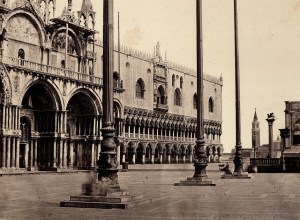
venice2But pardon me if I hurry you across Northern Italy. This delightful Milan with its wonderful Cathedral & clean sheets, thro’ Brescia & Verona where I visited Juliet’s house three times, I think, thro old Padua with its ancient University & streets lined with arcades, its tomb of Antenor[e] & great wooden horses to the best of all—most poetic, romantic, historic & beautiful—the strangest of cities—O glorious Venice! The one of all places that I remember with greatest delight & long to revisit, associated with all that is grand & inspiring. Poets time & again have referred to thee, how can I enough extol thee? We crossed the long bridge which leads from the mainland on a most beautiful day when the surface of the water glistened like a mirror in the sun & away in the distance disappeared in the sky. Some one shouted “gondola” & all became as enthusiastic as possible at the sight. And so we entered the station as jolly & gay, rushed for the boat & almost without knowing how began to move so easily & swiftly along the Grand Canal while others flitted past us in the same smooth, light manner. Palace after palace passed us, sometimes a dark massive structure rising from Doric to Tuscan & from Tuscan to Corinthian order, or its front of coloured marbles giving a gay & festive air. Soon rise up in the distance the great arch of the Rialto, but the boatmen turned aside before we reached it into a narrow canal full of angles where one must give a warning cry to others. Then we passed between two dark buildings & above us appeared a bridge & a second fit of enthusiasm seized all at the cry of “Bridge of Sighs.” But as usual, hotels are the first care & romance must have the second place.

The glory of Venice is the Piazza & Piazetto of St. Mark, places beautiful in themselves, famous for the scenes which have there taken place & peculiar & unique & without parallel. All that has occurred here has gained a strange, enchanting character & the usual events of history lose their tiresomeness here & read like romance. Of all the churches that of St. Mark’s is the most curious & perhaps the most interesting. Just in front are three bronze supports in which are thrust poles from which in former times waved the flags of conquered states. Over the central portal stand the famous bronze horses by which alone the Venetians are aware that there is such a species. All over the front are mosaics & the portals are filled with columns of rare marble, then a hall or entry extending the whole width of the church. Above are mosaics representing scenes from Bible history, below in the center the spot where Fred Barbarossa submitted himself to the Pope. At one end the tomb of [Ludovico] Manin, the last Doge. Entering & the same strange, fantastic character prevails as one on the exterior. A continual smell of incense, gold mosaics covering the arches & roof & pillars in which are worked figures of the Apostles, Martyrs & Saints, the pavement of little squares & triangles & round pieces of coloured marbles arranged in various forms, columns of rich marble brought to Venice as spoils from the East. Directly opposite the entrance is the choir with its canopy & altar under which rest the relics of St. Mark? Behind this another altar of whose columns two in alabaster came from Solomon’s temple & almost transparent. As to these relics I can hardly reckon how many pictures I have seen that were painted by St. Luke. How many impressions in stone made by the feel of Christ or the Saints & a miracle must have happened in regard to the true cross. But Venice is hardly the place for such superstition as the Popes never found her given over to superstition & blind obedience but rather a perverse & obstinate republic.

venice3In front of the church of St. Mark is the great Square with colonnades on three sides under which are the great stores which like all European establishments make beautiful displays in the shop windows & my evenings have generally been spent in strolling along stopping every little while to look in all the windows & no one is regarded as a greenhorn for doing it. As to the wonderful appearance of Paris shop windows, especially in the Palais Royal—alas—I refer you to Mons[ieur] Rich who fairly won the hearts of the Parisians during his stay. There are very good assortments of gift books, but jewelry holds the first rank & as I see city after city my perplexity ever increases as to what & where to choose. Then the Cafés (Hal. Caffé) where, rather curiously, one finds the very best society in Venice—gentlemen & ladies all coming to meet one another—and of all Cafe Florian’s is unrivalled (oh that lemonade). It is jolly enough to sit down at one of the little tables with a friend, order that beverage, hear the great bands play in the centre of the Sq[uare] around the immense candelabrum with numberless gas jets [and] watch the people promenading & around in one great circle or walking arm in arm around the colonnades. Such swell couples as they were, for the ladies of Venice are famous for their beauty.

From this great “Piazza” leads off between the Doge’s Palace & the huge Campanile & Library the Piazetta with its two famous columns on one of which is the Lion of St. Mark’s. This Piazetta at the end opp[osite] to the church form the quay where gondolas lie crowded together & gondoliers continually pester one. It is like a dream to stand here at the edge & not only enjoy the glorious view of the Lagune but to bring to mind (by the guide book) all that has taken place here. The sight of the Doge’s Palace is enough of itself to bring up visions & after visiting the Chambers of the “Council of Three,” “Council of Ten,” & Senate & then into the dungeons small & close & utterly black with the places for decapitation & strangling close by an opening into the canal for the bodies one feels that the romance has indeed a dark side. Here were pointed out the cells of Marin[o] Falier[o] & the Foscari & in the Court is the great staircase where it is said that Faliero was beheaded. We also passed into the Bridge of Sighs, but one could believe that conspirators found enough that was terrible in the Palace itself without needing to cross the Bridge. But what perhaps most attracted my attention was a little hole in the wall of the antechamber to the rooms of the Councils, formerly ornamented with a lion’s mouth, into which were once dropped secret accusations.

But jolliest of all to take an afternoon’s siesta in a gondola (twenty cents the first hour, fifteen after). Regularly we ordered the boatman “Up the Grand Canal” and back on the cushions put up our feet on the stools, whispered good night & passed into a blissful, cozy, half dreamy state to be aroused only by the approach of the dinner hour. Oh! I am getting homesick, not for America yet, but for Venice, where walking about & all exertion was tabooed. There I place the Isles of the Blessed. Here [in Rome] it is nothing but trudge thro narrow, dirty streets smelling horribly. How I hate these cities & I feel good only when away from them. Yet says that nuisance, the guidebook, “no visitor should neglect” &c. I am fast coming to a horribly utilitarian & degraded wish. Give me fresh air, the sun & good food & down with pictures, statues & antiquaries. Away with them—Hurrah. Soon a woolen shirt, broad brimmed hat, big shoes & shillalah. A free & easy life on the Nile where clean shirts & neckties are forbidden & jolly camel back donkey-riding trip in Syria. Then won’t I make a holocaust of civilization & kidgloves—whoop—toot—toot—toot—that’s my bugle. There are some jolly people gone East whom if I meet—“Now my boys let’s all go in.”

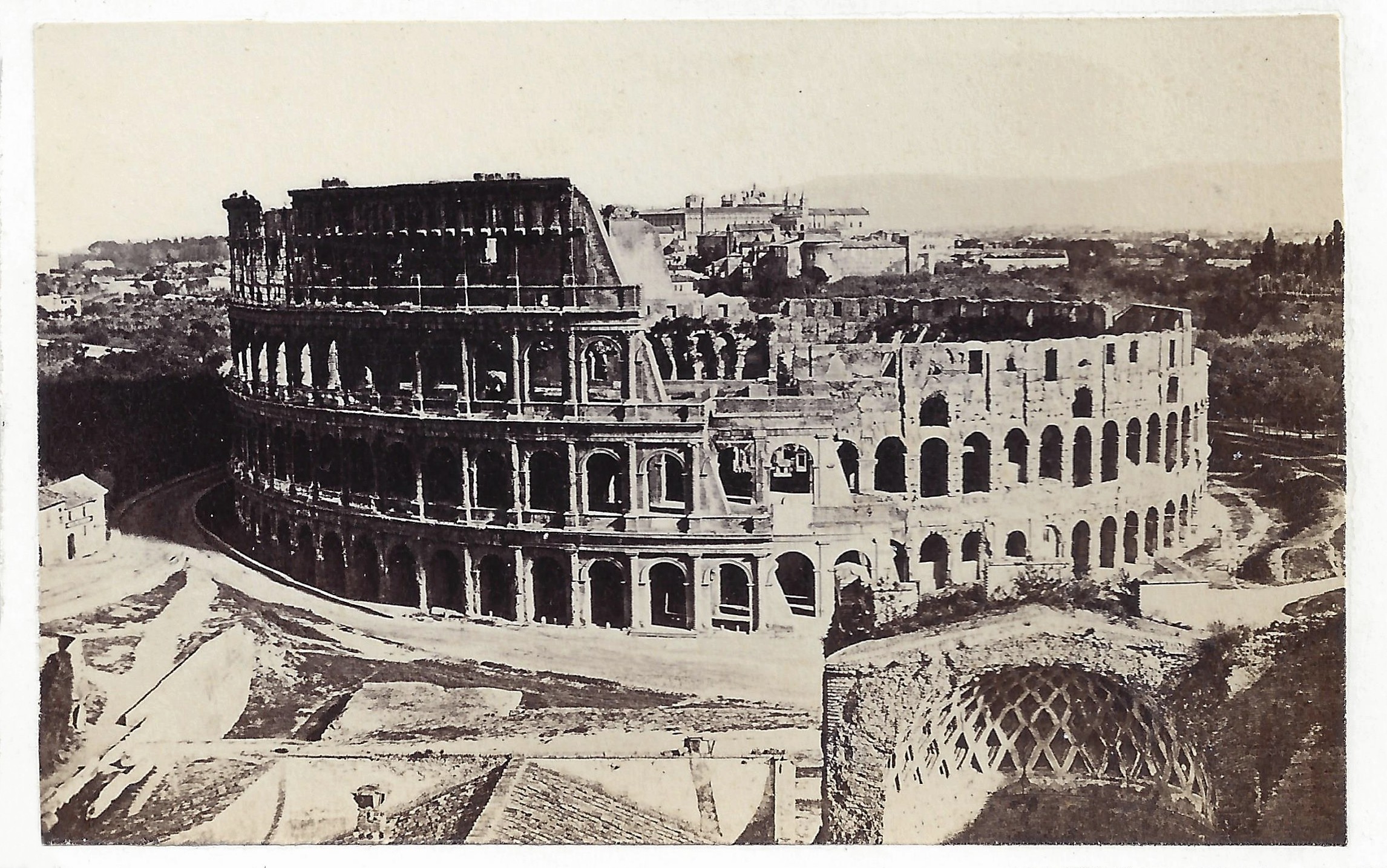
cdv-colosseumBut Oh dear! Here is this awful task of Rome on my hands. A mass of brick to investigate, excavations to penetrate, from a few scattered labyrinthic, pell-mell ruins to get an idea of what Rome was from eight feet of stone wall to guess what, the wall of Servious was & to make this out thro mud & rain & bad odours. That Cloaca Maxima had so bad an effect on a gentleman whom I accompanied that he ran off to the corner of the next street & waited there for me (literal fact). It was pretty bad. All that could be seen was an arch of coarse stone just peeping out of the stream. It certainly should not be visited in rainy [weather], being almost submerged. Most of my time I have spent merely in walking about, find out where the places are situated & this is more than enough for two weeks & as to visiting the places thoroughly, say from one year up. Moreover, the Pope has lightened my labours by closing the Vatican at which one acts like a child who with his hands full of fruit wants more. But most fortunately, coming here a little before the crowd, I got one of the few tickets given out and had the luxury of seeing the Apollo Belvedere, the Laocoon & the Torso. That was a glorious afternoon to me & perhaps I ought never to visit them again. Such a great impression did they make upon me I can hardly describe them now as I don’t know what words to use.

I am sure, however, if I did not remember Plato & my standing on the scale as respects my understanding him, I should call the Greeks first in everything—art, literature &c.  But the summum bonum of Rome is perhaps the Forum. I have tried to descend the Capitoline Hill by the winding way where the ancients walked & stand on the Rostia or sit on the cone which represents the ideal centre of Rome, but “none e permesso.” After all, I shall only appreciate Rome after getting away when forgetting its filth & discomforts. I can think of its power in the post & its grandeur. Yet one does feel the influence of the power perhaps past, when under the shadow of St. Peter’s. The thought of being at the centre not only of a mighty temporal empire, but of an awful spiritual power which has so long & so completely controlled men’s souls, is sometimes terrible. And perhaps nothwithstanding Bunyan’s parable there is mighty life remaining, one is compelled to think a little about Popery here.

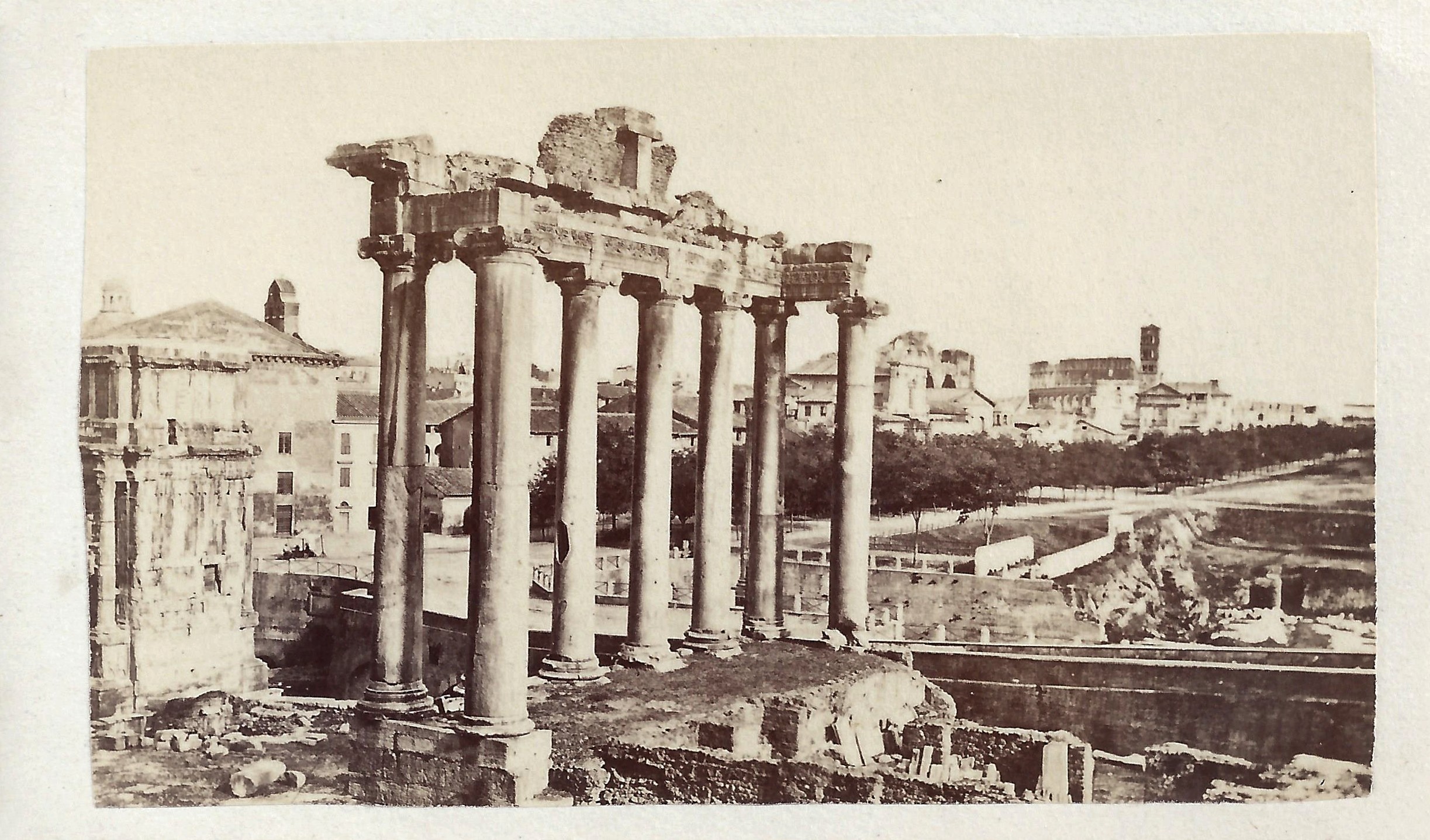
cdv-romanforumBut, if I can, I will describe in dull prose that Forum from the Capitol to the Colosseum. I hope to send home some photographs of Rome & I should be very much pleased if you would call & see them. Your letter has set me to dreaming of baseball. I am very fortunate so far in acquaintances, having fallen [in] with good, jolly fellows. Please direct to Munroe & Co. as before & remember me to your family. Hope to leave in a week for Naples & Sicily. I write amid the difficulties of sightseeing &c. My quarters are gay, being just opp[osite] the Palazzo Barberini.

Truly Your Friend,
Roger W.S.

Dec 14, 1870

Top 10 Things to Do in Florence, Italy

Top 10 Things to Do in Florence, Italy

Whenever I think of Florence, I like to remember my favorite scene in E.M. Forster’s 1908 novel, A Room with a View. When the heroine, Lucy Honeychurch, first enters the Basilica of Santa Croce without a guidebook, she feels lost and alone.

Of course, it must be a wonderful building. But how like a barn! And how very cold! Of course, it contained frescoes by Giotto, in the presence of whose tactile values she was capable of feeling what was proper. But who was to tell her which they were? She walked about disdainfully, unwilling to be enthusiastic over monuments of uncertain authorship or date. There was no one even to tell her which, of all the sepulchral slabs that paved the nave and trancepts, was the one that was really beautiful, the one that had been most praised by Mr. Ruskin.

Then the pernicious charm of Italy worked on her, and, instead of acquiring information, she began to be happy.

We should all be more like Lucy when we’re in Florence—that most intimidating of cities. As her companion, the outspoken Miss Lavish says, the “true Italy is only to be found by patient observation.”

With that in mind, put the guidebooks aside. “Give it to me; I shan’t let you carry it. We will simply drift.”


An interactive map of the sites recommended in this article:

#10

Walk in Lucy’s footsteps and visit the Basilica of Santa Croce

The colorful marble stripes on the front of this Franciscan church may be Victorian—described by Forster as a “black-and-white façade of surpassing ugliness”—but the interior dates to the dawn of the Renaissance. There are frescoes by Giotto and Gaddi, as well as tombs and cenotaphs dedicated to many great Italian men, including:

  • Galileo Galilei, the mathematician and astronomer;
  • Dante Alighieri, known for his Divine Comedy;
  • Niccolò Machiavelli, author of a famously shrewd treatise on power known as The Prince; and
  • Michelangelo Buonarroti, the renowned sculptor, painter, architect, and poet, who designed the dome of St. Peter’s in Rome, created the iconographic statue of David before his battle with Goliath, and painted the ceiling of the Sistine Chapel.

Take your time to wander about Santa Croce, then be sure to see the wonderful church museum that’s adjacent, just through the cloisters.

LOCATION:  Piazza Santa Croce, 16

HOURS:  Monday-Saturday, 9:30 AM – 5:30 PM; Sundays and Holy Days, 2:00 PM – 5:30 PM

COST:  Full price ticket, €6; reduced price ticket for children, €4

RULES:  Appropriate dress; photography is permitted without a flash, no tripods

WEBSITE:  Basilica di Santa Croce 

#9

Shop for leather goods at the venerable Scuola del Cuoio

Florence is justifiably famous for its leather. You can shop the San Lorenzo street market* for fun and inexpensive items of questionable origin, or visit any number of the high quality boutiques in town, including Madova, Roberta, Peruzzi, and Frizzoni, but my own personal favorite is the Scuola del Cuoio. Their products—ranging from belts and wallets to stunning purses—are meticulously handcrafted out of lambskin and other more unusual pelts, including deer, ostrich, python, and alligator. For a memorable experience, you can also visit the workshop and watch as an artisan monograms your purchase in gold or silver leaf.

* Update: As of January 2014, the San Lorenzo street market has been indefinitely moved to Piazza del Mercato Centrale and its surrounding streets.

LOCATION:  Enter through the Basilica di Santa Croce, or through the garden that surrounds the apse, at Via San Giuseppe, 5r.

HOURS:  Fall/Winter, Monday-Friday, 10:00 AM – 6:00 PM, Saturday, 10:30 AM – 6:00 PM; Spring/Summer, Daily 10:00 AM – 6:00 PM.

WEBSITE:  Scuola del Cuoio

#8

Cross the Ponte Vecchio and explore the antique galleries and artisan shops of the Oltrarno

The name “Oltrarno” simply means the “other side of the Arno.” From sculptors and wood carvers to gilders, bookbinders and goldsmiths, the small shops you’ll find along the maze of streets between the Ponte Vecchio and Piazza Santo Spirito may seem a world away from the hoards that congregate in Piazza della Signoria and Piazza del Duomo, but getting there requires nothing more than an easy walk across one of Florence’s beautiful bridges.

While the Ponte Santa Trinita and the Ponte alle Grazie were both destroyed by the Nazis near the end of World War II and later rebuilt, the Ponte Vecchio—or “Old Bridge,” in the middle—was spared. Like Brunelleschi’s red-tiled dome, the Ponte Vecchio is an iconographic symbol of Florence.

Before you cross the bridge to the Oltrarno, be sure to stand back along the riverbank to admire the shops that hang pell-mell from the sides. The butchers and fishmongers of the medieval city are long gone, replaced by jewelers whose wooden doors and wrought iron hardware at the close of day resemble a row of pirates’ treasure chests.

GETTING THERE:  Explore the area on your own (The New York Times and National Geographic both offer useful itineraries), or book a walking tour with a guide.

NOTE:  For a full day, combine a stroll about the Oltrarno with a visit to the Pitti Palace or the Boboli Gardens, or even late afternoon vespers at the church of San Miniato al Monte (see #4 below).

WEBSITE:  Welcome to Oltrarno

#7

Climb Giotto’s bell tower for a breathtaking view of the city

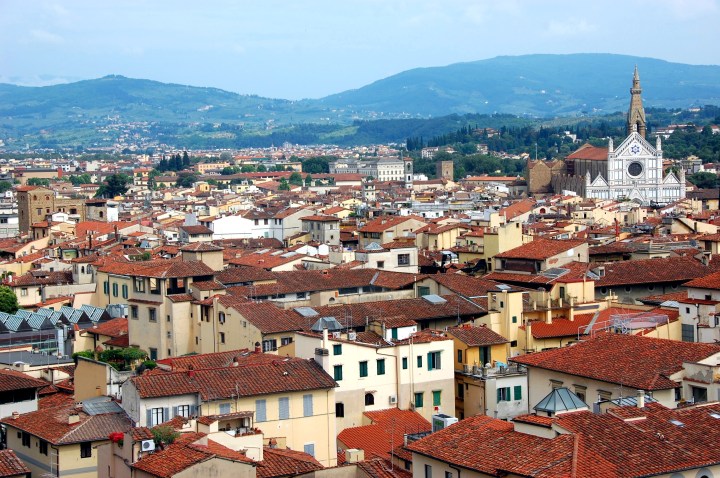
Getting to the top of the cathedral’s campanile in Florence requires 414 steps, but the view overlooking a sea of red tiled roofs more than makes up for the effort. You can see San Lorenzo and the Medici Chapel to the north, the Palazzo Vecchio to the south, Santa Croce to the east, and the church of San Miniato al Monte in the far distance on a hill across the Arno. Best of all, Giotto’s bell tower will give you an unparalleled look at Filippo Brunelleschi’s famous dome.

If you make it to the top and back, be sure to reward yourself with a few scoops of gelato. The delicious Grom is nearby, on Via del Campanile, at the corner of Via delle Oche.

LOCATION:  Piazza del Duomo. Enter via the stairs in the nave of the cathedral, or outside on the south side of the cathedral

NOTE:  There is no elevator. Visitors must climb 414 steps to reach to the top of the bell tower, but unlike the trek to the dome, the staircase is wide and headroom is ample, making it a better choice for those who are claustrophobic.

HOURS:  Daily, 8:30 AM – 7:30 PM

COST:  €6, although a combination ticket including the Duomo, bell tower, dome, crypt, baptistery, and museum is also available

WEBSITE:  Museo del Duomo

#6

See the Gates of Paradise and glimpse the fiery pits of Hell at the cathedral’s baptistery

Michelangelo once called Lorenzo Ghiberti’s bronze panels for the baptistery doors the “Gates of Paradise.” Here in Piazza del Duomo, those panels, which depict scenes from the Old Testament of the Bible, are reproductions of the originals that were installed in 1452, but they are stunning nonetheless.

Inside the baptistery, the scene is somewhat different. The lush ceiling mosaic depicts a benevolent Jesus with arms outstretched and a choir of angels overhead, but what you’ll notice most is a disturbing image of “The Last Judgment.” Look carefully and you’ll see Satan munching on the naked torso of an unrepentant sinner, while others meet an equally unpleasant fate in the jaws of snakes, lizards, and giant beetles.

If you save your visit for a sunny day, you’ll also see rays of sunshine slanting through the room’s narrow windows. When the gold leaf on the glass tiles capture the light, they shimmer and glow as if lit internally by the flames of a hundred candles.

LOCATION:  Piazza del Duomo

NOTE:  Ghiberti’s original bronze panels for the baptistery doors can be seen nearby at the Museo dell’Opera del Duomo

HOURS:  Monday – Saturday, 12:15 PM – 7:00 PM; Sunday and the first Saturday of the month, 8:30 AM – 2:00 PM

COST:  €4, although a combination ticket including the Duomo, bell tower, dome, crypt, baptistery, and museum is also available

WEBSITE:  Museo del Duomo

#5

Museums, museums, museums!

It’s hard to think of a city with more enticing museums than Florence.

You can see Sandro Botticelli’s The Birth of Venus at the Uffizi Gallery, compare Michelangelo’s David at the Accademia to Donatello’s David at the Bargello, marvel at the world’s largest collection of artists’ self portraits in the Vasari Corridor, stand before Benozzo Gozzoli’s stunning frescoes in the Chapel of the Magi at the Palazzo Medici-Riccardi or Fra Angelico’s Annunciation at the San Marco monastery, or indulge in the splendors of the Pitti Palace and the Palazzo Vecchio.

There is never time enough to visit museums in Florence, but be sure to wile away the hours at one—if not all—of these:

COST:  Admission fees for individual museums vary, but consider buying a Firenze Card which provides queue jumping access to 60 different churches, museums, and historical sites at a cost of €72. The card, which is valid for 72 hours, also includes public transportation, use of the city’s wifi network, and dedicated Android iPhone, and iPad apps with built in GPS. Another option is the Amici degli Uffizi pass, which costs €60, but is valid until the end of the year. For useful tips on which to buy and why, click here.

#4

Hear Benedictine monks sing in Georgian chant at the church of San Miniato al Monte

The basilica of San Miniato al Monte is a beautiful Romanesque church in its own right. Built between the 11th and 13th centuries, it has a long, graceful nave and an adjoining cloister and cemetery. But once you’ve visited the grounds thoroughly, consider staying for vespers, an evening prayer service in the Roman Catholic church during which the local Benedictine monks sing in Gregorian chant. It can be a wonderfully serene moment in an otherwise intense and overwhelming city.

LOCATION:  Via delle Porte Sante, 34

TIME:  On Sundays and Feast days, the monks accompany Mass with Gregorian chant at 10:00 AM and 5:30 PM in the crypt. In the summer, Gregorian chant also takes place during vespers at 5:30 PM on weekdays.

NOTE:  If you go, please—I beg you—be polite enough to stay through the entire service. There is nothing worse than a tourist who drops by, only to wander out a few minutes later.

COST:  Free, but a small donation to the church is a welcome gesture

WEBSITE:  Basilica di San Miniato al Monte

#3

Rub the snout of Il Porcellino for good luck and a future return to Florence

Il Porcellino is the statue of a wild boar located under the loggia of the Mercato Nuovo, near Piazza della Signoria. Legend has it that if you place a coin in his mouth and allow it to fall into the grating below, it will bring good luck. And if you rub his snout, you will ensure your return to Florence someday. Needless to say, it’s been polished to a brilliant shine by thousands of tourists.

I’ve visited the little piglet myself on the final night of each of my trips to Florence, and I know it works because I always come back.

LOCATION:  Piazza del Mercato Nuovo

COST:  Free, aside from the coin you use for luck! The proceeds are collected and distributed to local charities.

#2

Stop and listen to a street musician

From Italian pop to accordions and classical guitar, it seems that there’s always live music on the streets of Florence, especially in the evenings on the Ponte Vecchio, and in Piazza della Signoria and Piazza della Repubblica.

Stop, listen, enjoy. It’s free.

And if you like what you hear, tip them a Euro or two. Or better yet, buy their CD to bring those lovely Italian memories home. Listening to Claudio Spadi sing “A te” or “Acquarello” in the middle of a cold, Vermont winter always brings a smile to my face.

WHERE:  In the summer, you can usually find local musicians on the Ponte Vecchio, Piazza della Signoria, Piazza della Repubblica, and often in Piazza San Marco, Piazza Santa Croce, and Piazza Santo Spirito.

WHO:  My personal favorites? Here are some videos of performances by Claudio Spadi and Luca Sciortino, Justyna Maria Janiczak, and Piotr Tomaszewski

#1

Watch the sunset from Piazzale Michelangelo

The panoramic view of Florence from Piazzale Michelangelo, high on a hill on the south bank of the Arno River, is magnificent. From a distance, the architectural details of the city melt into harmonious shades red and yellow, and like the brush strokes in an impressionist painting, the impact from afar is greater than the sum of its parts.

To see the city at its best, go in the evening and stay for the sunset. It’s a sight you’ll long remember.

LOCATION:  Viale Michelangelo

GETTING THERE:  Aside from a taxi or rental car, there are three options for getting to Piazzale Michelangelo:

1) Walk along the banks of the Oltrarno to the footpath that winds up the hill. Please note that there are many stairs and they are steep;

2) Take the number 12 bus from Santa Maria Novella train station; or

3) Reserve a sunset limousine tour with a company such as I Just Drive, which costs €18 per person and requires a minimum of four people.


Where to stay when in Florence

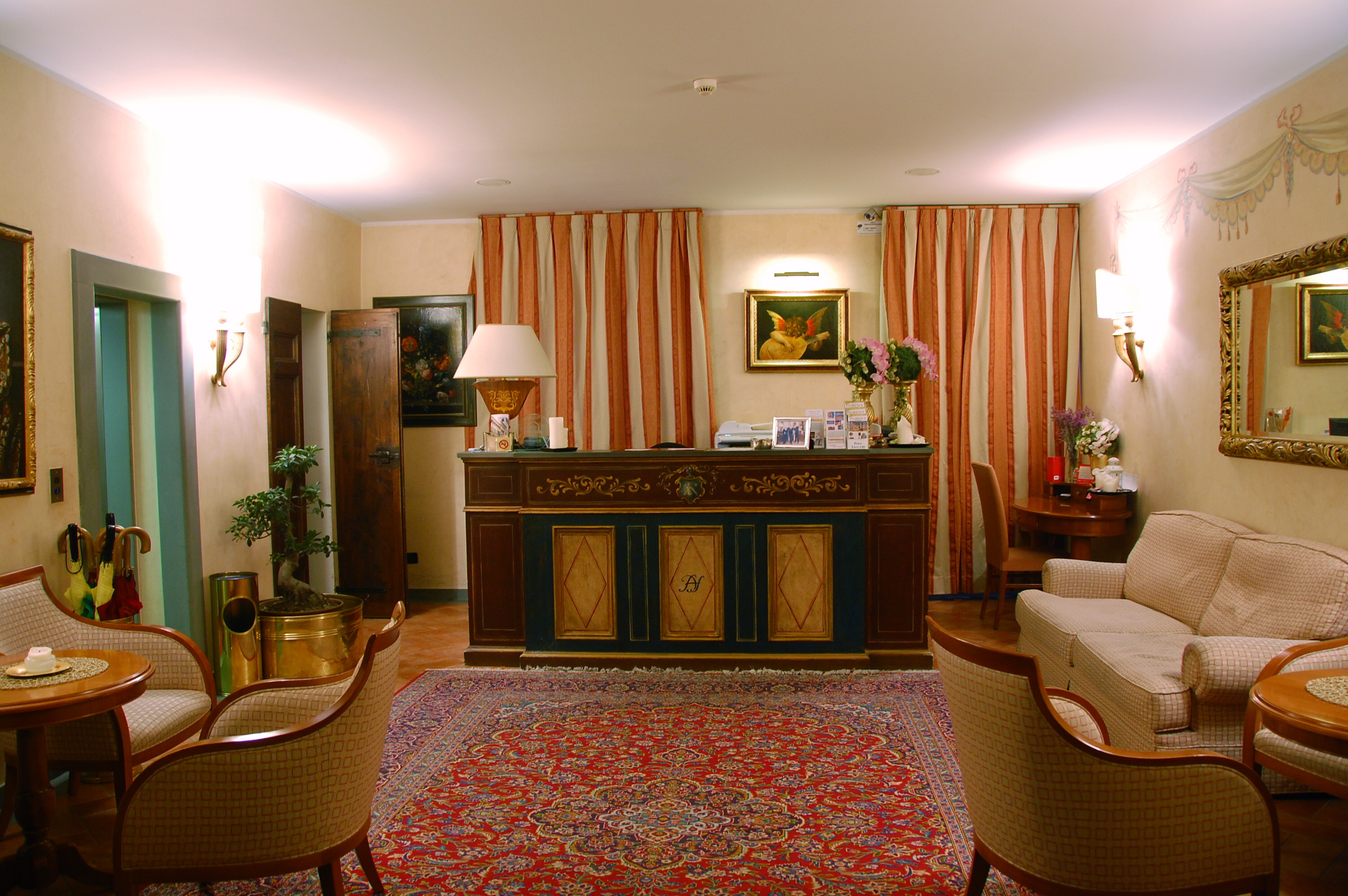
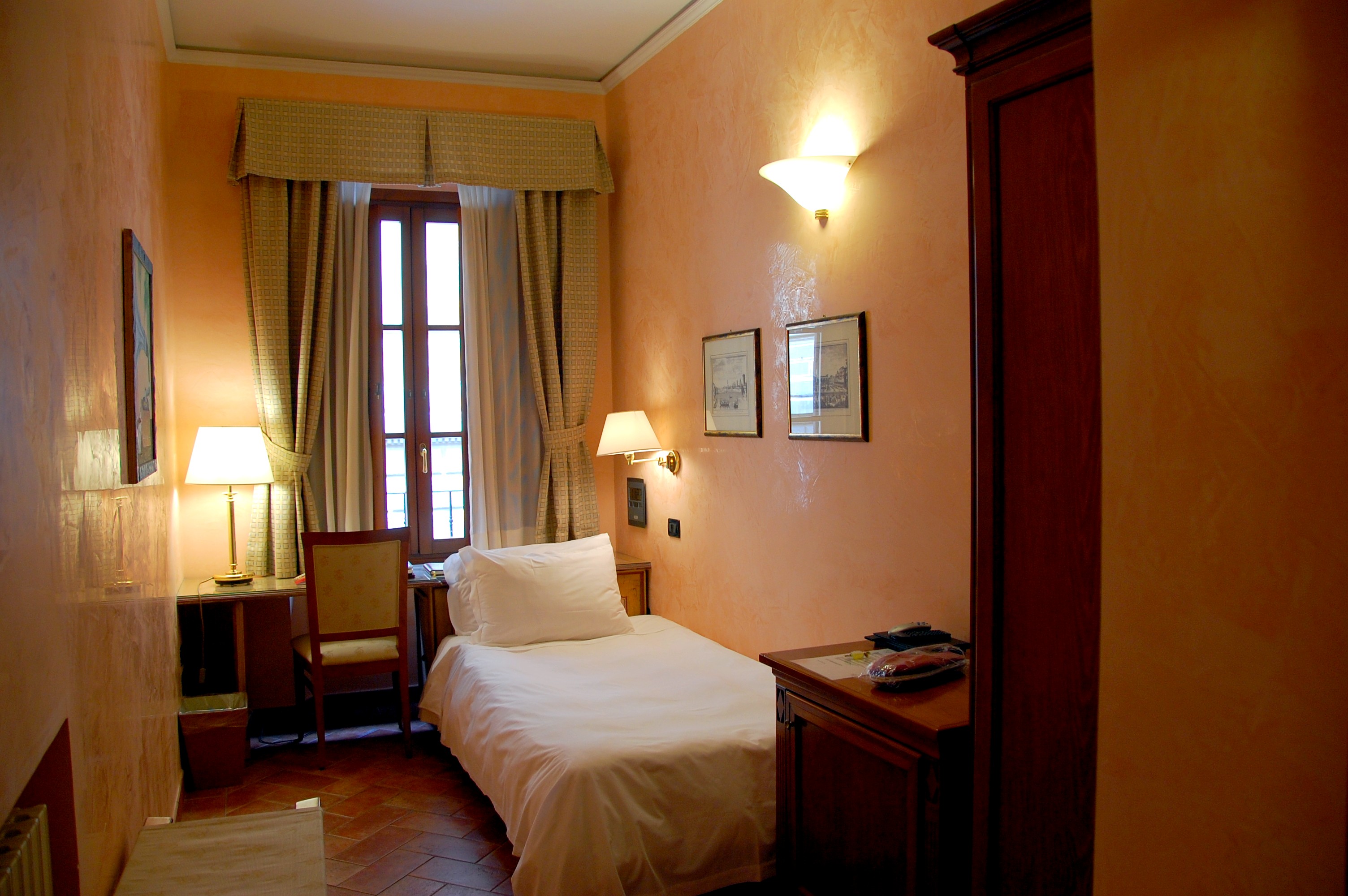
My personal choice is always the Hotel Davanzati at Via Porta Rossa, 5, but don’t just take my word for it. Check out their reviews on TripAdvisor.

Hotel Davanzati Hotel Davanzati Hotel Davanzati


A Photo Gallery of Florence

This slideshow requires JavaScript.

Top 10 Things to Do in Venice, Italy

Top 10 Things to Do in Venice, Italy

More than a century ago, it was the great American novelist cum travel writer Henry James who decided that there was “nothing left to discover or describe” about Venice, and that “originality of attitude is completely impossible.”

But, he said, “it would be a sad day indeed when there should be something new to say. I write these lines with the full consciousness of having no information whatever to offer. I do not pretend to enlighten the reader; I pretend only to give fillip to his memory; and I hold any writer sufficiently justified who is himself in love with his theme.”

And so I am.

Released from the burden of originality and the guilt of self-indulgence, here is my own To Do List for first-time visitors to Venice.


An interactive map of the sites recommended in this article:

#10

Ride a vaporetto down the Grand Canal

Whether you arrive in Venice at Santa Lucia railway station, at the bus depot in Piazzale Roma, or at the small airport across the lagoon, the glorious Grand Canal will be among the first sites you see, and invariably, it will look exactly as you imagined. It will feel at once foreign and familiar, as if you’ve stepped into an 18th century painting by Canaletto, only to find that the world around you has changed little in its substance.

To extend the illusion a little longer, board a public water bus—known as a vaporetto—and ride it the length of the canal, under the Rialto Bridge, by the colorful and crumbling façades of grand palazzos like the Ca’ d’Oro and the Ca’ Rezzonico, all the way down past the dome of Santa Maria della Salute, before disembarking at St. Mark’s Square.

If the Grand Canal seems heavy with traffic today, bustling with motor boats, water buses, and gondolas, remind yourself that it was even more crowded in the 16th and 17th centuries, during the golden age of the Venetian Republic, when it was a major thoroughfare for merchants who traded goods across Europe and the Far East.

BUYING TICKETS:  ACTV tickets can be bought: 1) Online; 2) On site from the Hellovenezia ticket office at the railway station; or 3) From the automatic ticket machines on some landing docks.

COST:  A single ticket on the vaporetto costs €7, so buying a tourist travel card is a wise decision. Cards allow unlimited access for a period of either 12, 24, 36, 48, or 72 hours, or for 7 days from the time it is initially activated. Prices vary accordingly, from €18 to €50. For further details, see one of the websites below.

NOTE:  For the purposes of sightseeing, board a vaporetto on Line 1 (map), or pay slightly more to board the special Vaporetto dell’Arte, which includes a multilingual audio and video system. Remember, you will need to swipe your travel card on the iMob validating machines located at the entrance to the ACTV loading docks before you board, or face a hefty fine.

WEBSITES:  ACTV, VeniceConnectedVaporetto dell’Arte

#9

Soak in the Byzantine splendor of St. Mark’s Basilica

At the eastern end of St. Mark’s Square lies the basilica that was built to house the remains of St. Mark the Evangelist, plundered from Alexandria, Egypt in 828 A.D. Legend has it that the Venetians hid the relics in a barrel under layers of pork to slip them past Muslim guards, a scheme they later depicted in a mosaic above the portal that is farthest left of the front entrance.

While Venice is replete with Baroque churches, St. Mark’s Basilica is an exotic outlier, with its massive marble columns, graceful arches, and onion domes clad in lead. Look carefully about and you’ll also see a hodgepodge of ornaments that were brought back piecemeal over the centuries by Venetian merchants who had sailed to the Orient and back.

To see the interior—a “glittering robber’s den” encrusted with gold mosaic tiles, set unevenly to better refract the light—you will have to survive the basilica’s infamous queue, as well as its strict rules for entry, but both are a small price to pay for the privilege of seeing one of Europe’s finest churches.

GETTING THERE:  For directions to Piazza San Marco from various locations, including the train station and Piazzale Roma, click here.

HOURS:  Summer hours for the basilica are from 9:45 AM – 5:00 PM weekdays and Saturdays, Sundays and holidays from 2:00 PM – 5:00 PM. Please check the website below for hours at other times of year.

NOTE:  Modest dress is required (cover those knees and shoulders!) and photography is not allowed, nor are large bags and purses. To avoid the maddening queue to get in, consider making a reservation online.

COST: Admission to the basilica itself is free, but small and very worthwhile charges apply to enter the chancel, treasury and loggia, areas which include the Pala d’Oro, a gold altarpiece constructed of enamel icons and encrusted with gemstones; an odd and extensive collection of chalices and reliquaries containing the blood and bones of saints; and the original gilded horses of St. Mark, the prize of so many lootings over the centuries.

MORE:  If time permits, consider purchasing a Chorus Pass for €12, which grants admission to sixteen churches in Venice.

WEBSITE:  Basilica di San Marco

#8

Visit the Doge’s Palace to walk across the Bridge of Sighs and see the prison cell from which Casanova famously escaped
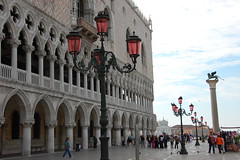
The Palazzo Ducale, which adjoins St. Mark’s Basilica, was once the residence of the Doge of Venice. To make the most your experience here, book a “Secret Itineraries” tour with a well-trained guide, who will explain the civic and political history of the city and its “Council of Ten.”

You will see where the most delicate administrative tasks were performed, in an attic space far removed from prying eyes, then you’ll continue through the Chancellery, where walls of cabinets once contained secret documents, before arriving in the torture chamber in which prisoners were hung by their arms from ropes. You’ll even get to cross the infamous Bridge of Sighs and enter the prison itself to see the cell once occupied by Casanova, and from which he made his daring escape.

Along the way, be sure to keep your eye out for centuries old graffiti scratched into the window panes by bored clerks.

GETTING THERE:  If arriving by vaporetto, chose either the Vallaresso or San Zaccaria stop. For more information, click here.

HOURS:  From April to October, the Doge’s Palace is open daily from 8:30 AM – 7:00 PM, and from April-March, daily from 8:30 AM – 5:30 PM. “Secret Itineraries” tours in English run at 9:55 AM and 11.35 AM and should be reserved in advance.

COST:  A full-price ticket valid for the Doge’s Palace as well as the Museo Correr, Museo Archeologico Nazionale, and the Monumental Rooms of the Biblioteca Nazionale Marciana costs €16. The “Secret Itineraries” tour is €20. For those tourists who intend to visit many of the city’s churches and museums, purchasing the Venice Card (€39.90 for adults) may be a worthwhile option.

MORE:  In addition to the Doge’s Palace,Venice offers an array of enticing museums. If time permits, or foul weather forces you indoors, consider visiting the following: Gallerie dell’Accademia (pre-19th century Venetian art); Peggy Guggenheim Collection (contemporary art); Museo Correr (collections focus on the art and history of Venice); or Ca’ Rezzonico (a museum of 18th century art).

WEBSITE:  Palazzo Ducale

#7

Gaze out across the rooftops of Venice from the top of the campanile in St. Mark’s Square

While most ancient bell towers in Italy require a sturdy pair of legs, the campanile in St. Mark’s Square has a large and speedy elevator. Ride it to the top for the sheer pleasure of the view. From a height of 324 feet, you can easily see the entire city, with a rim of coastline in every direction. Look for the iconic church of Santa Maria della Salute at the mouth of the Grand Canal. If you scan the red tiled roofs carefully with a camera lens or a telescope, you might also spy the elegant spiral staircase of the Palazzo Contarini del Bovolo.

Rest assured, while the original 15th century campanile collapsed into rubble quite suddenly in 1902, the reconstructed tower won’t fall again because Venice recently completed a multi-year engineering project to shore up its foundation.

LOCATION: Piazza San Marco

HOURS:  Summer hours for the campanile are from 9:00 AM – 9:00 PM. Please check the website below for hours at other times of year.

COST:  A ticket to ride the elevator to the top of the campanile costs €8.

MORE:  For another extraordinary view of the city of Venice, take a vaporetto out to the island of San Giorgio Maggiore and take the elevator to the top of the bell tower there.

WEBSITE:  Basilica di San Marco

#6

Visit the Rialto Market to experience the vivid sights, sounds, and smells of Venetian life

In the morning, the open-air Rialto Market is a feast for the senses, as local farmers and fisherman unload trays of fresh squid, cuttlefish, crabs and clams, as well as baskets of whatever produce is in season, from cherries and grapes to peas and asparagus.

If the old adage about eating with your eyes first is true—mangiare con gli occhi, as the Italians would say—you will stroll about and leave feeling very full and very happy.

LOCATION:  San Polo, Campo de la Pescheria (fruits and vegetables) and Campo de le Becarie, Loggia Grande and Loggia Piccola (fish)

HOURS:  The markets open around 7:00 AM. Note, the produce market is closed on Sundays and the fish market is closed on Sundays and Mondays.

WEBSITE:  Mercato di Rialto

#5

Go shopping anywhere and everywhere for Murano glass

While the fame of Venetian glass extends back to the Roman Empire, all of the furnaces and foundries were moved to the island of Murano in 1291 out of fear that a fire would consume the city’s wooden buildings. Today, the art, craft, and tradition of Murano glass continues and local boutiques sell a dizzying array of whimsical sculptures and ornate chandeliers.

On one of my visits to Venice, the shop window at Pauly & Co. in St. Mark’s Square displayed a series of balloon animals that would surely pass for the real thing, in addition to a green fedora for €7,500, and a folded shirt, complete with buttons, for €8,100. A craftsman even made what would appear to be Cinderella’s glass slipper, although at nearly €11,000 most women would need to marry Prince Charming to be able to afford it.

For a far less expensive option and one that’s easy to slide into a suitcase already bulging with Italian souvenirs, shop for jewelry instead.

RECOMMENDATIONS:  Personally, I like the jewelry collections at Antica Murrina and Le Perle. Here are some other suggestions from Lonely Planet.

NOTE:  If you spend enough and you’re a non-EU citizen, consider applying for a VAT refund.

#4

Escape the crowds for a day and go island hopping

Eventually, even the most ardent admirer of Venice will want to escape for the day to the nearby islands of Murano, Burano, or Torcello. The first is best known for glassmaking, the second for lace, and the third—I suspect—for being seldom visited by tourists.

Start with a short boat ride to Murano, where you can any number of glass factorys for a free tour. In the heat of the furnace, the craftsmen work quickly and deftly with molten glass that is roughly the texture of salt water taffy, just be wary of the salesmen who will follow you afterwards into the showroom. They can turn the subtle art of browsing into an uncomfortable, high stakes game of cat-and-mouse.

Next, make your way to Burano, a tiny fishing village where the streets are a riot of color, lined with houses that are painted in improbable shades of blue, orange, green, purple, and red. Flower pots rest on window ledges, laundry hangs to dry, and in the summer nearly every front door stands ajar, covered only with a striped curtain that catches the breeze, as a sail might on a boat.

If time remains, consider one last jump to Torcello. There is a brick walkway that leads away from the dock, but much of the island consists of open fields and undisturbed wetlands. Follow the path to a cluster of old buildings that includes two magnificent churches side-by-side—Santa Fosca, which is low and round, and the more conventional Santa Maria Assunta, with its solitary bell tower. Both are primitive, peaceful and calm, far removed from the opulence of Venice and its madding crowd.

GETTING THERE:  The islands of Murano, Burano, and Torcello are easy to reach using public transportation. Vaporetto line numbers 12, 13, 14, 4.1, and 4.2 make the journey to Murano from Fondamente Nove (on the north side of Castello), and line number 12 continues on to Burano and Torcello.

COST:  Travel to the islands is included with a standard ACTV ticket

WEBSITES: Murano, Burano, Torcello 

#3

Be indulgent and hire a gondolier

Yes, it is cliché, and it is expensive, but you have traveled long and far to come to Venice, and you really should ride in a gondola.

Henry James once wrote that “little mental pictures rise before the collector of memories at the simple mention, written or spoken, of the places he has loved.” When he conjured an image of Venice, it was not Piazza San Marco that he thought about, nor was it the basilica, or the dome of the Salute church, or even the Grand Canal. Instead, in his mind’s eye he saw:

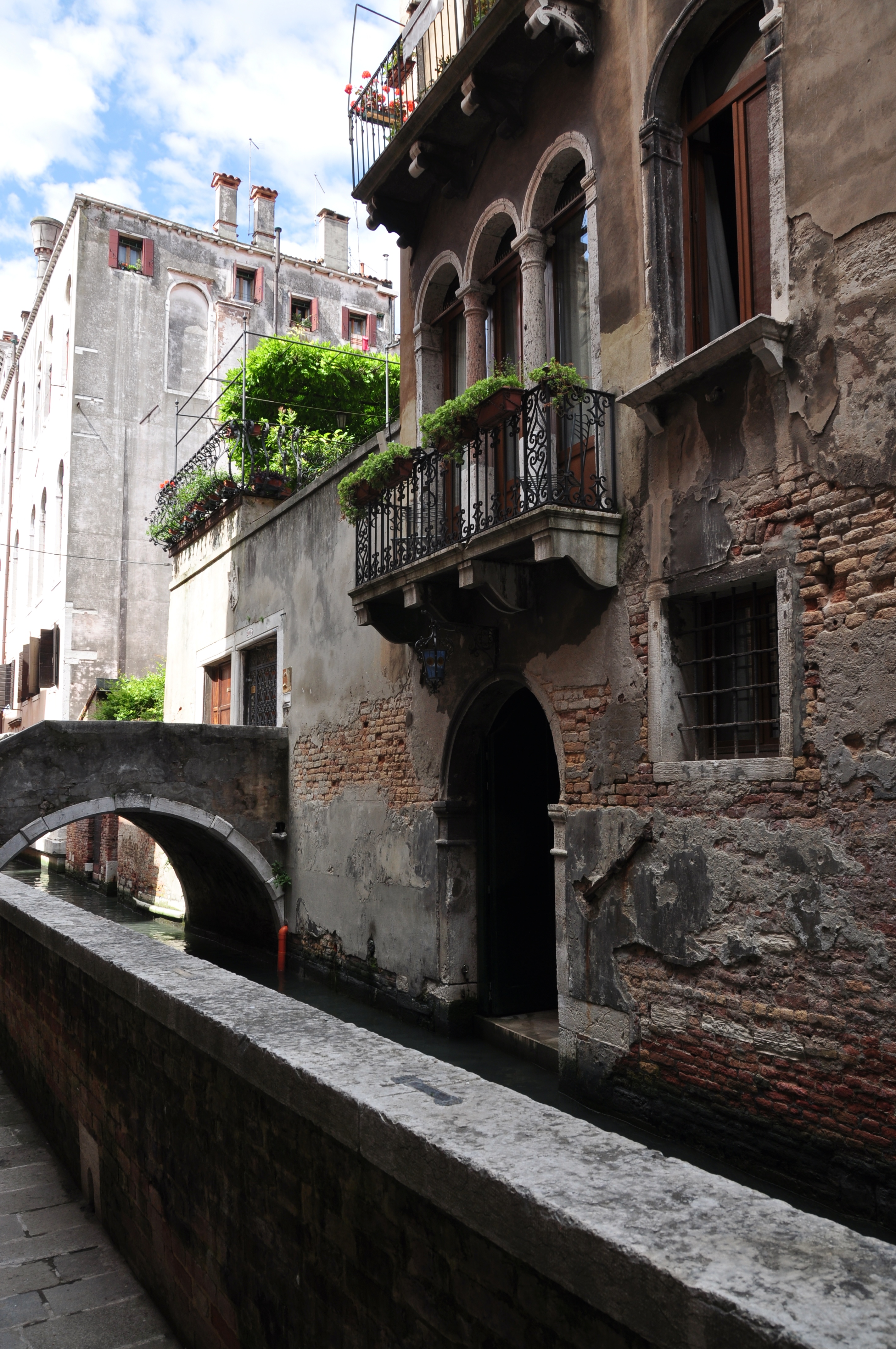
“…a narrow canal in the heart of the city—a patch of green water and a surface of pink wall. The gondola moves slowly; it gives a great smooth swerve, passes under a bridge, and the gondolier’s cry, carried over the quiet water, makes a kind of splash of stillness. A girl crosses the little bridge, which has an arch like a camel’s back, [and] you see her against the sky as you float beneath… On the other side of this small waterway is a great shabby façade of Gothic windows and balconies… It is very hot and still, the canal has a queer smell, and the whole place is enchanting.”

I rest my case.

LOCATION:  Gondolas depart from nearly every dock in Venice, so wander about and pick a neighborhood that appeals to you. Most itineraries will include at least a short piece of the Grand Canal, but it’s often a ride along the quiet side canals that is most enchanting.

COST:  The rates for gondoliers are fixed by the city of Venice. During the day, expect to pay €80 for a 40-minute ride for a maximum of six people, and €40 for each additional increment of 20 minutes. In the evening, the rate increases to a base price of €100. If you would like to be serenaded by your gondolier, that fee is additional and must be negotiated.

Too expensive? Here are some affordable alternatives:  1) Share a gondola ride with others at Santa Maria del Giglio; or 2) Take a traghetto across the Grand Canal. For a list of crossing points, click here.

WHAT TO EXPECT:  Gondola Rides in Venice: How to Get the Most from your Venice Gondola Experience

WEBSITE:  Gondola Venezia

#2

Spend a lazy evening under the stars listening to the orchestras play in Piazza San Marco

It’s said that when Casanova escaped from prison in 1756, he stopped off for a cup of coffee at Caffè Florian before fleeing to Paris. It’s easy to understand why when you see how lively and pleasant Piazza San Marco becomes at night, once the crowds have slipped away.

There are three restaurants in the square, each with neat rows of tables and chairs, and awnings under which an orchestra plays. Take a seat at Caffé Florian, Ristorante Gran Caffé Quadri, or Caffé Lavena, order a cocktail, lean back and relax as you are serenaded with sentimental waltzes and lively folk dances.

No one will blame you if you get up and dance.

LOCATION:  Piazza San Marco

HOURS: 

  • Caffé Florian is open daily from 9:00 AM – 11:00 PM in the summer, and closed Wednesdays in winter (menu)
  • Ristorante Gran Caffé Quadri is open Tuesday through Sunday for lunch from 12:30 PM – 2:30 PM, and for dinner from 7:30 PM – 10:30 PM
  • Caffé Lavena is open daily from 9:30 AM – 11:00 PM

NOTE:  To avoid an unhappy surprise when the bill arrives, please know that there is a supplemental charge per person whenever the orchestra is playing.

WEBSITES:  

#1

Put away the map and get lost

In a city built of islands, where there are 150 canals and 400 bridges, maps are of little use, and modern gadgets like cell phones with GPS, even less so. For that reason, it can be genuinely difficult to find things in Venice, so resolve to discover them instead. The lack of intention makes all the difference in the world. It allows frustration to give way to serendipity.

In exploring the city’s labyrinthine streets and canals, you may find comfort in periodic signs that read “Per Rialto and “Per San Marco,” but notice how they often they point in two directions at once, creating endless combinations.

Right, left, right.

Left, left, right.

Follow your fancy and see what pleasures await. On one of my tramps around Venice I was treated to shop windows that had exotic spices stacked into powdered pyramids, papier-mâché masks formed into the fanciful faces of cats, hedgehogs and owls, and tiny gold fish suspended in blown glass aquariums of every size and shape.

Walk on, and soon you’ll find yourself wondering what more there is to see just around the corner, and you’ll be tempted to devote the entire day to finding out.

It will be a day well spent.

LOCATION:  It matters not.

HOURS:  Unlimited.

COST:  Nothing.

MEMORIES:  Priceless


Where to stay when in Venice

My personal choice is always the Hotel Al Ponte Mocenigo at Santa Croce 2063, but don’t just take my word for it. Check out their reviews on TripAdvisor.

Hotel Al Ponte MocenigoHotel al Ponte MocenigoDSC_3323c


A Photo Gallery of Venice


This slideshow requires JavaScript.

Travelogue for Italy, 2013

Travelogue for Italy, 2013

You may have the universe
if I may have Italy.

— Giuseppe Verdi

Welcome! This is an online travel journal for my June 2013 trip to Italy, which covers the following destinations:

  • Venice
  • Bassano del Grappa
  • Florence
  • Bologna
  • Siena
  • Lucca
  • Pisa
  • Rome

Also, you should know that while I’ve embedded some photographs into the entries, many more are posted on Flickr, and travelogues for all of my previous trips to Europe are still available from the navigation menu, including those from Italy in 2008 and 2010.

Enjoy!
DLG

Tuesday, June 4, 2013

I’m not a superstitious person by nature. I don’t read tea leaves, play with tarot cards, or knock on wood. I don’t balk at the sight of a black cat, or avoid walking under ladders, and I only rarely cross my fingers for luck, and yet I’ve come to believe in the Odd Year Curse.

Perhaps an explanation is in order.

Whenever I travel to Europe in years divisible by two—say, in 2006, 2008, 2010, or 2012—I have a jolly good time wherever I go, be it London or Paris or Rome. And yet in those years in between, things have a way of going horribly awry. It rains in torrents, day after day, for instance. Or there’s a global outbreak of swine flu. Or my camera lens breaks. Or I catch a mysterious illness and have to come home.

I’m a social scientist by trade, so of course I know that the correlation is weak at best—it rained every bloody day last year in England, but I still enjoyed myself, and that ridiculous volcano in Iceland that scattered airplanes for weeks on end with its plumes of drifting ash happened in 2010, the year of a very safe integer. The curse is also based on a limited number of data points from which little of the future can be extrapolated, but this isn’t about knowing something, this is about believing. And I believe in the Odd Year Curse. Granted, in its folklore and longevity, it doesn’t rank up there with the Curse of the Bambino or the curse of King Tut’s tomb, but it’s real nevertheless, and in 2013 it has struck with a vengeance. I’m starting to take it personally.

Let’s weigh the evidence, shall we?

First—Six weeks before I’m set to leave for Italy, I develop what’s called a posterior vitreous detachment (PVD) in my right eye, followed by a more serious one in my left eye a few days later. I tell my optometrist about my plans to fly and he sends me immediately to a specialist because he’s worried that the change in air pressure on the flight might cause a tear in my retina, which would be very bad indeed. “This almost never happens in both eyes at once,” he says, but somehow I’m not surprised. I am cursed.

Second—Just four days before my scheduled departure, I pick up a bad sinus infection and I’m so congested the doctor thinks it’s prudent to warn me about the risk of a burst ear drum were I to fly in such a condition. This has me imagining life as Helen Keller, both blind and deaf after an ill-advised adventure. She gives me an antibiotic and—fingers crossed, just in case—we hope for the best.

Third—The day before my flight, I discover a number of fraudulent purchases on my credit card. Someone has been downloading computer software and pornography and it’s not me. I call Capital One in a morose state of mind and they immediately close my account, effectively stranding me in Pennsylvania until a new card can be delivered.

It’s at this point that a friend of mine from work suggests that I read the Book of Job. It gets me thinking about biblical pestilence and whether I might be smited with dreadful boils next.

I stop packing and start making phones calls and typing e-mails. The effort of dismantling a year’s worth of planning makes it feel like 2011 all over again, the year in which I got sick and was forced to leave half of my itinerary and the entire country of Austria behind. I was supposed to fly U.S. Airways to Italy on May 29. I had booked a hotel with a rooftop terrace facing the basilica of Santa Maria Maggiore so that I could see the new Pope’s candlelight procession on Corpus Domini from high above the streets of Rome. Then, I was to head to Umbria for the annual infiorata festival in Spello and the start of the Giostra della Quintana in Foligno. None of that is going to happen now.

I need to delay things and to simplify. I decide to fly to Venice instead on June 4 and from there skip the trek over to Portofino and Santa Margherita Ligure in favor of five easy nights in Florence. I’ll keep my reservations in Lucca and Pisa for now, and end up, as planned, in Rome. If I can manage that much, it will still be a good trip, but the disappointment of what I can’t do stings.

By now the Odd Year Curse has burrowed so deeply inside my head that all the way down to the airport I’m convinced that the other shoe is about to drop, or rather the fourth shoe, or the fiftha virtual hurricane of shoes. I keep waiting for something bad to happen. Will a traffic jam on I-476 cause me to miss my flight? Will security pull me aside as a suspected terrorist? Will I trip on the escalator and break an ankle?

I’m holding my breath as the wheels on the airplane leave the tarmac and we ascend into a dusky sky dotted with the first stars of night. Only then do I believe that I’ve left my troubles behind.

It seems I am going back to Italy after all.

Wednesday, June 5, 2013

It’s a glorious morning in Venice. I know it is because I can see sunlight out the window of the plane as we approach Marco Polo Airport. I catch my breath when I spot the campanile in Piazza San Marco rising high above the skyline and the dome of the Salute church at the far end of the Grand Canal. The island is beautiful from a distance, but also small, like a tilt-shift photograph that renders the cityscape in miniature.

My flight lands on time and before long I’m stretching my weary legs on the long walk out to Pier 14 where there’s a water taxi waiting for me. This is a great indulgence of mine—I’ve always taken the bus before—but after all that’s happened in the last few weeks, I figure I deserve a break.

As the boat pulls away from the dock, I sink back into the seat and exhale deeply. At the touch of a button, the driver retracts the tinted roof and I close my eyes as rays of morning sun warm my face.

We gather speed as we make our way across the lagoon, and as the boat begins to skip across the choppy waves I can feel a fine salt mist on my skin. I had left my luggage upright on the floor of the cabin and now it’s starting to slide slowly on its wheels, back and forth.

We enter Venice proper through a square of open water in the sestiere of Cannaregio, near Fondamenta Nuove and the 14th century church of Madonna dell’Orto, and from there head south towards the Grand Canal. It’s just a short distance to San Stae and there the driver makes one final turn and pulls up to the water entrance of the Hotel al Ponte Mocenigo. I’ve stayed here before—twice, in fact—but I’ve never arrived in such grand style.

Walter greets me warmly at the door and hoists my luggage out of the boat. It’s still early in the day, just 10:30 AM, so my room isn’t ready, but he invites me to sit for a while in the hotel’s courtyard and kindly offers to bring me a cappuccino. I feel exhausted from the flight and more than a little seasick from the bobbing of the water taxi. At the same time, though, I’m exhilarated to be here and comforted by the sight of familiar surroundings.

I leave my luggage behind and walk out the gate, following the signs that point to Alla Ferrovia and Piazzale Roma. It’s a pleasant walk through tiny alleyways and along quiet canals. I’m heading to the train station to buy an ACTV pass for the vaporetto and a Venice Card to cover my admission fees to a wide range of museums and churches. I’m trying to be optimistic about what I’m able to do.

It’s noon by the time I return to the hotel and my room in the Annex is waiting. It’s a lush space, with an open beam ceiling, dark silk walls, a carved headboard, and damask bedspread. High overhead there’s a Murano glass chandelier and I stare at it as I lay back and rest for the next two hours. I’m still not feeling well and I need to pace myself.

It’s 2:00 PM by the time I venture out again in search of a late lunch. I stop at Ostaria al Garanghelo and order a plate of ravioli with a sage butter sauce that tastes good, but settles hard in my stomach. There are two young women sitting at the table next to mine and I amuse myself by listening in to their conversation. One hands her phone to the other and says: “Look, you got a picture of that famous house and whatever.” Sophisticated travelers they are not.

Soon, however, their inane commentary is drowned out by two street musicians who settle in across the street. With a guitar and violin they smile widely as they play “Cheek to Cheek,” an Irving Berlin tune from the 1930s that has me envisioning Fred Astaire in white tie and tails with the lovely Ginger Rogers in his arms.

Heaven, I’m in Heaven,
And my heart beats so that I can barely speak;
And I seem to find the happiness I seek
When we’re out together dancing, cheek to cheek.
And the cares that hang around me thro’ the week
Seem to vanish like a gambler’s lucky streak
When we’re out together dancing, cheek to cheek.

With no particular destination in mind, save one minor errand, I wander down across the Rialto Bridge to a Vodaphone shop, where I wait in line to buy a SIM card with a data plan for my iPhone. I press on, all the way to Piazza San Marco, where at long last, restoration work on the base of the campanile has been completed, freeing the square of five years worth of fences and construction debris. It’s been a nice afternoon, but my legs are tired and I’m ready to head back on the vaporetto.

I’ve been to Venice twice before, and as the water bus passes the colorful and crumbling palazzos that line the Grand Canal all the way back to San Stae, I think about how this releases me from the burden of expectations. I’ve seen nearly all of the major sights and tourist attractions in town—St. Mark’s Basilica, the Doge’s Palace, the Accademia museum, and the Bridge of Sighs. I’ve been out to the islands of Murano, Burano, and Torcello, and to San Giorgo Maggiore with its majestic views of the city proper. With so few boxes left to tick, my time is my own, to wander and explore, and I’m quite looking forward to it.

By the time I leave the hotel at seven in search of dinner, the deep blue of the afternoon sky has given way to a brooding canopy of gray. A light rain is starting to fall as I slide into a comfortable seat at Trattoria al Ponte, just around the corner. I sit and relax through a bowl of bean soup and a fine plate of tagliatelle with tomato, eggplant, and smoked ricotta cheese. I had hoped to go back to Piazza San Marco tonight to listen to the orchestras play, but the gentle patter of raindrops on the awning overhead tells me it would be best to tuck in early for the night.

Venice may be sinking, but it will still be here in the morning.

Thursday, June 6, 2013

This morning, when I sit down to breakfast in the shaded courtyard of my hotel, I am greeted by a woman with a friendly smile, and she brings me a frothy cup of cappuccino sprinkled with cocoa and a basket of fresh croissants. With apologies to Gérard Mulot in Paris, these are my very favorite croissants in the whole, wide world.

I smile with recollection and then bite through the flaky exterior of the pastry into a warm center, filled with apricot preserves. The memory of it sends a shiver of delight down my spine and I am reminded of Proust and his tea-soaked madeleine. It’s been five years since my first visit to the Hotel al Ponte Mocenigo and I’ve returned twice since. It’s nice to know that some things never change.

With the taste still lingering on my tongue, I set off on a leisurely walk toward Piazza San Marco. Breakfast has reminded me that Venice is a feast for the senses. I stop at the Rialto Market to savor the smell of fresh produce and the pungent odor of local seafood. I wander in and out of shops to admire the rich colors of Murano glass sculptures and vases and jewelry. And I pause to listen to the sweet sounds of street musicians, and the whir of motor boats down the Grand Canal.

It’s only when I reach the square that I realize just how crowded Venice is in the high season. It was Henry James who once said: “Though there are some disagreeable things in Venice there is nothing so disagreeable as the visitors.” They’re everywhere, with their cameras and baseball caps and flip flops—day trippers from Hell. But this year they’re not alone. Within the last week, an international art exhibition known as La Biennale di Venezia has opened at the Giardini and the Arsenale, and so the city is congested with celebrities and art critics, too.

Eager to escape, I duck into the campanile and ride the elevator to the top for the sheer pleasure of the view. From here, I look toward the island of San Giorgio Maggiore where there is a gigantic and rather incongruous inflatable figure of a naked, pregnant woman, created by the British artist Marc Quinn. I recognize it immediately as one I saw years ago—in smaller form—on the fourth plinth in Trafalgar Square in London. I don’t much like it here, either.

I take pictures of the church of Santa Maria della Salute at the mouth of the Grand Canal, which was covered in scaffolding the last time I was here, and then scan the city with my telephoto lens, until it rests upon the elegant spiral staircase of the Palazzo Contarini del Bovolo. It’s breathtaking, really, this sea of red tiled roofs.

Back in the square, I’m directly across from the Doge’s Palace on which hangs a banner advertising a major exhibition of paintings by Éduoard Manet, titled “Manet: Ritorno a Venezia.” I’ve been looking forward to it for months. I check my watch and see that it’s nearly noon. The line at the entrance is short and the sun overhead is bright and warm. The dim light of a cool museum sounds appealing.

The centerpiece of the exhibit is the contrast of two famous works of art—Manet’s own “Olympia,” unveiled to great controversy at the Paris Salon of 1865, and its inspiration, Titian’s “Venus of Urbino,” painted by the Old Master in 1538. I’ve seen both before, the former at the Musée d’Orsay in Paris and the latter at the Uffizi in Florence. But here they stand side-by-side, and the influence is striking and the interpretation modern. I like Manet very much, and many of my favorite paintings are here, including “The Balcony” and “The Fifer” as well as a view of “The Grand Canal” painted by the artist on a visit to Venice in 1875.

Hungry for more, I decide to head straight for the Biennale, although just outside the Doge’s Palace I get my first glimpse with an unofficial exhibit titled “This is Not A Czech Pavilion.” Intrigued, I peek inside and see a ring of shoes on the floor, each covered with the kind of disposable, blue booties that cable TV repairmen wear when they visit your house, so as not to soil the carpets with their muddy boots. It’s odd, especially when I notice a handwritten message scrawled on the wall. It reads: “This is the best piece at Venice Biennale.”

God, I hope not.

I take the vaporetto down to the Giardini and stand in line to buy a ticket. It’s a beautiful area of the city that I’ve never explored before, leafy and lushly green. The man at the ticket counter asks where I’m from and he is genuinely pleased that it’s Vermont. It seems he combats the boredom of his job by counting places and I’ve just added a rare specimen to his collection.

My first order of business is to find a place for lunch, but along the way I can’t help but stare at the entrance to the Spanish Pavilion. Inside there is a pile of rubble. There’s really no other way of saying it. It’s just rubble. A sign on the wall explains that the artist is Lara Almarcegui and her work “is not just formal or ontological, but also social, in that it points to the historical nature of the construction materials she uses, and addresses the complex interactions between materials, economy, and space. It is also political, insofar as she understands and places architecture and urbanism, their developments and historical dimensions, within the framework of the complex ecology of our social and political fabric.”

There’s a man standing next to me and we exchange a significant look. He doesn’t speak English and he doesn’t have to. We’re both thinking the exact same thing—

Bullshit.

There. I’ve said it, and I mean it. Give me a Manet any day over an “installation” of rock. Still, I have to admit, I’m having a rollicking good time already. Bad art really is kind of fun.

I walk toward the Central Pavilion, past a row of people lounging on porch chairs, all the way around to the back to a outdoor café, where I break for lunch. It’s just a simple Caprese salad, but the tomatoes are sweet and the buffalo mozzarella tangy. It rejuvenates me, and before long I’m ready to explore again.

It’s time to brave the United States pavilion. I must say I was warned about this one in advance, but it still didn’t prepare me for the horror of it all. A review in The Guardian put it this way: “America has an irritatingly complex ‘ecosystem’ composed of millions of fribbling bits of paper, string and gum by Sarah Sze for which there is simply not world enough and time.”

And there it is. “Fribbling bits” of this and that—balls of string, plastic water bottles, rulers and clamps—crawling up the front of the building like a tinker toy skyscraper on steroids. There’s a brochure that attempts to explain it all and it says something about inscribing a “fragile personal order upon a disordered universe,” but really The Guardian had it about right when they said there wasn’t enough time in the world to care.

Feeling apologetic and unpatriotic about the U.S. entry, I enter the Russian Pavilion next. There’s a hole in the ceiling from which a bucket hangs, and in the room next door I can see a large pile of gold coins on the floor. Before entering to investigate, a woman hands me a clear umbrella and I grin. It’s always a good sign when you’re handed a prop. It means interesting things are about to happen!

It becomes immediately apparent that the umbrella serves as a shield to protect me from being struck by the coins that are falling continuously from the roof. I’ve been instructed to bend down and interact with the coins, and to place a handful of them in the bucket next door. They’re stamped TRUST, UNITY, FREEDOM, LOVE. And, “The artist guarantees the value with his honor, 2013.”

And that’s just the start… There is also a man upstairs who is dressed in a business suit, riding a saddle astride a beam that he has reached with the help of a tall, wooden ladder. Every now and then he reaches out with his left hand and sprinkles sawdust on the floor below. On the wall, there is a motto that reads: “Gentleman, time has come to confess our Rudeness, Lust, Narcissism, Demagoguery, Falsehood, Banality and…”

There’s a brochure explaining all of this—of course there is—and it says something about a “cave womb” and the “anatomical construction of a myth,” but really who cares? This may peg me as one of those day trippers from Hell that I maligned earlier this morning, but the whole thing strikes me as perfectly ridiculous, but also pretty neat.

I spend the rest of the afternoon lazily walking through Ai Weiwei’s forest of stools and inside of what looks like a huge Fabergé egg. There are tables of artfully composed law directories, walls covered with plastic Mickey Mouse toys, and wire coat hangers twisted into the shape of turtles. There is a painting of a hairy man’s ass crack aptly titled “The Butt (2007),” which amuses me, and the clothed mannequin of an armless child wearing a sun bonnet that seems like a creepy version of Little House on the Prairie, which does not.

I’m still chuckling over the Biennale later when I sit down for dinner at La Porta d’Acqua. I laugh harder still when the waiter greets me by singing “Buona Sera” by Dean Martin. He’s quite a character.

I order some fried zucchini blossoms and stuffed shells with Bolognese sauce, but no wine. When I got sick in Germany two years ago, I developed a neurological condition called dysautonomia. Alcohol makes the dizziness and the nausea worse. It’s a hard enough thing to explain in English let alone a foreign language, so I just decline politely. The waiter sniffs at me suspiciously and says: “What kind of woman are you who no drink wine?” I shrug.

As I wait for my dinner to arrive, I pull out my iPhone and check for e-mail. Last night, I reserved a seat on a bus tour leaving tomorrow for the Veneto hill towns of Bassano del Grappa, Asolo, and Marostica. The Avventure Bellissime website says it’s one of their “most popular day trips from Venice!” Alas, it’s not. They’ve just cancelled.

Undeterred, I decide to go on my own, and so I pull up the Trenitalia website to check on train departure times. When the waiter comes by with the food, he looks over my shoulder and asks where I’m going. Bassano del Grappa, I say. I ask if he’s been there and does he recommend it? “Yeah, yeah,” he says, “the grappa.”

It’s the alcohol he likes. Of course it is. He’s Italian.

Come to think of it, though, quite a lot of art is inspired by booze. Quite possibly a lot of what I saw today. How else to explain the hairy ass crack? And a potent green liquor known as absinthe was equally famous in Manet’s day as the seductive muse of poets and painters alike.

I look down at my solitary glass of water, and I feel suddenly left out of an entire history of creative thought. Perhaps I should try some grappa in the morning. I’m already an academic with a tendency toward verbosity. I can certainly write a convincing brochure. All I really need for a change in career is a decent sense of irony and some “fribbling bits.”

Friday, June 7, 2013

It’s probably a bad idea to base a day trip around a single photo op, but there you have it.

I once saw a picture of Bassano del Grappa that showed a covered bridge called the Ponte degli Alpini. I’m not sure why it appealed to me so. I think it was because the buildings on either side of the Brenta River were clearly Italian. To me, the warm colors, balconies, window boxes, and towers were reminiscent of Verona, another city I had liked in the Veneto. And yet the wooden bridge itself seemed so very un-Italian. With some minor alteration in the trusses, that bridge would have looked very much at home spanning a babbling brook in a forest of autumn leaves back in Vermont. I became determined to see a place at once so exotic and familiar for myself.

I had hoped to visit Bassano del Grappa and two other small hill towns on a minibus tour offered by Avventure Bellissime, but they cancelled my booking last night due to a “lack of participants,” offering instead a tour of the Dolomites at the same price. I am two years removed from my disastrous trip to Germany and I still recoil at the thought of an alpine landscape. I suppose it’s a Pavlovian response, but I’d rather see the bridge.

While on previous trips to Europe I’ve gotten up early and stayed out late, this morning I slept in and barely made the 10:27 AM train from Santa Lucia station, which means I won’t arrive in Bassano del Grappa until nearly noon. On the journey out, it didn’t occur to me that this was a problem, but it is. By the time I arrive and pick up a map from the local tourist information office, the city has fallen into a deep slumber. It’s the afternoon siesta, a tradition rarely observed in larger tourist destinations, but here, nearly everything—churches, museums, shops—will be closed for the next several hours. I’m just going to have to make do.

I walk past the towering Torre Civica in Piazza Garibaldi, struck by the silence in the streets, and then continue on past the Loggia dei Podestà, with its sun dials and astronomical clock, to Piazza Libertà, from where I veer off to the right, down toward the river.

Known alternately as the Ponte degli Alpini, or the Ponte Vecchio, there has been a bridge in this spot since least 1209, but over the centuries it’s been destroyed several times through acts of war, as well as the forces of nature. Each time, it has been faithfully rebuilt according to Palladio’s design of 1569.

The bridge is open and airy inside, and it reminds me of a picnic pavilion somewhere in the Adirondacks. Standing here is pleasant, a cool retreat from the midday sun, and the view north of the Valsugana valley is nothing short of spectacular. To see it properly, though, I need to cross to the other side and walk along the banks of the Brenta. When I do, I look back and see the frame of the photograph I fell in love with so many months ago.

Today, there are white clouds of cotton candy high overhead, floating in a pale blue sky. There is a wall of mountains in the distance and a cluster of pastel buildings in shades of lemon yellow and salmon pink spilling down over the hill toward the river. In the contrast between the elegant architecture of the town and the rustic red bridge with its large wooden feet, there is also balance. They marry well, or as the Italians might say, si sposano bene.

I’m glad I came.

For lunch, I buy a sandwich at Taverna al Ponte, which has a tiny balcony overlooking the bridge, and then wander back up through the town, past the ceramics museum in Palazzo Sturm, which is closed, and the church of Pieve di Santa Maria, which is closed as well. I should have known.

The walk and the ascent up the hill tires me more than I expect, and by the time I reach the civic museum in the former convent of San Francesco—which is blessedly open for business—I need to sit and rest. Even so, I feel spent. Residual illness and jet lag are catching up with me. I rove through the impressive picture gallery upstairs, and marvel at a painting by Roberto Roberti titled “Il Ponte di Bassano” (1807) that shows the city looking much the same in the early 19th century as it does today. But the truth is, I’m ready to head back to Venice. It’s nearly 3:30 in the afternoon and the shops will be reopening any moment now. Even so, I don’t have the energy or the enthusiasm left to stay. I did what I came to do.

After relaxing on the train and laying for a while in the my air conditioned room at the Hotel al Ponte Mocenigo, I feel surprisingly hungry later. Not wanting to go far, I have dinner at Il Refolo, in a small piazza facing the Ponte Ruga Vechia. I order the “Pizza del Doge,” with fresh mozzarella cheese, ham, tomatoes, and radicchio, and remembering the previous night’s admonition, I decide that I do not want to be “the woman who no drink wine.” I order a glass of prosecco, figuring that one glass—just one—couldn’t possibly hurt. Except that it does. The pizza is outstanding, one of the best I’ve ever had in Italy, but the wine sends my head into a nasty tailspin for the remainder of the night.

Cursing Germany once again (because, really, when is there ever opportunity enough?), I know that to make it through I’ll have to go teetotal from here on out.

I’ll be in Florence in two days time. I’m already mourning the Chianti.

Saturday, June 8, 2013

Normally, I like itineraries. It’s the sense of order, I suppose, that appeals to me. But this year, everything is different. Because of the Odd Year Curse and its corollary complications, I was forced to rearrange large chucks of travel at the last minute, and the days have never quite fit back together again. It’s time to throw everything aside and wing it.

My original plan was to go to Vicenza for the day by train to see the Teatro Olimpico and some Palladian villas, but now that I’m here in Italy, I don’t much feel like it. I’m in the mood for lazy exploration, and no city invites that more than Venice.

After breakfast, I walk down through the market again and across the Rialto Bridge, stopping at Antica Murrina to buy myself a Murano glass necklace, with a matching bracelet and earrings. I buy jewelry every time I’m in Venice—it’s too hard to resist—and this set, with its unusual combination of coral, tan and purple beads, is destined to be one of my favorites.

When I reach Piazza San Marco, I circle around the perimeter, peeking in the shops that line that the arcade, then I turn past the Doge’s Palace and join the wide promenade known as the Riva degli Schiavoni. It’s crowded with bodies this morning and with souvenir stands selling T-shirts with slogans like “Keep Calm and Love Venezia.” When I reach the Bridge of Sighs, it’s difficult to push past the bottleneck of tourists taking pictures, but I need to press on. I’m heading for the Arsenale, the city’s naval shipyard, which is the site of still more art exhibits for the Biennale.

It’s a long walk back under the heat of the summer sun, past a pair of cars sunken into a makeshift beach with striped umbrellas perched overhead, but I’m determined to see a performance piece I read about in The New York Times. It’s by an Icelandic artist named Ragnar Kjartansson and it features a small boat, described in the newspaper as “a cross between a Viking ship and a gondola,” slowing sailing back and forth with a cargo of professional musicians.

Much of the art I’ve seen at the Biennale has been forgettable, and some pieces have been memorably ridiculous. This is simply memorable.

There is a captain onboard commanding the rudder of the S.S. Hangover, and a five piece brass ensemble playing the same haunting piece of music in repetition. A sign nearby introducing the piece says that the procession “alludes, perhaps, to the sixteenth-century Venetian tradition of Theatres of the World, among many other of the city’s floating festivities.”

It’s the “perhaps” that I like. The interpretation is open and loose, and there may be none at all. One article I read likened it to a funeral dirge and to sailors “crossing the bar.” All I know is that it’s a moving spectacle, and I’m glad I made the effort to see it.

The walk back to Piazza San Marco through the quiet canals and alleyways of Castello is long and confusing, but intensely beautiful. There are rainbows of laundry hanging everywhere and flower boxes resting on sills. Aside from an occasional dog on the street, or a cat perched high in an open window, Venice seems entirely mine and mine alone. It’s nice to be far away from madding crowd, if only for a moment.

It’s my last night here and I have yet to linger and hear to orchestras play. In the mood to celebrate, I settle in at Caffè Florian and order a club sandwich, a plate of Parisian style macarons, and a vividly red, non-alcoholic drink called a “Skywasser” that passes for an exotic cocktail. The bells in the campanile are chiming the bottom of the hour, and the band is warming up.

A mother and daughter from Florida are sitting next to me and we strike up a conversation, which is pleasant enough at first, but the daughter doesn’t understand why I’m sitting facing the orchestra, rather than watching the people milling about the piazza. Frankly it’s what I always do and it never occurred to me to do otherwise. I was a musician myself for many years and I like to watch the orchestra play. I think it must be strange indeed to perform night after night to the backs of people’s heads, but the daughter doesn’t understand. “But why would anyone DO that?” she whispers loudly.

As the sun begins to set, I walk west through Piazza San Marco and follow the meandering streets all to the way to the Accademia Bridge, where I board a vaporetto for home. I haven’t ticked many boxes on this trip, and I’ve barely used my Venice Card at all. I’ve never felt less inclined to visit churches and museums, but it’s been a deeply satisfying visit nevertheless. The Italians call this wondrous city of canals and bridges La Serenissima, or most serene, and rightly so. I arrived here on a water taxi four days ago struggling under the weight of things, and I leave in the morning for the bustle and excitement of Florence, more at peace with the world than I have been in a long while, and ready to embrace whatever opportunity awaits.

Sunday, June 9, 2013

I’m bound for Florence this morning, but not quite yet. My train doesn’t leave until just past noon, so there’s still time left for one last walk around the sestiere of Santa Croce before I have to say goodbye to Walter and the wonderful Hotel al Ponte Mocenigo.

There are two “unofficial,” or collateral, exhibits from the Biennale nearby, plus a separate gallery devoted to honeybees and Murano glass. I decide to visit them all.

The first involves a crane and an odd red sculpture that’s been suspended from it these past four days. I saw it when I first arrived that day on the water taxi, just to the right of the church at San Stae, and I’ve wondered about its purpose ever since.

When I enter the United Cultural Nations exhibit, a beam of light leads me down the hall of a grand palazzo towards a room filled with the sound of tribal drums. Overhead, a hole has been cut in the ceiling and there, suspended high above, the red sculpture is hovering. It’s called the “Flying Ship.” The brochure says it’s meant to “promote rethinking the relations between individuals and others” and the “spirit to reach a new destination.” For me, though, it’s simply an Aha moment. It resolves a mystery. I may not understand what it means, but at last I know what it is.

The second exhibit is sponsored by Paraguay and while a number of artists are represented, two in particular stand out. On a small computer monitor, Daniel Milessi offers an imaginative history of his country in video game format. It reminds me of the old Pac-Man consoles I used to play in pizza parlors when I was a girl, though in place of the game’s original ghosts, the enemies are invaders and the outcome is told in pixels of blood.

My favorite of the day, though, is Pedro Barrail. There is a wall in the palazzo that’s been covered with its own image, printed with a large red dot in the center and the words: YOU ARE NOT HERE, alongside the longitude and latitude measurements of the room itself. It’s clever, really, and while I may not grab the “red lifesaver and head for redemption,” as the brochure advises, I find myself staring at it in defiance. It reminds me of the hurdles I have crossed over the past two years, to say nothing of the past two months.

I AM (most decidedly) HERE.

I grab my luggage at the hotel, promise Walter I’ll be back again next time, and then sprint off to the train station. It’s just a short journey to Florence, less than two hours, but the change in scenery is striking. Here, too, I am greeted by a series of familiar associations that bring a smile to my face as they pass outside the window of the cabthe green and white façade of Santa Maria Novella, the tower of the Palazzo Vecchio, and Brunelleschi‘s enormous red dome on the Duomo, which peeks out from behind nearly every street in town.

As in Venice, I’m returning to the same hotel that I booked on two previous trips to Italy. I’m a creature of habit and revisiting places gives me a sense of comfort and identity, a neighborhood to call my own. When I’m in London, I livetemporarily, at leastin South Kensington. In Paris, the 5th Arrondissement is my home. And when I’m in Florence, I stay at the Hotel Davanzati. It’s as simple as that.

It’s mid-afternoon when I climb the stairs and emerge out of the elevator into the quiet lobby. Tommaso greets me warmly from behind the reception desk and I inquire about his family, and his father Fabrizio in particular, as he encodes the key card. Before long, we’ve caught up and we’re talking about businesses and unions and Italian politics, and debating whether or not the U.S. is any less dysfunctional. It feels good to be back.

Outside, the day has turned gray and cool, and I spend the remainder of it reacquainting myself with the city. I stroll down to the Ponte Vecchio and across to the Oltrarno for some window shopping, before retracing my steps back to Via Porta Rossa for an early dinner at La Grotta Guelfa—some mixed crostini and a bowl of risotto with mushrooms.

Afterwards, I walk back to the Ponte Vecchio in the hope of finding a street musician named Claudio Spadi there. I’ve heard him play every time I’ve been to Florence, and there he is again, singing a cover of Coldplay’s “The Scientist” to an appreciative crowd and the setting sun.

As in Venice, some things never change, and for that I am grateful.

Monday, June 10, 2013

It’s a rainy morning in Florence, although I didn’t know it until I stepped out the door. The window in my room at the Hotel Davanzati has a pair of heavy wooden shutters which I kept closed all night, creating the darkest and most blissful cave in which to catch up on my sleep. Needless to say, I’m getting a late start. So late, in fact, that I barely catch the tail end of breakfast at 10:30 AM. Thank goodness for Patrizia’s delicious cappuccino. It’s helped me to wake up with a spring in my step.

Among other things, I’d liked like to do some shopping today. My Dad wants a new leather wallet and my nephew a leather belt. Tommaso is at the reception desk again this morning, so I approach him for some advice on where to go. Like his father, Fabrizio, he’s good at multi-tasking. He’s juggling the phone while he pulls out a map and circles the location of several boutiques he’d recommend, in addition to the San Lorenzo street market.

This is my third stay at the Hotel Davanzati, and yet somehow I’ve never visited the Palazzo Davanzati which is, quite literally, next door. I decide to go there first. With its lushly frescoed walls and wood beam ceilings, is a wonderful surprise. Yes, the hours are limited, which likely explains why I haven’t visited before, but the admission is cheap and the collection of furnishings, ceramics, and lace is magnificent—a time capsule, really, of Florentine life in the 15th and 16th centuries, at least for those families fortunate enough to be in the merchant class.

When I emerge an hour later, the pavement outside is still slick and wet as I turn from Via Porta Rossa onto Via Calimala. I walk past Piazza della Repubblica and its brightly colored carrousel and stop at Gilli to look at the window display. There’s an attractive selection of candy boxes in the shape of Florence’s cathedral dome, baptistery, and bell tower, but none that could survive uncrushed in my crowded suitcase at the moment.

My next destination is the Palazzo Medici Riccardi, where I’m going to see a famous cycle of frescoes by Benozzo Gozzoli in the “Chapel of the Magi.” It’s another loose end left over from a previous trip’s itinerary. It’s a small space with limited access, which leads to a line of visitors downstairs, but it’s well worth the wait. The colors are rich and vibrant, and the scene is breathtaking in its detail. Ostensibly, Gozzoli depicts the procession of the Three Kings on their way to Bethlehem, but in a nod to his patron, the work is set in a rich Tuscan landscape, filled with wildlife and crowded with the faces of Florentine noblemen in their finest clothes. Some even believe that Casper, the youngest of the kings, is a portrait of Lorenzo de’ Medici, who would later become a patron of the arts in his own right to luminaries such as Leonardo da Vinci, Sandro Botticelli, Domenico Ghirlandaio, and Michelangelo Buonarroti.

After two museums in a row, I’m ready to go shopping, I stroll through the San Lorenzo street market, but see little to tempt me. When I can’t find anything I like at Peruzzi, either, I decide to try the venerable Scuola del Cuoio, a leather school in the friary at Santa Croce.

I haven’t been inside of the basilica itself since my first trip to Florence in 2008, when the entire apse was filled by a skyscraper of scaffolding. Surely, the work must have been completed since, so I decide to make a return visit along the way. Except that it hasn’t been completed, not even close. I think about the number of years it took to restore the campanile in Venice, or Bernini’s “Fountain of the Four Rivers” in Piazza Navona in Rome, and recall my conversation with Tommaso about Italian politics and how hard it is to get anything done in Italy.

The wallets at the leather school are simple and beautiful, just what I had in mind. I pick out a bifold in lambskin for my Dad in a deep chocolate brown, and I’m surprised at the register when the clerk tells me they would be happy to monogram it for him free of charge. She sends me back to a row of ancient looking worktables where I meet a cheerful young man who places the letters I need in a branding iron and holds it over a flame, before pressing it vigorously into a piece of gold leaf on the inside of the wallet. It’s the perfect gift and I can’t thank him enough.

By the time I leave, the sun has brightened considerably and the late afternoon temperature is rising. I decide to stop by the hotel for Happy Hour and to drop off my bag from the Scuola del Cuoio. Afterwards, I grab a light dinner at La Bussola and then take a slow walk up to the Duomo and back, stopping to watch an artist create a copy of Vermeer’s “Girl with a Pearl Earring” in chalk on the street.

Florence, ItalyI’m standing on the Ponte Santa Trinita when the street lamps turn on at half past nine. There’s a musician with an accordion nearby playing a medley of “Somewhere over the Rainbow” and “It’s a Wonderful World.” As I listen, I watch the color drain from the sky over the Ponte Vecchio, as if consumed by the fiery orange of the sunset dying behind me.

I’m thinking about how much I love Italy, and how glad I am to have come back to Florence, in particular. This place really is quite something.

Tuesday, June 11, 2013

I slept in so late yesterday that I barely made breakfast, and today I’ve missed it entirely. It’s after 10:30 AM and I need to make plans.

Tommaso is manning the reception desk at the Hotel Davanzati this morning, so I tell him I think I’d like to go on one of those tours of the Vasari Corridor. Does he think he can get me a last minute reservation? Of course, he can. He is a master at such things. He makes a quick phone call and finds that there’s room available in a group that leaves at 3:15 this afternoon. He prints out a confirmation page and shows me where to meet the guide on Via de’ Lamberti.

By now my stomach is growling, so I grab a late breakfast at Caffè Donnini in Piazza della Repubblica. As I scrape up the last bit of foam in my cappuccino with a spoon and pay the bill, I look at a map and settle on what to do next. I’m going to explore the Oltrarno in search of antiques and artisan workshops.

I cross the river on the Ponte Santa Trinita and continue along Via Maggio, where the store window at Giovanni Turchi’s catches my eye. There’s a lovely portrait miniature of a boy on a hobby horse. I ask to see it, and Giovanni himself—a kindly soul with frail legs and white hair—pulls it from the case. It’s probably American, he says, and I agree. He notices my accent and remarks that it would be nice to send it home where it belongs. I’d love to have it, but I glance at the price tag and know that I can’t possibly afford it. I hand it back and say I’m sorry, but Giovanni is a true Italian gentleman. He raises a hand to show that no apology is necessary and declares it “pleasure enough to see a beautiful woman” in his gallery. I just might come back later and invite Giovanni out on a dinner date, he’s just that sweet.

I wander aimlessly for a while, up one street and down the other, stopping at a neighborhood flea market in Piazza San Spirito. By early afternoon I’ve worked my way over to the Ponte Vecchio and I head back across the river in time for a quick lunch at a self-service cafeteria called Marchetti on Via dei Calzaiuoli, one the city’s main shopping streets.

I still need to find my nephew a black leather belt and the stores in Florence are overflowing with options, but most are marked “Made in Italy,” which seems tacky in English and destined for the tourist market. Feeling pressured for time, I decide to return to the Scuola del Cuoio, where I find something that’s perfect for a good price. The same young man who monogrammed my wallet yesterday is there again in the workshop. He recognizes me and greets me with a cheerful “You’re back!”

I rush to the hotel to drop off my purchase, careful not to be late for the Vasari Corridor tour. I arrive just as the guide is handing out headsets with radio receivers so that we can hear his commentary more clearly. His name is Mario and he has a thick accent and an even thicker mop of curly hair. He’s the Italian equivalent of a hippie, but he has the soul of a teacher. There are a dozen or so people on the tour and within minutes he’s learned all of our names. This impresses me at first. Hundreds of students a year pass through my classes, and I have to rely on flashcards to learn the names of even half of them by the end of term. He’s done well.

Mario begins with an introduction to medieval versus Renaissance art by pointing to the niches on the front of the Orsanmichele church across the street from the FlorenceTown tour office. We have an interesting discussion about Verrocchio’s bronze statue of “Doubting Thomas,” but from there, things quickly fall apart. We walk to the Uffizi where he spends the next hour and a half lecturing the group in a room full of paintings of the Madonna and Child. He talks obsessively about the “dropery” of the fabric and how it “devil-op-id” through the years, which has us scratching our heads, not just at the mispronunciations of drapery and developed, but at the tedium of the subject matter. I’ve been to the Uffizi before, and most us here have, so we’re eager to move on to the Vasari Corridor—after all, that is what we paid an astounding €85 to see. Still, Mario insists on quizzing us using the Socratic Method, which is when I begin to curse him for learning our names so well. “Deborah, John, Beverly, George—Come here. Which of these two paintings was first? Can you tell from the dropery?”

By the time we finally reach the entrance to the corridor, we’re running late, of course. The museum is about to close and the security guard who opens the door has a harsh word with Mario before letting us in. The guard follows us and remains disgruntled throughout, his arms crossed menacingly across his chest.

The Vasari Corrider is an enclosed passageway that was built for the Medicis in 1564, extending from the seat of government at the Palazzo Vecchio to their lavish living quarters at the Palazzo Pitti across the river. As such, it runs above the Ponte Vecchio and is nearly unnoticed by the shoppers below perusing the jewelry shops that line the bridge today.

The corridor itself is bare in its design, but it houses the world’s largest collection of artist’s self-portraits, including Old masters such as Rembrandt, Rubens, and Velazquez, but also more contemporary examples by John Singer Sargent and Marc Chagall, among many others (about 1,500 in all). On our sprint toward the Pitti Palace, we pass a wonderful work from 1790 of Elisabeth-Louise Vigée-Lebrun painting at her easel with a brush in her hand. Mario doesn’t mention her at all, nor any of the female artists in the collection for that matter. He is still acting fanatically about “dropery” and he’s hell bent on pointing out the darkest and dreariest portraits on the wall. He’s far more concerned with the technique of painting than with the sitters themselves, which misses the entire point of a self-portrait, it seems to me.

Back at the Hotel Davanzati during Happy Hour, I discover that two of the couples from the tour are staying here as well, so we sit together and talk and gripe about Mario until it’s time for dinner. Tonight, Tommaso has recommended Osteria Il Porcellino, named for the statue of a wild boar that people rub on the snout when they want to return to Florence someday.

Afterwards, I see that Claudio Spadi is singing in Piazza della Repubblica, so I listen for a bit before moving on to an organ concert at Santa Maria de’ Ricci, where the proceeds are used to fund the church’s renovation. And later, I see a classical guitarist on the steps of the Mercato Nuovo. She’s playing “Con te partirò,” a phrase that means “Time to Say Goodbye.”

As I head back to the hotel under the orange glow of the street lights, I realize that I have just two nights left in Florence. The time to part will come soon enough, which is hard to bear when standing on the sidewalk in a city of endless possibilities.

I might just keep walking.

Wednesday, June 12, 2013

In a moment of inspiration I’ll come to regret, I’ve decided to visit Bologna for the day.

I’ve never been there before, but I know that it’s a university town in Emilia-Romagna famous for its miles of covered walkways—known as porticos—as well as for its food. This is where that scrumptious pasta Bolognese sauce gets its name, so how could I possibly go wrong? It does occur to me that I should have researched the place a bit first, but my entire trip this year has been spontaneous, free of the burden of itineraries and expectations, and it’s worked out exceedingly well so far. I feel confident that serenditpity will guide me in Bologna, too.

I’m getting a late start again, and my train is running behind schedule, which doesn’t help matters, so I don’t get to Bologna Centrale until nearly noon. We’ve arrived at the new underground station that opened just days ago and I feel disoriented immediately. It’s cavernous inside and almost entirely barren. I had expected to find a tourist information office where I could pick up a city map, at least, but there’s nothing around and no one to ask for help. I take the escalator from one level to another, and then another, and eventually find my way out onto the street, but the neighborhood looks nothing like what I expected.

Originally, before I got sick and had to reshuffle my trip, I had reserved a hotel room in Bologna for one night at the Starthotels Excelsior directly across the street from the train station, but standing here now I can see it’s not here. Only later do I realize that I’ve emerged far on the other side of the tracks, facing north instead of south. Without any sense realistic sense of direction, I grab a taxi and tell the driver to take me somewhere in the city center. He drops me off in Piazza Maggiore, and hands me his card in case I need a ride back later. The truth is, part of me wants to turn back now.

I stumble into a branch of the tourist information office and a disinterested woman behind the counter hands me a map, and sells me a €12 ticket for a sightseeing bus that should give me a feel for the city, but really who knows? She waves me off without comment and sets back to reading her book.

By the time the City Red Bus reaches Piazza Maggiore, all of the outdoor seats on the deck are taken, which leaves me to the front of the vehicle under a plastic roof that acts like a greenhouse on a summer’s day. It’s sweltering. At each of the stops, I look back hopefully at the other passengers, praying that someone will step off somewhere to visit something so that I can take their place. The two leaning towers, the Torre Asinelli and the Torre Garisenda? No. The church of Santo Stefano, or San Domenico, or maybe San Francesco? No, no, and no. What about San Michele in Bosco, with its panoramic terrace overlooking the city? Surely, someone will disembark there to appreciate the view. No, indeed. Everyone stays resolutely on the bus, craning their necks and taking pictures. No one ever does get off.

By now, I’m drenched in sweat and in a raging mood. I reach into my purse for something to eat and find that my scarf—the one I keep on hand for covering my shoulders when visiting churches in Italy—has gotten caught in the zipper. When I can’t slide it free, emotion gets the best of me and I tug it HARD, expecting the scarf to tear away. Instead, the zipper breaks. I’ve yanked it clean apart, and I sit there staring at the crooked teeth and at the metal pull in my hand, wondering how I could have been so stupid. In vain, I try to hold the purse closed with a safety pin, knowing all the while that I’ll be an easy target for pickpockets from here on out.

When we complete the loop and arrive back at Piazza Maggiore, it’s nearly 2:00 PM. The buses are taking a long break for lunch, and so do I. I’m not feeling finicky, I just want to eat and to get out of the heat of the sun. In an alleyway just off the square, I find a place called Al Voltone and it seems reasonable enough. I order the Antica Bologna platter with fried tortellini, a foam of mortadella, polenta with fresh cheese, and a petroiana spear—at least that’s what the menu says. It’s all perfectly fine, but certainly not memorable. Nonetheless, the chance to sit and rest in the cool shade does me good.

I take some pictures in and around Piazza Maggiore, of the Palazzo del Podestà, the Palazzo D’Accursio, and the Neptune fountain, and then set off on foot through the porticos, past the leaning towers, to the basilica of Santo Stefano, which has just reopened for the afternoon. Actually, it’s a cluster of medieval churches, chapels, and cloisters, all from different periods. As I stare up at the dark brick dome in the ancient Santo Sepolcro, a polygonal temple dating from 12th century, I decide that I’ve done enough to justify the day. Perhaps my standards are low, but I’m ready to head back. Bologna hasn’t been my finest hour.

Near the Piazza Santo Stefano, I catch the City Red Bus back to the train station and walk past the clock that’s been frozen in time to honor the victims of the terrorist attack that occurred here in 1980. I buy a ticket for the next train to Florence and settle in for the ride.

I’m safe and sound back at the Hotel Davanzati in time for Happy Hour, entertaining Tommaso with the story of how I broke the zipper on my purse. He finds it quite amusing, and now that I’ve had a chance to unwind, I suppose I do, too. Still, he says I should remind him never to make me angry.

Indeed.

Perhaps it’s a good thing to be surprised by your own strength from time to time. Who knows what it may accomplish, even if it does mean sacrificing a perfectly good purse.

Thursday, June 13, 2013

After a less than inspiring visit to Bologna yesterday, I’m determined to do better today. Over breakfast, I unfold a map and consider my options. The Hotel Davanzati has a sister company called I Just Drive, which offers a number of small group tours. I had hoped to go on their outing to Pienza, Montalcino, and Montepulciano, but as in Venice my timing as a solo traveler is bad. No one else has booked the trip this week, so it’s understandable that it’s been cancelled. Modena could be reached by train, but Tommaso thinks it’s too far to go for the day. Ferrara is within reach, but Fabrizio wouldn’t recommend it. I’ve already been to San Gimignano, and while it’s a stunning town with soaring medieval towers, it’s too small to consider going back so soon. And tomorrow I’m heading west to Lucca and on to Pisa, so those destinations are out as well. I consider Fiesole for a moment, or maybe Pistoia, but I decide to roll the dice and lay my bet on the surest thing I know. I’m going to revisit the classic Tuscan hill town of Siena.

I went to Siena on my first trip to Italy back in 2008, but after touring the Palazzo Pubblico to see the frescoes depicting “The Allegories of Good and Bad Government,” and climbing the Torre del Mangia, I was too weary to bother with the cathedral or the baptistery or the adjacent Museo dell’Opera del Duomo. I spent the afternoon instead wandering the hilly streets in a happy stupor induced by some truly excellent food. It was a memorable day. Only later did it occur to me that I had missed the finest view of all, which is reached from the top of an unfinished wall of the Duomo, abandoned in the 14th century when the Black Plague swept through the city. My return today is all about unfinished business.

I walk to the SITA terminal near Santa Maria Novella and board a corse rapide bus that offers little in terms of scenery, but gets to Siena via the autostrada in little more than an hour. By 11:30 AM we’ve arrived at Piazza Antonio Gramsci and just as before, I follow the crowd of day trippers along Via Banchi di Sopra toward the city center and Piazza del Campo. I stand on the sloping pavement for a few minutes, soaking in the surroundings and the grandeur of the Palazzo Pubblico. There are pigeons bathing in the Fonte Gaia, children playing tag, and people lounging with their backs upon the warm bricks. It’s such a lively and pleasant place to be on a summer’s day that I’m tempted stay and eat lunch at one of the cafés that line the campo, but the meal I had here in 2008 was so exquisite that I feel obligated to find something that competes.

I pull up some TripAdvisor reviews on my iPhone—a wonder of technology that wasn’t at my fingertips the last time I was here—and opt for a table at Dolceforte. The owner, Anna, is sunny and gregarious, and justifiably proud of her food. I order a plate of wild boar ragù, and an arugula salad with walnuts, pears, and pecorino cheese, drizzled with a homemade balsamic reduction. Everything is delicious, especially the balsamic and when I tell her so, she beams.

With fuel in my stomach and energy in my legs, I decide to tackle the most trying item on my itinerary first—the narrow, corkscrew stairway that leads to the Panorama del Facciatone. Because I am determined to do things properly this time, I invest in an all-inclusive Opa Si pass for €12, then enter the Duomo museum and start climbing. There’s a waiting line to get there, but the sight of Siena at my feet more than makes up for the bottleneck. Between the height of the unfinished nave wall and the topography of the land, I am high above the fan of Piazza del Campo, as if floating on air. It would be difficult to imagine a more sublime view.

I descend the winding stairs and explore the museum itself, which has a treasure trove of medieval art, including Pisano’s original statues from the front façade of the Duomo, and Duccio’s “Maestà,” a stunning two-sided altarpiece completed in 1311. When I see the enthroned Madonna with Child, though, I can’t help but think of Mario and his “dropery.”

Once outside again, I round the corner to get a better view of the cathedral itself. It’s a lacy confection with a round window that reflects the clouds and the blue of the sky. The pink and green marble reminds me of the basilica of Santa Maria del Fiore in Florence, but the Gothic spires and the gold mosaics have me thinking of Orvieto instead, which makes sense since the architects there were Sienese as well.

Inside, the nave is lined with bold striped columns of black and white stone, and the floor is paved with intricate mosaics and inlaid marble panels. There is a Nicola Pisano pulpit depicting the life of Christ that was completed in 1265, and an adjacent library that houses a collection of illuminated manuscripts with a series of stunning wall frescoes devoted to Pius II. The entire cathedral is a deeply spiritual place, and impressively intellectual as well for its place in art history, and yet somehow I can’t stop giggling at all the tourists who have been forced to wear the “cloak of shame.”

In many ways, Italy is still a conservative country, and a devoutly Catholic one, too. While in America, someone might attend mass on a Sunday morning wearing shorts and a halter top, there are standards of modesty here—shoulders at least, and often knees, must be covered. Surely, that’s not asking too much? I carry a scarf in my purse for such occasions, although today it is a looking a bit tattered and worse for wear after that wrestling match with the zipper on my purse in Bologna. But at least I come prepared. For those who don’t, there are disposable paper capes that must be worn, and they make people look positively ridiculous, as well they should. If only they could ban flip flops, too, I would be well satisfied.

Once I visit the crypt and the cool darkness of the baptistery, I’ve completed all the sites covered by my Opa Si pass, so I’m ready to wander about. I stop for some raspberry and lemon gelato at Grom, window shop for ceramics that display the coats of arms of the seventeen contrade of Siena that compete in the Palio each year, and buy a few ricciarelli cookies from Nannini to eat later.

By half past four, my legs have given out on the hilly terrain and I decide to catch the next SITA bus back to Florence. It’s been a scorching day and the slant of the afternoon sun warms the bus dangerously. By the time we reach the entrance to the city at Porta Romana, the temperature gauge on the dashboard is reading 40° Celsius, or more than 100° Fahrenheit.

Back at the hotel, I lay down to rest for a bit in my room and once again crank up the air conditioning. A while later, I come out for one final Happy Hour. As usual, there is music playing in the background, there are candles on the tables, and a dish of crostini alongside the hotel’s own Davanzati sauce. There’s a full house tonight, so I’m sitting at a table in the lobby when Tommaso comes over and sits down to join me. He leans over and peers into my glass. “What are you drinking,” he says, half curious, half amused. “Is that Coca-Cola?” Yes, I say, burying my face in my hands. With a good-natured grin, he says: “We do offer prosecco and Chianti, you know.” Will the embarrassment never end? Am I forever destined to be either pitied or scorned as “the woman who no drink wine”?

After enduring the heat on the bus, I can’t muster enough hunger to warrant going out for dinner. I grab a sandwich from the takeaway counter of a café instead and head over the Ponte Vecchio to buy a ceramic piece I saw in a shop there the other day on my morning tramp around the Oltrarno. The sign reads Sciccherie: Artigianato d’Arte Italiano. The woman behind the counter recognizes me and she introduces herself. Her name is Tiziana. She is kind and she enjoys practicing her English, which encourages us to talk. When I pick out an occupational plaque that depicts a L’INSEGNANTE, or teacher, she asks if I am buying it for myself, and I nod. At that, she wraps it carefully, first in bubble wrap, but then in paper, and ties it with a brightly colored ribbon, treating it with the care of a special present. “It is a gift you give yourself,” she says, and I like the sentiment very much.

On the walk back to the hotel, I stop and listen as Claudio Spadi sings Venderò. Tonight, Luca Sciortino has joined him and the mood on the Ponte Vecchio is as mellow as the setting sun. As I sit on the edge of the curb, I think about Tiziana and about Giovanni Turchi and the young man in the workshop of the Scuola del Cuoio, about Claudio who sings his heart out every night, and about Tommaso and Fabrizio back at the Davanzati. They’ve all been so nice. Perhaps that’s why I’ve grown fond of Florence over the years, and why I always feel wistful when it’s time to move on. It’s a strange feeling, to be so much at home in a place so far away from home, but there you have it.

When I pass the Mercato Nuovo, I make sure to drop a coin in the mouth of Il Porcellino and to rub his well-worn snout. It’s a ritual I’ve held to each trip on my final night in Florence. I suppose that means I’m a bit superstitious after all.

I know it works, though, because I always come back.

Friday, June 14, 2013

There’s a handsome new face at the reception desk this morning. It’s Fabrizio and Patrizia’s younger son Riccardo, fresh out of high school. He’s as friendly as everyone else in the family, and equally efficient in handling my hotel bill. We talk pleasantly for a few minutes as he runs my credit card through and prints the receipt, and when I ask for a small favor, he says he would be happy to store my luggage in the corner behind the desk to allow me a few more hours to sightsee before moving on.

There’s a special exhibit at the Palazzo Strozzi called “The Springtime of the Renaissance: Sculpture and the Arts in Florence, 1400-1460” that I want to see before I go. It’s an impressive collection that includes Filippo Brunelleschi’s original wooden model for the dome of Santa Maria del Fiore. That object is the fundamental starting point of the Early Renaissance, along with the bronze panels Brunelleschi and Lorenzo Ghiberti completed for a competition to determine which would be commissioned for the doors of the Baptistery. Those panels are here, too, each depicting the “Sacrifice of Isaac” from the Old Testament. There are nine large rooms in all to digest, with major works by Donatello, Lippi, Masaccio, and Della Robbia, among others. Coming here has been an afterthought, of sorts, but a welcome one.

I return to the Hotel Davanzati and walk up the flight of stairs one last time to claim my bags. Riccardo kindly arranges for a taxi to pick me up downstairs, and before long, I’m on the 11:38 AM train to Lucca. By accident, I’ve picked one of the slower Regionale trains, which makes more stops along the way, but perhaps the extra time will do me good. I need to clear my head after an intense five days in Florence. I have another week in Italy ahead of me and I want to enjoy it.

It’s half past one when a cab driver drops me off at the door of the Hotel Palazzo Alexander on Via Santa Giustina in Lucca. It’s a quiet residential street and a pleasant place to stay, if a bit worn around the edges. I’ll be here for the next two nights, mainly to explore an antiques market that opens tomorrow morning. The rest of today is my own, and I feel no need to rush.

I’ve been here before, on my first trip to Italy in 2008. I combined it then with a day trip to Pisa to see the Leaning Tower, the cathedral, and the Camposanto. It had started out with unseasonably cool temperatures, a driving wind, and torrential rain, but by the time I arrived in Lucca in mid-afternoon, the sun was splitting the clouds and the air was warm and breezy and fresh, as it so often is after a storm. I spent the time I had wandering the streets, walking the city’s walls, enjoying a late lunch at a café in Piazza dell’Anfiteatro, and climbing the Torre Guinigi to stand under the shade of the oak trees and to see the hills of Tuscany roll out like a carpet before me. On one of the rooftops, someone had written in large, block letters: WHERE IS THE HAPPYNESS? And for me it was there, captured in a moment now five years gone. It became one of my fondest memories from that trip, and I always knew I would come back.

I meander up to Piazza dell’Anfiteatro to take some pictures, then down Via Fillungo to the square by the church of San Michele in Foro, where there are people lounging lazily on the steps eating gelato. The shops have reopened following their afternoon slumber and the town is gradually crawling back to life.

Later, I walk into Trattoria Canuleia for dinner, which is just steps away from the curved walls of the Piazza dell’Anfiteatro, and ask for un tavolo per uno—a table for one. It appears dark and nearly empty inside, but the waitress leads me out through the dining room to a shaded courtyard in back where there are a dozen or more people dining merrily under a canopy of umbrellas. There are white and aqua tablecloths and potted flowers on the tables, and there is a warm glow coming from the lamps that line the edge of the stone patio. It has the charm of a secret garden, and I’m grateful for the impulse that led me here.

There is a woman seated at the table next to mine and she’s likewise dining alone. Within minutes, she leans over to ask if she can join me. I nod readily, and she carries a glass of wine over to the seat across from mine. Her name is Diane and she’s from Melbourne, Australia on the last leg of her trip to Italy. As I work my way through a bowl of chilled zucchini soup with fresh mint and ricotta cheese, and then a dish of cabbage with buffalo mozzarella and sundried tomatoes, we talk about our travels—all the places we’ve been, and those we’d still like to see. She has a cheerful disposition and a lovely lilting accent, which reminds me of another Australian woman I once met on a train between Assisi and Arezzo.

When we part at the end of dinner, I’m sorry to see her go. Solo travel has its rewards to be sure, but it can be a hard and lonely business sometimes, which is what makes sharing an unexpected meal with a sociable stranger so comforting.

Saturday, June 15, 2013

Three years ago, I spent a wonderful morning wandering the streets of Arezzo during their famous Fiera Antiquaria, an antiques market that’s held in the city on the first Sunday of each month and the Saturday before. I bought a pair of Italian paintings that day that hang on the opposite sides of my living room window at home in Vermont. Hoping for more good luck, I’ve come to Lucca where there’s a similar fair this weekend.

It’s been a constant refrain on this trip, but once again I’m getting a late start. It’s ten o’clock by the time I sit down for breakfast at the Hotel Palazzo Alexander, and I feel compelled to apologize to the hotel’s manager, who smiles warmly despite the inconvenience and offers to make me a cappuccino to go along with my bacon and eggs. He’s a very nice man.

When I tell him of my plans for the day, he says that the antique dealers and their wares are spread out along a chain of piazzas, and he circles the map to get me started—Piazza Napoleone, Piazza del Giglio, Piazza San Martino, and Piazza San Giovanni. It sounds like a treasure hunt, and I’m hoping to find where X marks the spot.

It’s a perfect summer’s day as I wander through stalls crammed with books and linens and china and urns, but what I really want I spy from the start. It’s a 19th century oil painting of Florence, probably intended for tourists on the Grand Tour. It depicts a group of boaters on the Arno, with the imposing tower of the Palazzo Vecchio and the red dome of Santa Maria del Fiore dominating the city skyline in the background. It’s reasonably affordable as it is, but it’s large and the condition is only fair. I can’t imagine how I would be able to ship it home without damaging the paint surface on the canvas, and even if I could, I’m afraid of what it would cost.

I ponder this for a bit and ask for advice from a helpful Brit who owns a gallery in town. It seems I can mail the painting to myself easily enough, but that requires a skill in packaging I simply don’t have, not to mention the materials themselves. Moreover, it would be difficult to find a local shipping company before I leave for Pisa in the morning. It is the weekend, after all. There are art dealers who handle such things, of course, but that would require the formality of Italian export laws, which treat antiques as cultural assets. He says that it could both time consuming and costly to acquire approval. Inasmuch as I like the painting, I decide not to risk it in the end.

I’m disappointed, but when I don’t see anything else to tempt me, I opt to walk away empty handed, and turn my focus to other pursuits.

I go shopping in the upscale boutiques along Via Fillungo, and visit the church of San Michele in Foro and the San Martino Cathedral. I stop for some macadamia nut gelato at De’ Cotelli, and climb the Torre dell’ Orologio for the postcard views. And, of course, I walk along the city walls, alongside joggers, and bicyclists, and families with strollers. It’s too beautiful of an afternoon to be caught indoors.

By 7:00 PM, I’m back at the church of San Giovanni for a concert, at the suggestion of Diane the night before. One of the great composers of Italian opera, Giacomo Puccini was born in Lucca in 1858 and has remained a favorite son ever since. The daily concerts that are offered during the Puccini e la sua Lucca festival appeal unapologetically to the tourist crowd. Lasting just an hour, they are the perfect pre-dinner recital, and the musical selections are largely arias and duets from accessible and well-known operas, including Tosca, Madame Butterfly, and Turnadot. Still, the soloists are first rate and I enjoy it immensely, with one exception.

There is a woman in the row in front of me who insists on videotaping the entire event on her cell phone, probably for bragging rights back home to impress friends and family with her cultured taste. It’s like having double vision, seeing the performers singing live in one eye, while a tiny video simulcast plays in the other. It’s beyond annoying and it would never be allowed at La Scala in Milan or at the Metropolitan Opera in New York, but here in Lucca there is a benign and relaxed tolerance for such things.

Because it seems fitting, I have dinner afterwards at Paris Bohème in Piazza Cittadella, so that I can sit facing the city’s bronze statue of Puccini. The night air has grown chilly and I wish I had thought to bring a jacket. I have a bowl of carrot soup and a satisfying plate of tortelli lucchesi in a rich ragù of Chianina beef.

On the short walk back to the hotel, I find myself humming “O Solo Mio,” the encore sung by the two dueling tenors at the concert tonight, to the rousing applause of the audience. It seems appropriate, for indeed, “what a wonderful thing a sunny day…”

Che bella cosa na jurnata ‘e sole,
n’aria serena doppo na tempesta!
Pe’ ll’aria fresca pare già na festa…
Che bella cosa na jurnata ‘e sole.
Ma n’atu sole
cchiù bello, oje ne’.
O sole mio
sta ‘nfronte a te!
O sole
O sole mio
sta ‘nfronte a te!
sta ‘nfronte a te!

Sunday, June 16, 2013

I’m traveling to Pisa today and the train ride is a short one—only thirty minutes. I sit back and enjoy a relaxing breakfast at the Hotel Palazzo Alexander, knowing that there’s no need to be there just yet.

I saw the Leaning Tower and the sites in and around Piazza dei Miracoli on my first trip to Italy back in 2008, and I’m not planning to go again. I’m visiting for a very different reason this time, to see the Luminara di San Ranieri, a festival held every June 16 in honor of the city’s patron saint, a 12th century troubadour who traded in his music for a deeper commitment to God. Tonight, in a tradition that dates back more than 300 years, over 100,000 candles will be lit along the banks of the Arno. Despite the inevitable crowd, I’m looking forward to it.

With plenty of time to get there, I decide to linger on in Lucca for nearly half the day. I visit the medieval church of San Frediano, stroll through a local flea market where I donate a few Euros to an animal shelter that has a cage full of adorable kittens, buy a hand painted Christmas ornament with the Piazza dell’Anfiteatro on it as a souvenir of my stay, and walk along the walls one last time, past the lush gardens of the Palazzo Pfanner to Porta San Gervasio and back.

It’s two in the afternoon when I arrive at Pisa Centrale and phone the Hotel Bologna to arrange a ride on their free shuttle bus. By half past, I’m settling into a nice single room, with a tall ceiling and a striped bedspread in warm tones of orange, yellow, and red.

Later, when I walk out to Lungarno Gamacorti with a dish of gelato in hand, there are preparations for the night’s festivities already underway up and down the banks of the Arno. There are street vendors selling balloons and candy and roasted nuts. White wooden frames in decorative shapes and patterns (called linen) have been attached to the buildings along the riverbank, and there are workmen in a dozen or more boom lifts, stretched high like a giraffe’s neck, hoisting candles into place. There are also platforms in the river itself, from which fireworks will be launched at the end of the night.

With hours to go before dark, I decide to go shopping along Corso Italia, Pisa’s equivalent of High Street. At the insistence of an old woman behind the counter at Catherine di Rofrano Patrizio, who speaks no English but communicates exceedingly well in gestures, I buy an aqua wrap dress with a low V-neck because she thinks it brings out the color of my eyes. I also pick out a simple coral sun dress from Vuerre, since it matches the Murano glass necklace I bought in Venice. As I’m in the dressing room trying it on, Avril Lavigne’s “Wish You Were Here” is playing on the store radio, and it makes me think of someone I miss, someone who’s going to like this dress very much when he sees it.

Damn! Damn! Damn!
What I’d do to have you here, here, here
I wish you were here
Damn! Damn! Damn!
What I’d do to have you near, near, near
I wish you were here

What was it I said, that solo travel is a hard and lonely business sometimes? It is.

I follow Corso Italia all the way down to the train station and back before stopping for a casual dinner in Piazza Chiara Gambacorti. I order a caprese salad and a plate of ravioli in a walnut cream sauce, and while neither are particularly good, the lively atmosphere more than makes up for the food. There is a flag with a Pisan cross hanging from an open window, a man on stilts walking about in red and black polka dot pants, and a cluster of balloons representing an odd mix of pop culture icons—from Smurfs and Barbies and Winnie the Poohs, to Spongebob Squarepants and Tweety Bird.

I head back to the hotel for a fresh camera battery, a new storage card, and a small tripod. By the time I reach the riverbank again, the crowd has swelled and it’s growing claustrophobic. Teenagers have taken positions high on the cement embankments, so I work my way over to the Ponte Solferino, where I’m fortunate to find a prime viewing position midway across.

By 9:30 PM, the sky has deepened into a rich cobalt blue and the candles on the palazzos are twinkling like a thousand strands of Christmas lights. It’s a beautiful sight, and for a moment I am tempted to walk all the way up to Piazza dei Miracoli to see the lanterns hanging on the Leaning Tower, but the thickness of the crowd makes moving virtually impossible.

Eventually, I work my way down to the Ponte di Mezzo and across to the other side to get a closer view of the candles, but it’s an unnerving crawl in an increasingly boisterous mob. I’m grateful to be back in place on the Ponte Solferino by the time the fireworks start at half past eleven.

It’s been a unique experience being here tonight, much like visiting London during the Queen’s Diamond Jubilee, or standing on the Rue de Rivoli in Paris for the final laps of the Tour de France. I’ve been fortunate enough to do both, but no one throws a party quite like the Italians, with the same mix of ancient tradition and unbridled joy. It says a lot about a people to watch them celebrate.

I may have missed the infiorata in Spello this year, but I’m glad I made it to Pisa.

Monday, June 17, 2013

There is more celebrating to do in Pisa today, but things will have to go on without me.

It’s the feast day of San Ranieri and there will be a regatta on the Arno late this afternoon in honor of the city’s patron saint. Teams of oarsmen representing each of the four neighborhoods will row against the current, down to the Palazzo Medici, and climb a rope to grab a flag at the top of a ten meter pole mounted at the finish line. I’m tempted to stay—of course, I am—but it’s too long to wait and I’m not in the mood to jockey for a position in the crowd. Besides, I’m eager to set off for Rome. This is the final leg of my journey and I’m already feeling the weight of shrinking days.

My train arrives at just past two, and soon I’m in a cab heading for the Hotel Hosianum Palace, a snug and sunny place with yellow stucco and green shutters on a tiny street near Piazza Venezia. I’ve booked a single room at a reduced rate for a four night stay, so I’m surprised when the clerk behind the desk upgrades me to a far more spacious double. I’ve stayed here twice before, and they’re grateful for my loyalty.

By now, I’m starving, but I’ve arrived too late for a proper lunch. I decide to walk down to the Jewish Ghetto—one of my very favorite neighborhoods in Rome—to grab a sandwich from a take-out counter instead.

As I head out of the hotel lobby and turn right, I’m greeted by a rabbit’s warren of ancient lanes. I continue on, through Piazza Margana and along Via dei Delfini. Within minutes, I emerge, just as I thought I would, through a small passageway between Da Giggetto and the elegant ruins of Porto d’Ottavia. I’m surprised that I haven’t gotten lost, but the happy memories I’ve made here through the years are scattered like bread crumbs and they help me find the way.

I’m walking with no particular destination in mind, other than to reacquaint myself with the city. In Italian Hours, the great novelist cum travel writer, Henry James wrote about those who “ramble irresponsibly and take things as they come.” My goal for the remains of the day is little more than that, and before long it summons to me what James had called “the smile of Rome.”

I stop and sit by the turtle fountain in Piazza Mattei, and then continue on past the charming triangular square in front of the church of Santa Barbara ai Librari to Campo de’ Fiori, which is pulsing with the energy of an amiable crowd. Along the way, I see a sign in a shop window that reads: “A man who drinks only water has a secret to hide from his fellow men.” I laugh out loud and think again about the waiter in Venice who scolded me for being a “woman who no drink wine.” I wonder what secrets I’ve been keeping from the world?

By now, it’s late afternoon and there is a blistering summer sun that slants wickedly in the sky overhead, radiating off the pavement. I move out of the open square and seek out the shade of narrow streets on a pilgrimage to the Pantheon.

George Eliot once called Rome “the city of visible history,” and so it is. It’s impossible to be here in Piazza della Rotonda and not stand in awe of the Pantheon’s massive marble columns, its pediment, and its vast, flat dome. Even centuries after its construction in the first century AD, it was such an impressive feat of engineering that Filippo Brunelleschi studied it before drafting his own plans for the dome of Santa Maria del Fiore in Florence.

Nearby, I pause to watch a pair of street performers. They are cross-legged and silent, holding prayer beads. One is mysteriously levitating above the other with no means of visible support, aside from a single raised hand holding a pole. It’s a good trick and there is group of American college students clustered around them, examining the men with a careful eye. No one seems able to figure it out, and that for me merits an easy Euro tip.

I circle back, past the shop window of Ghezzi Luciano, where there are ornate monstrances and chasubles and mitres on display—a reminder that Vatican City and the Holy See are just across the Tiber. When I emerge onto Corso Vittorio Emanuele, the street is throbbing with the noise of rush hour traffic. I cross over at the light and stop at Largo di Torre Argentina to visit the feral cats who sprawl across the ruins at the sanctuary there, clearly enjoying the heat of day far more than I. By now, the air conditioning back in my room at the hotel is beckoning.

When I venture out again for dinner at eight, the air feels thick, but the sun has fallen behind the roofline and the atmosphere is more pleasant. I walk across the Ponte Palatino to Trastevere, where I settle into a table on the patio of Il Ponentino, under the shade of an umbrella. The waiter comes by and I order a bruschetta to start, and then a plate of cacio e pepe, a simple pasta dish made with cheese and pepper that I had once enjoyed in Arezzo. Tonight, however, my pronunciation reduces the man to peels of laughter, and he warns me, in English, that I should be careful how I say that. I’m not entirely sure, but I think I’ve mistakenly asked for a rather private part of the male anatomy. Tommaso, at the Hotel Davanzati in Florence, was fond of correcting my pitiful Italian. If he were here, undoubtedly he would find that very funny, indeed.

I walk along the Tiber after dinner, through the stalls of the Lungo il Tevere Roma festival, where temporary bars and restaurants have sprung up for the summer. There is live music here and there, and scores of vendors selling clothing and jewelry.

In writing about his trip to Rome, Henry James complained about a “general oppressive feeling that the city of the soul has become for the time a monstrous mixture of watering-place and curiosity-shop and that its most ardent life is that of the tourists who haggle over false intaglios and yawn through palaces and temples.“ It’s a fair enough point, I suppose, when I think about the cheap baubles at the fair and at the hordes of visitors, driven by the impulse to say I WAS HERE, who pose in front of the Pantheon with barely a glance backwards to marvel at the building itself. And yet, he said, “you are told of a happy time when these abuses begin to pass away, when Rome becomes Rome again and you may have her all to yourself.”

By the time I reach the Ponte Palatino, the bridge is quiet and there is a dusky peach sky behind the dome of St. Peter’s. I stop to take a picture, to capture a fleeting moment in time.

Rome is Rome once more, and she is mine.

Tuesday, June 18, 2013

Some of my fondest memories of the Hotel Hosianum Palace are of having breakfast on the rooftop terrace, high among the church spires and the winged chariots that perch on top of the Vittorio Emanuele monument. That was on my first trip to Italy in 2008. When I returned two years later, the terrace was closed and when I inquired as to the reason, the man at the reception desk said bluntly: “Madame, it is too cold.”

In point of fact, the weather was perfect.

Alas, this morning, there is a sign yet again directing guests to the breakfast room in the basement. Surely, with temperatures soaring into the 90s, it is no longer too frigid to sit outdoors—even by sensitive Italian standards—so I ask the manager for an explanation, pointing to the envelope that holds my key card. It reads: “From May 15 till September (weather permitting), the morning American breakfast will be served on the Roof Garden of the fifth floor from 7:30 a.m. till 10:30 a.m. where besides tasting a rich breakfast, you can enjoy an incomparable view of the roofs of Rome.”

Why, exactly, is the terrace closed in the middle of June, I ask? “Madame,” I am told, “It has been too wet.”

Now, things are getting perfectly ridiculous. It’s hasn’t rained here in weeks. The last measureable precipitation Rome had was on June 4, the day I flew to Venice, and even that was just a tenth of an inch. Personally, I think the staff don’t want to be bothered hauling food up to the roof, even though there is an elevator.

I’m still annoyed later, as I walk up Via del Corso in search of a Vodaphone store. I need to top up the minutes on my SIM card. When I see a Uomo Nuovo demonstration spilling out of Piazza Colonna, it inspires me to protest an injustice of my own. Perhaps I should rally the guests back at the hotel to storm the barricades tomorrow morning, to fight for our right to dine al fresco.

I cut over toward Piazza Navona to wander about the square, with its lively mix of street performers and artists’ stalls, and I visit the Baroque church of Sant’Agnese in Agone. From there, though, I grab a taxi to the Museo Nazionale Romano at Palazzo Massimo alle Terme, near the train station. It’s another blistering day and it’s much too far to walk.

The National Museum is one I’ve long overlooked, as do many tourists, it would seem, because the halls are nearly empty. There is a fine collection of Roman sculptures, including a marble copy of the original bronze discus thrower, his torso twisted and his muscles flexed. There’s also a large numismatic section, with more than 5,000 coins demonstrating the evolution of the Roman monetary system.

For me, though, the most impressive artifacts by far are the frescoes and mosaics. There’s a large floor mosaic with muses and mythological scenes from a villa along the Via Cassia, dating from the 3rd century A.D., and another depicting the struggle between Dionysus and the Indians from the Villa Ruffinella during the first half of the 4th century A.D.

It’s hard to imagine the time involved in creating such an intricate, and ultimately utilitarian, surface. There are thousands of individually cut pieces of stone—called tesserae—most no larger than a centimeter across. And they’re carefully placed in gradations of color, as if pulled from an artist’s palate, which creates a realistic sense of shape and dimension.

There are also a number of stunning room frescoes, including one from an underground triclinium at the Villa of Livia. Discovered in 1863, but dating back to the 1st century B.C., the room has been reinstalled here and it shows a lush garden with ornamental plants and birds drawn to such an exacting level of detail that most species are identifiable today. There are quince and pomegranate and boxwood trees, as well as poppies, ferns, violets, and irises.

As I walk toward Piazza della Reppublica afterwards, the oppressive heat that has descended on the city makes me wish I had lingered longer in the painted garden inside. But there are a number of sites I am determined to see, and my map looks like a game of connect the dots, with a long zig-zag line that stops at the Spanish Steps.

Across the street, I can see the crumbling brick wall that is the entrance to the basilica of Santa Maria degli Angeli. It’s a Baroque church inside, designed in part by Michelangelo, but it was built within of the ancient frigidarium of the Baths of Diocletian, which makes the space refreshingly cool. If I can find a pleasant oasis like this every hour or so, I just might be able to get through the day.

I continue on along Via Vittorio Emanuele Orlando, hoping to see Bernini’s “Ecstasy of Saint Teresa” at Santa Maria della Vittoria, but by the time I arrive, the church is closed for the afternoon. It’s scheduled to reopen soon, but I don’t want to stand in the sun and wait, so I turn down Via Barberini instead and stop for a late lunch in an air conditioned cafeteria. Then, I veer off and climb the stairs to the Capuchin Crypt on Via Venato.

On my first trip to Italy in 2008, I visited the Catacombs of San Callisto along the old Appian Way, but nothing has prepared me for this, not even the catacombs beneath the streets of Paris. There are alcoves of human bones, sectioned into parts—skulls in one, thigh bones in another, pelvises in a third, and so on—like a grandiose Halloween display. These are the remains of nearly 4,000 Capuchin monks, collected over the centuries and moved here in the early 18th century, to make room for new bodies in the friary’s small cemetery.

But the bones are not merely in neat stacks, as they are in Paris, with an occasional decorative flourish. They are woven into elaborate designs, including a skeletal grim reaper, holding scales and a scythe made of vertebrae. In The Innocents Abroad, Mark Twain had called it “a spectacle for sensitive nerves,” and so it is. He had wondered then how it might feel to be a Capuchin, to know that one day you would be “taken apart like an engine or a clock or like a house whose owner is gone, and worked up into arches and pyramids and hideous frescoes.” I find myself pondering the same morbid question. I leave grateful, though, because at least it was cool inside.

By the time I reach the Trevi Fountain, it’s after four o’clock and the heat of the day suddenly feels worse because of the congested crowd. Would anyone mind if I waded in, like Sylvia in the movie La Dolce Vita? Yes, I suppose they would.

There’s a souvenir stand directly in front of the fountain today, and the vendor is selling magnets and ashtrays alongside of bobblehead dolls, snow globes, and plastic Pietàs. It’s horribly tacky stuff. In his infinite wisdom, the mayor of Rome has banned tourists from eating and drinking near public monuments, but not this monstrosity, even though it’s an assault on good taste that’s every bit as bad, if not worse.

My final stop for the day is a social one. A colleague of mine from work is in Rome for a few days attending a conference. We’ve agreed to meet at the fountain at the base of the Spanish Steps. We order drinks at Babington’s Tea Room, a cozy and very English place, and then take the elevator to the top of the hill to reach his hotel, the Intercontinental de la Ville. It has a stunning terrace overlooking the city, and he wants me to see it.

Unlike the rooftop terrace at my hotel, this one actually is open.

Yes, I’m still bitter, but a least for an hour or so, I can pretend that it’s mine.

Wednesday, June 19, 2013

The city is still in the middle of a heat wave and I’m trying my best to survive it.

Originally, I had hoped to go to the Papal Audience in St. Peter’s Square today, but the website warns that “As Rome can get extremely hot in the Summer, particularly in June, July, and August, and the Audience is outside, it is good to come prepared. BRING HATS, SUN SCREEN AND WATER.”

Yeah, no kidding.

The website also advises visitors to arrive two hours early for a security screening and to expect the Audience itself to last at least an hour. Because I had to reschedule my trip at the last minute, I’ve already missed seeing the new Pope on Corpus Domini. I would hate to surrender my only other chance, but I can’t bear the thought of standing for three hours or more in the boiling sun. I decide to scrap Plan A.

I devise Plan B over breakfast—which is, incidentally, still in the godforsaken basement of the Hotel Hosianum Palace, and not on the rooftop terrace. I suppose if I were to ask again this morning, the answer would be: “Madame, it is too hot.”

And maybe it is.

Plan B involved securing a last minute ticket on Viator’s half-day bus tour to Hadrian’s Villa and Villa d’Este. At least that would have allowed me to escape the burning pavement of the city and retreat to a greener locale. My bad luck with bus tours has continued, however. The phone line keeps patching me through to a call center in the United States, where the difference in time zones makes it much too early to reach anyone during business hours.

Outside of hotel rooms, air conditioning is a rarity in Rome, especially in museums. Still, I’ve exhausted my options, and at least being indoors during the heat of the day is preferable to being out. Ultimately, I settle on Plan C, a return visit to the Vatican Museums. When I was first there in 2008, I was on an organized tour that careened through the galleries at breakneck speed. Today, I’ll be able to wander at will.

Determined to avoid the museum’s notoriously long queue to get in, I buy a ticket online before leaving the hotel. I have no way to print out the confirmation page, as requested, but I have an e-mail receipt on my iPhone and it’s a risk I’m willing to take.

Despite the temperature, I’ve decided to brave a leisurely walk down Corso Vittorio Emanuele II and across the Tiber to the Via della Conciliazione. It’s noon by the time I approach St. Peter’s Square. Apparently, the Papal Audience has just let out and I’m in need of Moses to part the Red Sea of people flooding towards me, many of them sunburned to a crisp.

It’s still a long walk out and around the Vatican walls to the museum entrance, but there’s no line at all for pre-paid tickets, and the man at the counter inside doesn’t hesitate when I show him the confirmation number on my phone. At least something has gone according to plan today.

In their only gesture toward crowd control, the Vatican Museums are arranged into a one-way street, with large black arrows printed on the gallery map. There are minor deviations here and there that allow visitors to move more quickly to the Sistine Chapel, but mostly it’s like being on a theme park ride from which there is no escape once the rollercoaster has left the platform.

I devote the rest of the afternoon to inquisitive exploration. I visit the Pinacoteca for the first time, which the tour guide had bypassed entirely on my previous trip, and also the Padiglione delle Carrozze, which has an historic collection of cars and carriages, including the white jeep John Paul II was riding in when he was shot on May 13, 1981.

It’s been especially nice to see the Gallery of Maps again. I had missed seeing the island of Venice the first time around because I was rushing to catch up with the guide, but today I’ve been able to gape all I want.

The frescoes were commissioned in 1580 by Pope Gregory XIII and they’re rendered in such exquisite detail that many of the maps are navigable today, which says at least as much about the permanence of Italian architecture as it does about the skill of the artist himself. In Florence, the dome of Santa Maria del Fiore is clearly visible, as is the octagonal baptistery in front. And today in Venice, all a time traveler would have to do is pull up a chair in Piazza San Marco to feel perfectly at home in familiar surroundings.

It’s late afternoon when I emerge back onto the street. There are vendors selling colorful paper parasols to shade the sun, and people are buying them in droves. Combined with shorts and T-shirts, it makes the average tourist look like an out of place extra in a production of Madame Butterfly.

I have one last errand for the day, and it’s a special request. I’ve been challenged by a good friend from work to find the “tackiest” souvenir in Vatican City. I walk up and down the Via della Conciliazione before picking a shop that has a “We ♥ Papa Francesco” sign taped to the window, which looks promising. Inside, I find a combination key ring and bottle opener stamped with the Pope’s likeness that surely meets the mark, and I laugh when I imagine my friend wafting a prayer over a bottle of beer before popping the cap.

It’s time to catch a taxi and head back to the hotel, although this time—for the first time ever in Rome (surprisingly enough)—I’m ripped off by the cab driver. Despite showing him the address of the Hotel Hosianum Palace on a business card, he takes me somewhere else entirely, a Via dei Prefetti instead of Via dei Polacchi, and then insists on running the meter all the back to the proper destination. When we get there, I refuse to pay him in full and we settle on a smaller amount, but the experience still leaves me steamed.

I’m tired and not in the mood to go far for dinner, so I pick a table at Vinando in Piazza Margana and enjoy a good Margherita pizza with fresh mozzarella and cherry tomatoes. Feeling as much refreshed by the meal as by the cool descent of night, afterwards I decide to stroll down Via dei Fori Imperiali to take some pictures.

In The Innocents Abroad, Mark Twain had described the Coliseum as a “band-box with a side bitten out… Weeds and flowers spring from its massy arches and its circling seats, and vines hang their fringes from its lofty walls. An impressive silence broods over the monstrous structure where such multitudes of men and women were wont to assemble in other days. The butterflies have taken the places of queens of fashion and beauty of eighteen centuries ago, and the lizards sun themselves in the sacred seat of the Emperor.”

As with so many evocative travelogues about Italy through the years, Twain’s words could have been written as easily today, which is a sign of the culture’s strength and resilience, just like the Gallery of Maps at the Vatican. And while inertia rarely serves modern Italy well in politics or business, it’s hard not to appreciate it here on a balmy summer’s night in Rome, when the sublime view you see is the very same view enjoyed by so many who have come before.

Thursday, June 20, 2013

When I wake up this morning and open the green shutters on my window overlooking Via dei Polacchi, I’m conscious of the fact that it’s my last day in Rome. With all of the delays and distractions that brought me to Italy nearly a week later than planned, my internal clock is off and I’m not ready to leave just yet.

After breakfast, I ramble around Campo de’ Fiori. The name means “field of flowers” and when the market is here, it really is. Clustered around the brooding statue of Giordano Bruno, a Dominican monk who was burned at the stake here in 1600, there are scores of umbrellas shading vendors from the sun. There are fruit and vegetable stands and dried pastas for sale, as well as bottles of olive oil and balsamic vinegar. And of course, there are flowers—big bunches of roses and chrysanthemums and daisies that burst with the vibrant colors of summer.

From here, I continue on to Piazza Navona, where there’s a jazz quartet playing “Somewhere over the Rainbow.” My levitating friends are back with their bright orange turbans and prayer beads, and there’s a street performer dressed like a headless man in a suit jacket and purple tie, waving to tourists as they stroll by, craning their heads in amusement.

I’m going to miss these walks. More than ever before this year, I’ve put schedules and itineraries aside. It was by necessity at first, but then—ever so gradually—by choice. It’s been nice to wake in the morning with little to do but wander as far as my feet will take me, and to embrace whatever the day, or the mood, or the moment, invites.

Originally, I had hoped to see a Brueghel exhibit titled “The Fascinating World of Flemish Art” at the Chiostro del Bramante, but it was set to close on June 2. I had scratched it from my list when the trip got postponed, so I’m surprised to see a poster this morning that’s been altered with a yellow banner reading PROROGATA, extended. Excited, I glance at my map and see that it’s just around the corner, to the west of Piazza Navona.

The Chiostro del Bramante is impressive in its own right, with graceful marble columns and porticos and arches, and the exhibition has been touted as the largest “devoted to the famous artistic dynasty ever to be held in Rome.” I buy a €12 ticket at the door and rove happily through the galleries, which include works by several members of the Brueghel family, including Pieter Brueghel the Younger’s “The Bird Trap” (1605), a sober winter scene with skaters gliding on a frozen river, and “Wedding Dance in the Open Air,” which overflows with carousing, ruddy-nosed peasants. There is also a series of intricate still lifes of butterflies, insects, and shells by Jan van Kessel, another descendent in a complex and talented family tree.

It’s one o’clock by the time I work my way back towards Piazza Venezia. Remembering the inspired view of the Roman Forum from the restaurant at the Capitoline Museum, I decide to go there for lunch, and wind up staying for much of the afternoon, exploring rooms I had somehow missed on my first visit back in 2008, including the Pinocoteca, where Caravaggio’s “The Fortune Teller” hangs, and the entirety of the Palazzo Nuovo and the Tabularium.

The sculptures I see are extraordinary. There is a naturalistic statue of a “Dying Galatian” that throbs with pain and human emotion, and another of Cupid and Psyche locked in a tender embrace. Then there are the rows of heads in the Sala degli Imperatori, or Hall of the Emperors, including the famous Fonseca Bust, with her mound of intricately carved curls piled high upon her head. There is such artistic wealth here that it’s hard to know where to look, or when to stop.

Outside on the Piazza del Campidoglio, it’s another blistering late afternoon, without a cloud in the sky to screen the sun. There are two people unloading cases of bottled water, though, and they’re handing them out for free. Whether the uniform they wear is from the city of Rome or from a corporate sponsor, I don’t know, but I’m exceedingly grateful for the refreshment.

I relax for a while in my air conditioned room at the Hotel Hosianum Palace, where my bags are already packed and stowed in the corner. Earlier in the day, I had liked the quiet streets near the Chiostro del Bramante, so later I head back to Piazza Navona and veer off onto Via di Tor Millina, to a little osteria and wine bar called Cybo for dinner. Loving as ever the languorous sound of Italian, I order the Brasato di vitella con carote glassate e purea di patate, or braised veal with glazed carrots and mashed potatoes, and while I wait for the entrée to arrive, I feel a cool vapor on my skin. I’ve seen fans on the patios of some restaurants in Rome, but here they have a complex system of hoses that work much like a mister in the vegetable aisle of a supermarket, and it feels absolutely wonderful! The veal is good, too, but it’s the gift of outdoor air conditioning on a hot summer’s night that I’ll remember best.

I walk back through the Jewish Ghetto one last time, following Via Giulia and a maze of smaller streets until I reach the Teatro Marcello, where there’s a choir singing in front of the ruins tonight. I stop to listen, and then continue on, back up the long stairs that lead to the Capitoline Hill, the lone statue of Marcus Aurelius on horseback, and the piazza designed by Michelangelo. I’ve come to watch darkness fall over the Roman Forum, and when it does it feels like a soft shroud.

It will lift in the morning, and the Gladiators will be back posing for pictures with tourists holding water bottles and paper parasols to shield their faces from the sun, but I won’t be here when it does.

It’s time to move on, and I’m excited by what comes next.

When I first came to Italy in 2008, the impulse was to pose in front of the Coliseum and the Ponte Vecchio and Piazza San Marco, and say I WAS HERE. What does it mean to have returned time and again, through sheer will and force of habit, to the same cities, the same hotels, and many of the same museums and streets? I’ve been thinking a lot about that this time around.

Nelson Mandela once said “There is nothing like returning to a place that remains unchanged to find the ways in which you yourself have altered.” Perhaps he’s right, but nothing about a place truly remains unchanged, even in Italy where it often seems as though inertia reigns. There is always more to discover, and new faces to meet.

In standing here, looking out across the vast remnants of Roman history, it occurs to me that time is more like layers of debris. Some memories we bury, but there are those we excavate purely for the joy of seeing them again, all the while building new walls and windows at the surface through which to see the world anew.

Places to Stay

Here is a list of some of my very favorite hotels in Europe:

Rome, Italy

Hotel Hosianum Palace (Centro Storico)

The Hotel Hosianum Palace is a snug and sunny place with yellow stucco and green shutters, tucked away on a tiny street near Piazza Venezia. I’ve stayed there three times—in 2008, 2010, and again in 2013. The rooms I booked were small but cozy, classically furnished, impeccably clean, and surprisingly quiet, with tall double-glazed windows. From here, nearly all of the historic center of Rome is within walking distance, even Vatican City which is no more than a pleasant thirty minute stroll. Even better, a right turn out of the hotel lobby takes you far away from the bustle of the city into the maze of narrow alleyways that spill unexpectedly into charming piazzas with wonderful shops and restaurants.

My only reservation in recommending the hotel is their reluctance to make use of a stunning rooftop terrace. Some of my fondest memories of the Hotel Hosianum Palace in 2008 were of having breakfast high among the church spires and the winged chariots that perch on top of the Vittorio Emanuele monument. When I returned two years later, the terrace was closed and when I inquired as to the reason, I was told that it was “too cold,” while it was, in fact, quite perfect. In June 2013, the terrace was closed once again and this time the manager explained that it was “too wet,” even though it had not rained in weeks. It’s perplexing, really, and just a bit maddening given that few hotels in Rome have such a pretty view, but depending on the season, it may be little more than a minor inconvenience.

Click here to read my journal entries about the Hotel Hosianum Palace in Rome.

This slideshow requires JavaScript.


Florence, Italy

Hotel Davanzati (Centro Storico)

I’m a creature of habit and when I travel I like having a neighborhood to call my own. When I’m in London, I live—temporarily, at least—in South Kensington. In Paris, the 5th Arrondissement is my home. And when I’m in Florence, I stay at the Hotel Davanzati. It’s as simple as that.

I’ve been fortunate enough to visit Florence three times in the last five years and, if anything, each of my stays has been more pleasant than the last. I’ve stayed in several different rooms on different floors at the Davanzati and I’ve always found them to be warm, inviting, sparkling clean, and well-equipped (with DVD players, laptops, and reliable wifi). The location on Via Porta Rossa is likewise superb—just a short stroll from Piazza della Signoria and the Ponte Vecchio—but the most important reason I return time and again is to enjoy the hospitality of this family-run hotel. Fabrizio and his sons are friendly and enthusiastic hosts with a deep knowledge of their city and a genuine kindness for their guests. They are always on hand and eager to make restaurant recommendations, shopping suggestions, and reservations for museums and guided tours. They also host a lively Happy Hour every night with music, candlelight, and complimentary drinks, which is a relaxing way to meet fellow travelers and to unwind after a busy day of sightseeing.

To those who follow online reviews, none of this will come as a surprise. The hotel is a perennial favorite on Trip Advisor, but it is nice to know that some things never change. Florence will always be a captivating city well worth a return visit, and the Davanzati will always be the perfect home away from home.

Click here to read my journal entries about the Hotel Davanzati in Florence.

This slideshow requires JavaScript.


Venice, Italy

Hotel al Ponte Mocenigo (Santa Croce)

I’ve stayed at the Hotel al Ponte Mocenigo three times in the last five years, and I would never consider staying anywhere else in Venice. The furnishings are elegant, the artwork unique, and the property overall spotless and well-maintained. A hearty continental breakfast (with amazingly good warm croissants) is served either indoors or in the hotel’s courtyard garden. I was equally impressed by the location, just steps away from the San Stae vaporetto stop on the Grand Canal. While I watched a great many tourists heave luggage over the city’s small canals and bridges, the hotel’s main entrance along Fondamenta Rimpetto Mocenigo required few steps, and the secondary entrance off of Calle dei Preti none at all. Walking to and from the hotel was an equal delight. The immediate neighborhood is quiet, charming, and largely overlooked by the hoards of visitors who congregate in St. Mark’s Square, and yet that vibrant piazza, and the Rialto Bridge and market you cross along the way, are just a fifteen minute stroll by foot. It really is the best of both worlds.

As always, my thanks go out to Walter and Sandro and the rest of the staff for their warm hospitality!

Click here to read my journal entries about the Hotel al Ponte Mocenigo in Venice.

This slideshow requires JavaScript.


Cinque Terre, Italy

Hotel Margherita (Monterosso al Mare)

The Hotel Margherita in the old town district of Monterosso al Mare is a friendly place, painted in shades of tangerine with green shutters. The rooms are well air conditioned, but if the weather cooperates in the summer, it can be nice to open the louvered windows, to draw in the scent of the lemon trees and fresh basil growing in the garden below.

This slideshow requires JavaScript.


London, England

The Millenium Bailey’s Hotel (South Kensington)

I stayed at the Millennium Bailey’s Hotel in South Kensington for one week in August 2006, and for three separate one-night stays in 2007. The staff were prompt and efficient, but also unfailingly pleasant at all times. The public areas of the hotel, including the lobby and winding grand staircase, were breathtaking in their Victorian opulence. The space featured ornate crown moldings, wrought iron railings, and original stained glass windows. On my first stay, I reserved a non-smoking Club room, which was enormous, but their standard double rooms are also clean, comfortable, quiet, and attractive.

The location of the hotel is also very convenient. The surrounding neighborhood offers every possible amenity, including restaurants, a grocery store, ATM machines, a pharmacy, and internet café. The Gloucester Road tube stop is directly across the street and joins the District, Circle and Piccadilly lines, the latter of which goes directly to Heathrow airport. As a result, I found that many major sites in London were just 10-20 minutes away. The hotel is also within walking distance of Kensington Gardens, the Royal Albert Hall, and several museums.

This slideshow requires JavaScript.

The Rubens at the Palace (Victoria)

This slideshow requires JavaScript.


Edinburgh, Scotland

Apex Waterloo Place Hotel (New Town)

This slideshow requires JavaScript.


Paris, France

Hôtel des Grand Hommes (5th Arrondissement)

I spent seven memorable nights at the Hôtel des Grands Hommes during my first trip to Paris in July 2007. I chose a “superior” room facing the Panthéon, booked months in advance on the hotel’s website at a special summer rate. It did not disappoint! While small in size, the room was exquisitely decorated with fine furniture, an open beam ceiling, and upholstered walls in a Toile de Jouy pattern. This was a boutique hotel in the truest sense of the word. There was none of the bland and uniform decoration typically found in chain hotels. Instead, there was sheer style that constantly reminded me that I was in Paris! The hotel’s location on the Place du Panthéon was ideal for exploring the city by metro or on foot. It was just a five minute walk from the Luxembourg RER station, which traveled directly to Charles de Gaulle airport, and a fifteen minute stroll to Notre Dame cathedral. The hotel was also well situated for dining out. There were many delightful places to eat nearby, including inexpensive sandwich shops and creperies, ethnic restaurants, and those that served traditional French cuisine, such as Le Coupe Chou. There was a fabulous boulangerie around the corner, an Amorino ice cream shop, and a patisserie called Dalloyau which made wonderful macarons. Along the Rue Soufflot, I also found basic but vital amenities such as a 24-hour internet café and an ATM machine.

This slideshow requires JavaScript.


Bayeux, France

Churchill Hotel

This slideshow requires JavaScript.


Amsterdam, the Netherlands

The Toren (Jordaan)

This slideshow requires JavaScript.


Munich, Germany

Platzl Hotel (Marienplatz)

This slideshow requires JavaScript.


Rothenburg ob der Tauber, Germany

Romantik Hotel Markusturm

The Romantik Hotel Markusturm, located in a former toll house that dates from the year 1264, is pretty as a postcard, situated alongside the Markus Tower and Röder Arch in Rothenburg ob der Tauber, Germany. Inside, there’s a rustic parlor with an oak paneled ceiling and fanciful fretwork chairs, and the halls are filled with antiques, including an old butter churn and a doll carriage, all of which give the place a warm and cozy feel. I suspect that Hansel and Gretel would be very much at home here! I certainly was.

This slideshow requires JavaScript.


Füssen, Germany

Hotel Sonne

The Hotel Sonne in Füssen is a charming place awash in salmon pink, where the corridors are lined with costumes and memorabilia from the local stage production of a musical based on the life and death of “Mad” King Ludwig II. It’s the perfect home base for exploring the castles nearby.

This slideshow requires JavaScript.