Friday, May 27, 2011

It’s just after 10 AM and my flight has arrived early in Terminal 1 at the Frankfurt am Main airport.  When I was last here in 2009, I was en route to Paris, but this time after filing through passport control and baggage claim, I follow signs to the Fernbahnhof where I buy a train ticket from a helpful clerk at the counter to the small town of Rothenburg ob der Tauber, which lies three hours away at the end of a solitary railway line.  It’s going to be a long day, this I know.  I am determined nonetheless to spend my first night in Germany along the Romantic Road, and from what I have read there is no more enchanting place than Rothenburg.

I climb aboard a high-speed ICE train to Würzburg, and from there change to a slower local train to Steinach, and in Steinach change yet again for the final leg to Rothenburg. The clock at the train station shows that it’s nearly 3 PM when I arrive, shoulders hunched and aching, dragging my luggage behind.  There is a dull sky overhead and it’s spitting rain as I walk the half mile to my hotel along bumpy cobblestone sidewalks that grind down the plastic wheels on my suitcase.  Yet as I pass under the stone arch of the town gate, my heart leaps.  I have been in the air and on the road for thirteen hours straight, but I have arrived a world apart from where I began, in a place Hansel and Gretel might have recognized as home.

Rödergasse is a snug street lined with colorful half-timber houses, where flowers perch from window boxes and the names of businesses are painted on plaster in bold Bavarian script.  My first thought is that it is pleasingly foreign and yet oddly familiar, like the well-worn page of a fairy tale brought to life.

I am staying at the Romantik Hotel Markusturm, a former toll house that dates from the year 1264.  It appears often in postcards of Rothenburg ob der Tauber because of its prime position alongside the Markus Tower and Röder Arch.  I duck inside and find a rustic parlor  with an oak paneled ceiling and fanciful fretwork chairs.  I check in at the reception desk and I’m led up the stairs and through a long hallway lined with antique pots, an old butter churn, and a doll carriage, all the way back to #114, a small room with a twin size bed.  I spend a few minutes settling in, but by now I’m famished and with a burst of adrenaline I’m eager to head out to explore the town.

It’s just a short stroll to Rothenburg’s market square—the marketplatz—and for a moment I twirl happily in the center, gathering my bearings.  My map tells me that the west side is anchored by the town hall, a massive stone structure dating back to 1250.  It’s ornamented with turrets and a portico, added later in 1681. Perpendicular to it is the City Councilor’s Tavern, or Ratstrinkstube, awash in salmon pink, and to the east a row of handsome shops and cafés under pointed gables and red tiled roofs. And finally, to the south there is a fountain with a tall column crowned by a painted figure of St. George slaying the dragon.

I take a short walk to stretch my legs, down Herrngasse to the castle gate and the edge of the Burggarten, before returning to the marketplatz for dinner.  I settle into a table at Restaurant Ratsstube, which faces the square, and dine well on pork tenderloin in a sherry cream sauce, with potato fritters, a salad, and a glass of crisp Riesling wine.  For dessert, the waitress offers me to bring me ice cream, fresh fruit, or apple strudel, but I have my heart set on something different.  I have been in Rothenburg for little more than three hours, but already I have seen hundreds of Schneebällen, stacked row upon row in shop windows, and as loathe as I am to admit it, I want one.

In English, Schneebäll simply means snowball, but here the shape is transformed into something of a local culinary specialty. They are, in essence, large deep-fried balls of dough, made from strips of pie crust.  Some are sprinkled generously with powdered sugar, others dipped in chocolate or coated in nougat.  In his Germany guidebook, Rick Steves is uncharacteristically harsh on Schneebällen, calling them “unworthy of the heavy promotion they receive,” but honestly I find nothing about the idea to dislike.

I walk down Untere Schmiedgasse, past the ornate wrought iron signs of butchers and bakers, until I reach the charming little square known as the Plönlein.  Nearby, I buy a Schneebällen of the chocolate variety from Café Uhl Gastehaus and happily munch through it as I mount the stairs to Rothenburg’s medieval walls.  By now, the sky has cleared and a slant of evening light is warming the stone. I can’t resist exploring.

I have walked a lot of walled cities in my travels, from York, England, to Lucca, Italy, but this night stands apart.  Maybe it’s the novelty of seeing a new place for the first time after an exhausting day of travel.  Maybe it’s the charm of the red tiled roof above the narrow corridor that frames the town like an Old Master painting, or maybe it’s the plaques I encounter every now and then that commemorate those whose loyal support rebuilt portions of the wall that were destroyed in a bombing raid during World War II.  Or, maybe it’s simply the unexpected break of weather.  Whatever the reason, I walk on and on in an elevated circle above the town until I reach the Klingen Bastion and the approach of darkness finally drives me home.

Saturday, May 28, 2011

As exhausted as I was when my head hit the pillow, I’m surprised to find myself oddly alert at 6:30 AM.  I lie still for a bit, trying to fall back asleep, but when sleep doesn’t come I seize upon a moment of inspiration and slip quietly downstairs and out of the hotel door with my camera in hand.

Rödergasse is a perfectly lovely street, but it is a busy one by day, with cars parked up and down the curb.  At this hour of the morning, however, I am quite alone in the world. Rays of sunshine are hitting the clock at the top of Markus Tower, casting shadows onto the timber-frame buildings below.  As I walk past the colorful Café-Stübchen, I glance up at the motto painted on its façade and at the year 1617.  It reads: Herr, der Du Segen teilest aus, Gib ihn auch mir und meinem Haus, which means something like “Lord, of thy blessings you divide, give them to me and my house.”  I’ve never been an early riser, but this accidental walk has been enchanting.  I almost feel as if I’ve stepped back in time. 

I walk back to the hotel and doze off until breakfast.  The restaurant downstairs has handsome wood paneling and the selection of food on the buffet line is superb, although the value of both seems lost on the gentleman seated at the table next to mine.  In a loud and grumpy British accent, he has beckoned to the waitress and is insisting on two boiled eggs, cooked for six minutes precisely, and warm milk—not cold—for his coffee.  I roll my eyes, but feel badly for him in spite of myself.  Inflexibility does not make for happy travels, and I suspect he has many disappointing days ahead.

I head outside and down to the marktplatz, where local farmers selling fruits and vegetables and flowers have set up shop under a canopy of green and white striped umbrellas.  I stop at one stand and buy a glass of fresh pressed apple juice, before cutting across the square towards the lacy spires of St. Jakob’s church.  

The church is bright and beautiful inside, with a trio of tall stained glass windows that soar above the High Altar, but the altar itself is equally impressive, with stunning figures of Christ and the twelve apostles carved in wood and then painted. I spend so long admiring it, I nearly forget that an even more famous treasure is housed upstairs in the Chapel of the Holy Blood. It is an altarpiece depicting The Last Supper, carved by the Würzburg sculptor Tilman Riemenschneider between 1499 and 1505 to house a reliquary containing a drop of Christ’s blood.  Here, the wood figures are left unpainted, which lends a rustic authenticity.

I make my way out of the church and decide to stroll next down Herrngasse to do a little shopping, stopping at the Käthe Wohlfahrt store to buy a Christmas ornament. It’s a massive place, stuffed to the brim with cheerful nutcrackers and incense smokers. I decide on a round little Bavarian man in lederhosen, clutching a mug of beer in one hand. It’s a cultural stereotype to be sure, but an appealing one I can’t resist.

After a steaming cup of cappuccino at a café nearby and a Franchise bratwurst from the local butcher, I feel fortified and ready to walk once more along the city’s walls. I make my way down past the Plönlein towards the Spital Bastion and then head clockwise to explore a new section of wall. Along the way, I meet a couple who greet me with a polite “Guten Morgan.” Never confident in predicting nationalities on sight, I return it with a smiling “Guten Tag,” only to hear the obviously American wife grumble to her husband after we pass, “See, I told you, it’s not morgen anymore!”

Mindful that the day is, indeed, slipping away, I climb down from the walls and wander back through town to the Crime and Pumishment Museum for an intruiging tour of medieval torture devices, ranging from the barbaric to the comical. There are grusome spiked chairs, hanging cages, thumb screws, and iron maidens, but also elaborate “shame masks” with long tongues and large ears that once subjected light offenders, such as gossips, to public notice and ridicule.

At 2:00 pm, I decide to join an English language tour of the city offered by the tourist information office, but I make an early retreat from the group once we reach the Burggarten. The guide is friendly and kind, but she seems to offer the same commentary that is printed on the city map, and the afternoon sun is beckoning me to linger longer in the shade and relax.

Late in the day, I use the last strength in my legs to climb the 13th century tower of the city hall for a glorious view all around, then settle in for dinner at Baumeisterhaus, at Obere Schmiedgasse 3, where I order a plate of Jager Schnitzel. It is a perfectly acceptable plate of food, but already I’m beginning to suspect that the best German food may be not much different from the worst.  Afterwards, I return to Café Uhl Gastehaus for dessert and find that my purchase of a small nougat Schneebällen and an almond crescent called a Mandelhörnchen improves my culinary mood tremendously. Sweet things always do.

It’s been a lovely day, but the true highlight has been saved for the end as I queue up for the night watchman’s tour at 8:00 pm, along with a least fifty others.  Wearing long black robes and a cap, from which long curls of hair protrude, the guide–a Rothenburg local named Hans-Georg Baumgartner–walks dramatically into the square carrying a lantern and an executioner’s axe. He has a dry and ironic sense of humor, but when a young woman posing for pictures asks to hold his axe, and then suddenly turns it sideways into an air guitar which she grips like a rock star, tongue stuck out, he has trouble suppressing a grin.

Hans-Georg, as it turns out, is a bloody fine tour guide, living up to every inch of his exhaulted reputation.  His jokes are entertaining and well-timed–such as his quip that the two lowest medieval professions, the executioner and the grave digger, “like to work together, only minutes apart”–but the stories he tells are also surprisingly touching.  During the second World War, the city’s perimeter was bombed by the Americans and the rest was slated to be destroyed until John McCloy, a Deputy Secretary of State, and a beleagurered Nazi officer intervened.  The Deputy remembered that his mother had come here as a child and he had grown up with a romantic painting of Rothenburg on the family’s dining room wall.  Impressed by its beauty, he pushed to delay, promising to spare the city if enemy troops withdrew.  This was in March 1945, and knowing the end of the war was near, the mayor and the Nazi commander acted against orders and chose to surrender the city rather than see it destroyed. 

History, it is said, makes for unlikely bedfellows, especially in times of war.  I think again of the commemorative plaques the line the reconstructed portions of walls today, and of how they represent the affection of those who have come here for centuries and been moved by its beauty.  How grateful we should be.

Sunday, May 29, 2011

This morning, inspired by a brief entry in the Rick Steves guidebook titled “A Walk in the Countryside,” I’m going to hike through the Tauber Valley, past Toppler Castle and across a covered bridge to the tiny village of Detwang.  It seems like a brilliant idea on a Sunday morning in late May, but midway there it occurs to me that I may have overlooked, or at least underestimated, the sentence that reads “The trail becomes really steep…” Heading down through the woods is fine, but with every step I take I become ever more acutely aware of the effort it will take to return.

In the end, the walk is a long and tedious one under a scorching sun, which somehow makes the destination less impressive.  When I reach Detwang I find a sleepy little town with little to recommend it, aside from the charming country church of Saints Peter and Paul, which houses another of Riemenschneider’s carved altarpieces.  I linger there in the cool of the interior, before trudging back down the road and up the hill and through the streets of Rothenburg, all the way back to my hotel, where I crash upon the bed for a much-needed one and a half hour nap. 

By 2:00 pm, I’m refreshed and back out on the streets, determined to see a quartet of small museums before I leave for Munich in the morning.  First, I browse the Christmas museum upstairs in the Käthe Wohlfahrt shop, where there are shelves of blown glass ornaments, feather trees, and Victorian diecuts.  Then, I head to the Imperial City Museum, which is housed behind lush gardens in a former Dominican convent nearby.  It’s a fascinating place to wander, well worth the extra fee they charge for photography.  There are trade signs and tankards and pastry molds, an impressive series of panels painted by Martinus Schwartz in 1494 that depict the passion of Christ, and the original weatherbeaten statues from the façade of the Baumeisterhaus depicting seven vices and seven virtues. Yet my favorite, perhaps, are the romantic paintings of Rothenburg so similar to those that must have hung on the McCloy’s dining room wall, which their son remembered so fondly years later.

Finally, I trace my steps back towards my hotel to visit a small museum devoted to German dolls and toys, and another that preserves the home life of an average tradesman from Rothenburg’s prime 700 years ago.

By now I’m starved for dinner.  I walk down Herrngasse and settle into a table at  Burgerkeller, where the owner is playing an odd selection of music that sounds as if it came from an American jukebox in the 1970s.  I order a hearty plate of Nürnberger Bratwurst, boiled potatoes, and white asparagus.  It’s Spargelzeit season, after all, so the latter is practically unavoidable on local menus, but for the life of me, I can’t think why.  The sausage is delicious, but the asparagus is sodden and tasteless, saved only by a generous portion of clarified butter on the side. 

This is my last night in Rothenburg, and I’m loathe for it to end.  I finish off a generous slice of apple streudel with vanilla ice cream for dessert and then head for the walls, as I have every night since coming here.  Like so many others who have come before me along the Romantic Road, I have found what I was searching for and will remember it always.

Monday, May 30, 2011

I’ve got a long and tedious journey to Munich ahead of me and I’m eager to get through it, but before leaving Rothenburg I have one last stop to make, with my luggage in tow.  For the past few days, I’ve been eyeing a beautiful sterling silver and seed pearl lavaliere in the window of an antiques shop along Rödergasse, so on the walk out to the train station I decide to stop in and see if I can negotiate a price.  The owner of Sammler Truhe is a sweet woman with an excellent grasp of English and before long I have a beautiful pendant around my neck, the perfect souvenir of my stay.

I board a mid-morning train to Steinach, change lines in Ansbach, and then change again for the final leg to Munich.  It’s not a difficult trip–the luggage belts that run alongside the stairs make changing tracks relatively easy–but it feels long.  By the time I reach the massive hauptbanhof in Munich three hours later, find my way outside, and settle into the back seat of a cab, I’m more than ready to relax.  Thankfully, the view from the car window on the way to the hotel seems to confirm all I had heard and read about Munich.  On first impression, it has a lively, laid back charm that I like very much.

I’m staying at the Platzl Hotel, in a prime location just a short walk away from Marienplatz. I check in at the front desk and take the elevator to room 515, a comfortable single room with a burgundy print carpet and green drapes.  It’s more than satisfactory, but when I pull back the curtains to look out the window, I’m thrilled by the view.  I am high among the red rooftops of the city, and the spires of the Heiliggeistkirche, Alter Peter, and Altes Rathaus stand before me.

I make my way outside and down the street, following the crowds to Marienplatz before deciding to climb the tower of Alter Peter for a better view of the city.  There are some 300 steps to the top and I have to stop multiple times along the way to catch my breadth.  Perhaps it’s jet lag finally catching up with me, or perhaps it’s only the fatigue that comes with energetic travel, but I feel unexpectedly tired and out of shape.  It’s only when a woman stumbles past me, panting heavily, that I feel justified.  She looks up at the spiral of stairs yet to come and grumbles “Jesus Christ!”

From the top, all of Munich is at my feet.  I gaze down at the fountains in the square and at the tourists perched lazily upon their brim, and then pan up the long, lacy façade of the Neues Rathaus and its carillon before turning to admire the twin onion domes of the Frauenkirche, their copper sheathing aged to a brilliant verdigris by the weather.  It is only then that it occurs to me that nearly everything I see was obliterated during the Second World War–the old town hall, the Frauenkirche, even St. Peter’s itself on which I stand–all were badly damaged by Allied bombs and painstakingly recreated after the war.

The afternoon is waning by the time I climb downstairs, but I’m eager to understand more of the history of Munich, not just of Hitler and the Nazis, but of the more distant past of the Bavarian kings. I check my map and see that The Residenz is just a few blocks away, so I chance to see what I can before they close for the day.  The exterior is entirely obscured by scaffolding, but the interior rooms of the palace are opulent beyond belief, from the Hall of Antiquities to the Ancestral Gallery, where more than a few of the Wittelsbach portraits lining the walls bare scars from being cut from their gilt frames in haste as the Allies approached Munich during World War II.  Indeed, much of the Residenz was bombed in the war and later rebuilt, as the signs posted in each room explain.  It’s a sad legacy, but an oddly worded one, too, for the plaques explain in a jarringly passive voice that the rooms “were destroyed,” with no reference to the armies involved on either side.  I leave feeling unsettled by it all. 

Several years ago I had a long conversation over coffee with a local couple in Bruges, Belgium.  I spoke then about wanting to visit Germany someday and they did little to conceal their distain.  The events of the war were too recent, they said, the wounds still too fresh, the crimes too unforgiveable.  I leave for the day, thinking of my Belgian friends and wondering if a brutal history can ever be forgiven, especially if it is not owned?

The early evening sun is still warm and there are some welcoming outdoor tables at Spatenhaus an der Oper, just across the street.  I grab one and order some traditional Bavarian fare for dinner: Wiener Schnitzel with Hollandaise sauce and buttered potatoes.  When the plate arrives with a generous helping of thick, white asparagus on the side, I sigh in disappointment and wonder when Spargelzeit season will come to its merciful end.  What is it with the Germans and their affection for beige food? 

In search of the lively, colorful city I saw earlier out the taxi cab window, I walk back through Marienplatz to the stalls of the Viktualienmarkt, past baskets of fresh produce and tables of tourists drinking beer under the shade of the trees. 

I’m not a beer drinker myself, but I am in Munich after all, so I decide to end the day with a stop at that cathedral of beer, the famed Hofbräuhaus. The atmosphere is jovial inside, but also loud and chaotic.  As a woman travelling solo, I don’t quite know how to find a seat along the long wooden tables.  I slide shyly onto a vacant patch of bench, but before long I’m greeted by the two cheerful men seated at the other end.  Their names are Tom and Rick, they’re from Ohio, and they are extraordinarily nice.  I order the best I dare, a one liter mug of “Radler” made of half beer and half lemon soda, which visually passes as beer for the photo I intend to send to doubting friends back home.  Tom and Rick have been here before, so as we listen to the Oompah band, they teach me how to clink glasses whenever a proper drinking song is played, which is, it seems, at least once every five minutes. 

Soon we are all singing along:

In München steht ein Hofbräuhaus: Eins, zwei, … g’suffa!
Da läuft so manches Fäßchen aus: Eins, zwei, … g’suffa!
Da hat so manche braver Mann: Eins, zwei, … g’suffa!
Gezeigt was er so vertragen kann
Schon früh am Morgen fing er an
Und spät am Abend kam er heraus
So schön ist’s im Hofbräuhaus.

I’m whistling it still when I stroll back around the corner to my hotel and fall into bed.

Tuesday, May 31, 2011

The weather report is calling for rain today, so when I stretch my aching limbs and draw aside the drapes in my room I’m surprised to see a bright blue sky and warm sun.  This will give me a good chance to make a day trip outside the city this afternoon.

After a hearty buffet breakfast at the Hotel Platzl, I decide first to visit the interior of the Frauenkirche, and then the tomb of “Mad” King Ludwig II in St. Michael’s church while I wait for the 11:00 AM glockenspiel show back in Marienplatz.

Munich’s famous glockenspiel on the new town hall dates from 1908 and consists of 43 bells and 32 life-sized figures that reenact two stories from the 16th century.  At the top is the wedding of Duke Wilhelm V to Renata of Lorraine.  In honor of the happy couple there is a joust with knights on horseback representing Bavaria, in white and blue, and Lothringen, in red and white.  The Bavarian knight wins every time, of course!  The bottom half depicts the Schäfflerstanz, or cooper’s dance.  According to myth, 1517 was a year of plague in Munich.  The coopers are said to have danced through the streets to “bring fresh vitality to fearful dispositions.”  The coopers remained loyal to the Duke and their dance came to symbolize pervereance and loyalty to authority through difficult times. 

After the festive music and the dancers have once again fallen silent and the tourist crowds have dispersed, I head underground and buy a day pass for the S-Bahn and ride the train to Dachau station, where I transfer to a free shuttle bus to take me the rest of the way to the remains of Dachau concentration camp, about 10 miles northwest of the city. 

Like so many other S.S. camps during the Holocaust, the slogan on the iron gate at Dachau makes a cruel promise: ARBEIT MACHT FREI, which means “work sets you free.”  Established by the Nazis in 1933 and run continuously until its liberation by American troops on April 29, 1945, more than 200,000 Jews and other political prisoners were interned here. More than 30,000 died–of disease, malnutrition, and murder.

A sculpture by Nandor Glid, erected on the parade grounds in 1968, represents the scale and human cost of those sins.  It is a massive wall of twisted metal, blending haunting human forms with fence posts and barbed wire.  Nearby, a plaque translates a simple message into a multitude of languages:

NEVER AGAIN.

I spend the next few hours in solemn thought, walking quietly through the interior of museum.  There are displays that attempt to explain the rise of the Nazi Party in Germany, a mundane office desk that was once used to register prisoners, a pile of chain from which prisoners were hung from, and a crematorium known ominously as “Barrack X.”

Before I go, I walk out past guard towers and rusted barbed wire fences and a row of reconstructed barracks towards the Jewish memorial on the far edge of the camp.  It slopes gently into the ground, allowing only a narrow beam of light to seep through an opening in the ceiling, revealing a menorah high above.  Chiseled over the entrance is a psalm: “Put them in fear, O Lord: that the nations may know themselves to be but men.” 

As I leave the cool air and dim light of the memorial and face the full glare of the afternoon sun, I squint and brush away a tear.  It has been hard, this visit, but it must be so.  How could it be otherwise? 

I ride the train back to Munich, where at 4:30 the day’s expected rain finally starts to fall.

For dinner, I want to stay close by and the promise of Italian food at Trattoria La Valle just down the street sounds like a refreshing change of pace.  Truth be told, I am growing weary of beige Bavarian cuisine.  I order a caprese salad and veal saltimbocca, which pale in comparison to a similar meal I once had in Rome, but for now it is more than good enough.  Afterwards, I turn the corner and walk down Tal street to Bäckerei Aumüller so that I can buy something sweet for later.

The sky is still spitting rain, but the cooler night air is pleasant, so I continue on to Odeonsplatz and the Theatine Church and the Feldherrenhalle, modelled after the Loggia dei Lanzi in Florence.  In the Hofgarten nearby, I duck under the cover of the Diana pavilion and then circle back to the Platzl Hotel, where a dry robe and a slice of lemon cake await.

Wednesday, June 1, 2011

The night’s drizzle has worsened into a steady morning rain, but since I am intent on spending the day in museums, the inclement weather doesn’t concern me in the least.  After breakfast, I plan to head first to the Schatzkammer, the treasury in Munich’s grand Residenz, but I can’t resist wandering through the luxury food store of Alois Dallmayr, at 14-15 Dienerstraße along the way to drool over trays of decadent pastries.

The treasury exceeds my wildest expections and I spend my time there happily.  On display are countless priceless objects that once belonged to the Bavarian kings, including religious art, orders and insignia, crowns, tableware, and toilet sets.  My favorite is the jewel-encrusted statuette of Saint George and the dragon, made in Munich between 1586-1597.

By midday, I’m back on the U-Bahn heading towards the Alte Pinakothek, which has one of the world’s greatest collections of Old Master paintings.  In honor of the museum’s 175th anniversary, Johannes Vermeer’s Woman Holding a Balance” is here on temporary loan from the National Gallery of Art in Washington, D.C.  In the early 19th century, the painting was part of an exceptional private collection amassed by the first king of Bavaria, Maximillian Joseph, but after his death it was sold at auction in 1826.  There is also a special exhibit devoted to Lucas Cranach.  I ask the clerk at the desk for a ticket to everything–the permanent galleries, the special exhibitions, and for good measure, the Neue Pinakothek next door.  It’s shaping up to be a fantastic afternoon. 

After admiring the Vermeer again (I’ve seen it several times in Washington, and it remains one of my favorites), and touring the Cranachs, I stop for a break in the museum café with a cappuccino and a slice of pear tart before heading upstairs.  For the next two hours, I wander from to gallery after gallery, immersed in Rubens, Bruegels, and van Dycks.  It’s only when I look at my watch that I grow concerned with the time.  There are several Van Goghs waiting for me across the street.  I’m down in the gift shop when a postcard reminds me that I somehow missed seeing a charming self-portrait of Rubens with his wife, Isabella Brant.

On a whim, I start to jog back up the long staircase, but halfway up I suddenly find myself out of breath.  By the time I reach the landing, I’m gasping for air.  My heart is pounding and I am shaking like a leaf.  I try to walk it off, but when I can’t, I grab my coat from the cloak room lockers and rush outside.  The cool mist is a relief on my flushed face, but I feel terribly, horribly, unwell.  Nearby, there is a taxi stand.  I pace until one arrives, then slump in the backseat as the driver takes me back to my hotel. 

I’ve felt tired for days, but dismissed the signs of illness as jet lag or merely the overexertion of travel catching up with me.  Now it seems like something more.  I call home for reassurance and later ring the front desk for room service when it becomes clear I won’t be going anywhere for dinner.  A mug of peppermint tea and a small bag of dry pretzels are all I can handle.  It’s not until 10 PM that the waves of nausea finally start to lift and I sink into a much needed sleep, not sure of what will happen in the morning.

Thursday, June 2, 2011

I feel completely wiped out this morning.  I’m not in any condition to go anywhere and yet my itinerary calls for me to head south to Garmisch-Partenkirchen today.  Reluctantly, I cancel my reservation at the Hotel Gastof Fraundorfer and talk to the clerk downstairs about staying two additional nights at the Platzl.  It’s going to cost me, because a single room isn’t available, but I don’t have any choice.

I lounge around the hotel, take a slow walk around the block, buy some medicine from a local pharmacy, and later buy a ticket for an open-top sightseeing bus so that I can be out in the fresh air seeing something, but while expending as little energy as possible. 

For now, I’m in a holding pattern, nothing more.

Friday, June 3, 2011

I’m feeling a bit better is morning.  In a surge of optimism over breakfast, I decide to head down to Mittenwald for the day in an attempt to get things back on track.  It’s clear that I won’t make it up the Zugspitze on this trip, but this much I can do. 

However, by the time I get to the train station, buy a Bayern ticket from the machine, and board the train, I’m feeling horribly ill again.  I step back off just before the cars pull out, and grab a cab back to my hotel. 

It’s going to be another long and lonely day in Munich.

Saturday, June 4, 2011

I am sick and tired of being sick and tired, and I am determined to get on with things.  I pack up my bags, order a cab to the train station, and settle in for the journey south to Füssen and the Hotel Sonne.  It’s a charming place awash in salmon pink, where the corridors are lined with costumes and memorabilia from the local stage production of a musical based on the life and death of “Mad” King Ludwig II.  I settle into room 212, but then immediately hop onboard the #78 bus to Hohenschwangau.  The town of Füssen can wait.  Above all, I want to see Neuschwanstein Castle and I will not rest until I do.  My reservation to tour the interior isn’t until tomorrow afternoon, but since the sun is shining brightly today, I think of this afternoon’s exploration as a prudent insurance policy.

As I peer out the window of the bus for my first glimpse of the castle perched high on the hill, I feel a welcome stir of anticipation, the first I have felt for days.  I walk through town, past a line of souvenir shops selling postcards and beer steins, to the shuttle bus stop and ride the rest of the way up a long and winding road to Marienbruecke.  Mary’s Bridge hangs suspended above a deep gorge and looking down gives me an unsettled feeling in my still fragile stomach, especially since the narrow planks are crammed by hoardes of tourists, but the view between the mountains and out across the valley towards Neuschwanstein Castle is nothing short of spectacular.  I snap away on my Nikon D5000 and when I’m through I inhale deeply and relax.  It’s hard to put what I feel into words, but I am grateful to be here.  Perhaps it is as simple as that.  No matter what happens next, I have been here.  I have at least done this, and perhaps it is enough.

Back in Füssen, I build on the afternoon’s success by visiting the opulent Baroque interior of St. Mang’s basilica, and then walk up gingerly to the Hohes Schloss, or high castle, once the summer residence of the bishop of Augsburg, to see its whimsical tromp l’oeil decoration.  I have a quiet dinner in the restaurant of the Kurcafe Hotel, and then stroll through town under damp and darkening skies, all the way to the banks of the River Lech and back.  Later, when my head hits the pillow and I fall off into a well-earned slumber, it is with a contented heart.

Sunday, June 5, 2011

After a cheerful breakfast at the Hotel Sonne, I stretch my legs by wandering down through the cemetery of St. Sebastian to the Franciscan Monastery, which provides a lovely view of the town of Füssen.  I head back up the hill just in time catch the bus to Hohenschwangau, retracing the steps I took yesterday afternoon.  This morning, however, I have to keep my eye on the time because I have reserved tickets to tour the interiors of Hohenschwangau Castle and Neuschwanstein

Hohenschwangau Castle, with its tangerine façade and blue and white striped awnings, was the childhood home of King Ludwig II.  The original castle on the site was built in the 12th century, but later destroyed in war.  The ruins were acquired by Ludwig’s father, King Maximillian II and the castle was rebuilt according to the original plans between 1833 and 1837.

It’s high on a hill overlooking the village, so when I see a sign outside the ticket office advertising a horse drawn carriage ride to the top, I seize it. 

Tour 152 doesn’t depart until 12:20 PM, so while I wait I admire the view from the castle gardens out across the valley to the foothills of the Alps, and then turn my attention to the castle itself. 

The lavish rooms inside, covered by murals of knights in shining armor and damsels in distress, confirm what I already knew.  Namely, that while there are turrets and battlements and coats of arms here, this is clearly a 19th century romantic vision of a medieval castle, which is more than all right with me. 

I make it to the 477 tour of Neuschwanstein Castle at 2:25 PM with little time to spare.  Here, much of the interior was left unfinished when “Mad” King Ludwig died under mysterious circumstances in 1886.  Only fifteen rooms are complete, including the Throne Hall, decorated in elaborate Byzantine style, the Singers’ Hall, intended for banquets and musical performances, and Ludwig’s bedroom, circled by wall murals depicting the story of “Tristan and Isolde” from an opera by Wagner.  It’s quaint and charming and sad, all at the same time. 

I would take pictures, but our tour guide is a young man with a chilling demeanor who promises to escort anyone who does into the eager embrace of castle security.  No one dares try, and although I am tempted to ask where Hitler and the Nazis hid their hoard of stolen art during the war, I don’t have the nerve.

All in all, though, it’s been a satisfying day.  I collect my luggage from the lockers at the station in Füssen and head back to Munich on the train, where I check in to room 519 at the ultra-modern Fleming’s Hotel across the street at Bayersraße 47, tuck in for dinner in the restaurant downstairs, and then shuffle off to bed.


Monday, June 6, 2011

Sensing a shift in both luck and momentum, I have decided to give Mittenwald another try before moving on to Salzburg, Austria tomorrow morning.  Along the way, the Bavarian landscape outside the window is an evolving panorama of tiny villages and barns and onion-domed churches.  As we approach the Alps, I start to see the remanents of snow in the highest peaks of the mountains, which for a native of the eastern United States are fantastically tall and sharp.

When the train pulls into the station in Mittenwald, I jump to my feet, eager to explore the town, which is best known for the colorful frescoes that adorn its houses.  As I step across the tracks, however, a familiar wave of dizziness and nausea cascades through my body.  I look around, feeling lost, and then find a park bench outside the tourist information center, where I sit patiently for the next hour, waiting for it to pass.  It does not, and so I sit for a few minutes longer, digesting the situation.  There are two things I know:  One, that it is time to see a doctor, and two, that the trip I had planned for over so many months, is over.

I open the door to the TI, step inside, and approach a young woman at the counter to explain that I’ve fallen ill.  She brings me a cup of water and I ask if there is a doctor in town who speaks English.  She makes a phone call and returns to say that there is and that his office is just a mile or so away.  She starts to me offer me walking directions, but I interrupt and ask if she might call me a cab instead.  She furrows her brow in incomprehension and says: “But that will cost you five Euros.” I assure her that will be fine.

She makes another call, and minutes later I’ve arrived at the office of Dr. Kristian Dressler, who is expecting me.  In truth, there is not much he can do so far from home, but he checks my blood pressure, shows me the result, and pronounces it “not good.”  It’s 159/96.  He gives me half of a beta blocking pill to lower it, but when that doesn’t work, he adds the other half.  Still nothing.

He thinks I have a virus and that I haven’t given my body sufficient time to recover from it.  He’s probably right.

By now, I’m desperate to lie down and he offers me the use of one of his examining rooms.  When I’m still not better two hours later, he recommends that I return to Munich on the train in first class so that I might prop my feet up.  He starts to give me walking directions back through town to the station when, as I had done earlier, I interrupt to ask that he call me a cab instead.  “But that will cost you five Euros,” he says, sounding exasperated.  I think: “What is it with these people and five Euros?”

I have come to believe that the Germans are tight fisted with money and that they do not tolerate weakness.  I am tired of their beige food and I want to go home.

This is terribly unfair, I know, and yet it is easy to think such things when we are sick.

Three days later I do go home, but not before dismantling the remaining days of my trip one hotel at a time.  There will be no Sound of Music tour this time around, no boat ride across Lake Hallstatt, no Vienna Boys Choir or Spanish Riding School, and no opera.  The closest I will come to Austria is the terrace of Neuschwanstein Castle with its sweeping vista south towards the Alps.

Travel is an adventure, and by virtue of that definition, it is not always a pleasant and rewarding experience, despite (or even because of) our lofty goals and expectations.  I will need time to recover from this, and to mourn for opportunities lost, but after that, I will—as I always do—cast an eye towards next year, in the persistent and unrelenting hope of doing it all again.

Travelogue for Italy, 2010

Travelogue for Italy, 2010

No sooner had we arrived in Italy than the loveliness of the earth and the serenity of the sky made the greatest difference in my sensations. I depend on these things for life; for in the smoke of cities, and the tumult of human kind and the chilling fogs and rains in our own country I can hardly be said to live.

— Percy Bysshe Shelley

Welcome! This is an online travel journal for my Summer 2010 trip to Italy, which covers the following destinations:

  • Rome
  • Arezzo
  • Assisi
  • Cortona
  • Orvieto
  • Florence
  • San Gimignano
  • Cinque Terre
  • Portovenere
  • Milan
  • Lake Como
  • Verona
  • Padua
  • Venice

Also, you should know that while I’ve embedded some photographs into the entries, many more from my trip are available on Flickr, and travelogues for all of my previous trips to Europe are also available from the navigation menu, including those from Italy in 2008 and 2013.

Enjoy!
DLG


Monday, May 31, 2010

It makes me smile to think that I can close my eyes and remember the moment exactly.

I made the decision to go back to Italy almost one year ago on a rainy afternoon in Paris, on a day that was—like so many others on that trip—unseasonably cold and damp. I was at the Musée d’Orsay, a stunning space on the banks of the Seine where 19th century art is displayed in an old railway station under a soaring ceiling of paned glass. I had been to the museum before, on a pilgrimage to see the Monets and Manets, the Van Goghs, Renoirs, and Cézannes. This time, I was drawn to a special exhibit called Voir l’Italie et Mourir, which in English means “See Italy and Die.”

At the time, that struck me as a strange motto for a country best known for its zest for life, but I was assured that the sentiment, with its “lofty hyperboles” intact, could be traced back to the poet Johann Wolfgang von Goethe and a journal entry about the city of Naples he wrote in 1787. As I stood contemplating the round robin translation from von Goethe’s original German, to Italian, to French, and finally to English, I knew only that I understood its meaning, deeply and instinctively. I had been to Rome, Florence, and Venice the previous year and I could no more quarrel with the old adage “See Italy and Die” than the generations of other travelers who had been to the Colosseum, the Ponte Vecchio, and Piazza San Marco before me. As melodramatic as it might sound, once I had witnessed the beauty of Italy with my own eyes, and felt myself transformed by it, I knew that was possible for someone to breathe their last, happy and content in the memory of such a place.

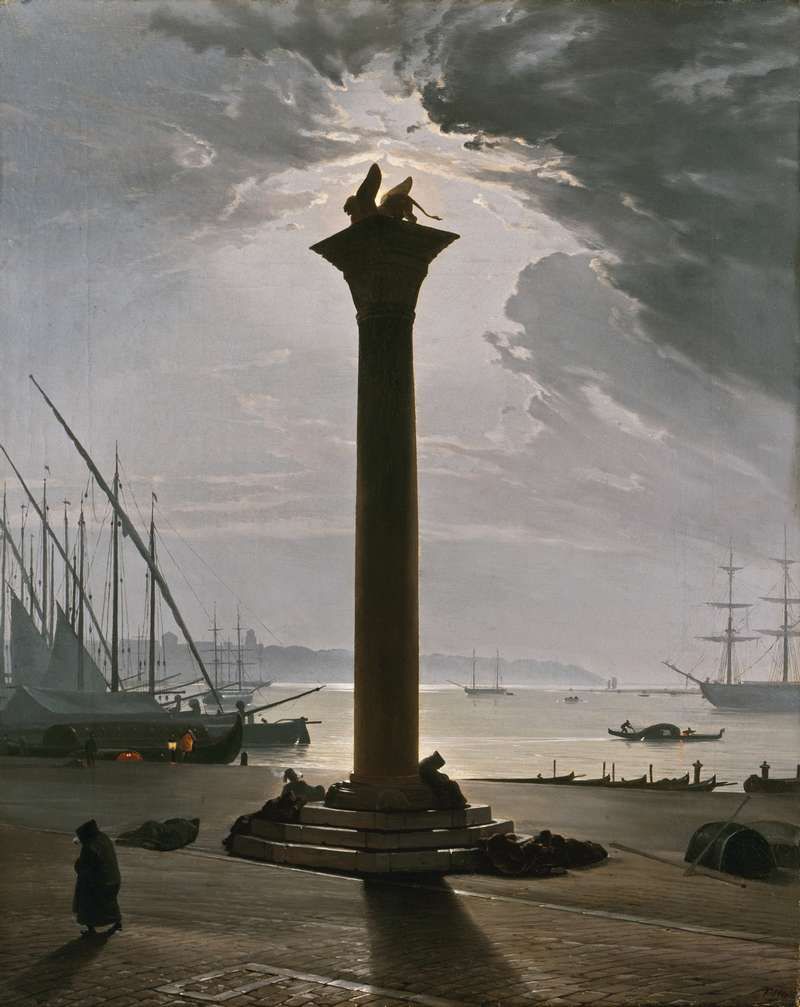
As I wandered that day through rooms full of Italian photographs, prints, and paintings from the golden age of The Grand Tour—that venerable trek that aristocrats used to make across the European continent—I felt strangely distant from my surroundings. Here I was in Paris, one of the most wonderful cities in the world, but all the while I yearned for the sea and the sunshine of Italy. Standing before a Friedrich Nerly painting of Venice in the moonlight, the sky breaking just above the column of St. Mark, I resolved, right then and there, to return.

After a few sodden weeks in France, Belgium, and the Netherlands, I came home to Vermont and settled back into the quiet routines of life. I watched the months slip by, as autumn leaves fell and were buried by blankets of soft, white snow. And in the darkest days of winter, I bought a fresh Italian guidebook, sent away for maps, finalized airline and hotel reservations, shopped for a new camera, and prayed that an Icelandic volcano with the unpronounceable name Eyjafjallajökull, wouldn’t ground my best laid plans with its plumes of drifting ash.

Thankfully, it did not.

So now, with the arrival of lilacs and spring irises, it is time to pick up where I once left off, to fulfill a promise, to have an adventure.

It’s a Monday night and I’m at the Philadelphia International Airport waiting for a U.S. Airways flight to Rome. I bide the time by recounting the plan for the next seventeen days in my head. Itineraries are complicated affairs, the endpoint of a tug of war between reality and desire. I had a long “wish list” for my return to Italy—one that included Da Vinci’s “The Last Supper” in Milan and Giotto’s frescoes in Assisi and Padua, as well as a hike along the cliffs in the Cinque Terre, and a stroll through the villas and gardens that line the shores of Lake Como. Through a herculean effort at planning, I’ve managed to fit nearly everything in, including the timing of several key events—the Republic Day festivities in Rome on June 2nd, a major exhibit of paintings by Caravaggio at the Scuderie del Quirinale, a weekend antiques show in Arezzo, and the procession of the Holy Blood in Orvieto on Corpus Domini.

For all of that to happen in an order that works using public trains and buses, this particular Monday night happens to be Memorial Day. While others are grilling hamburgers at backyard picnics, I’m playing musical chairs at the airport, until flight 718 finally settles on Gate A20 and we begin to board.

I’m in seat 14A, a window seat next to a globe-trotting Sicilian grandmother named Josephine. She’s a charming woman whose conversation lives up to all that description implies. I find myself enjoying her company, and before long dinner is served and stowed, the cabin lights are dimmed, and passengers are queuing at the restrooms in preparation for bed.

I close my eyes in satisfaction, knowing that in the morning I’ll be a world away.

Tuesday, June 1, 2010

Our plane touches down at Rome’s Fuimicino airport at 8:45 AM—right on time—and by 9:30 I’ve cleared passport control and baggage claim with surprising efficiency. Next, I meet up with a driver from Rome Cabs and embark on a brief and uneventful journey into the city, where I check into a small, single room at the Hotel Hosianum Palace, on a quaint side street near Piazza Venezia, shower and change clothes, and call home. All the while, my mind has been occupied by these mundane tasks, by the small necessities that come with long distance travel, and by a series of familiar associations. It is comforting to remember the airport terminal and the location of the ATM machine, and I grin when see the hotel lobby again, looking much as it did when I left two years ago.

I have been in a transitional state—somewhere between coming and going—but now, as I make my way out onto the street and down Via delle Botteghe Oscure, the stress of logistics begins to loosen, and for the first time I start to absorb my surroundings. It’s a Tuesday in late Spring, and I’m standing under a brilliant blue sky in the centro storico of Rome. As I walk in search of a cappuccino, my ears catch the strains of two musicians who are playing for loose change under a shrine to the Virgin Mary. Enticing aromas are wafting out from small cafés opening for lunch. For a moment I lean against the metal railing that surrounds Largo di Argentina and peer down to see a half dozen stray cats, each stretched lazily upon ancient steps and foundation stones, warmed by the midday sun.

It is here that the sights and sounds and smells of Rome remind me of something I read about the English poet Percy Bysshe Shelley. In a letter to a friend in April 1818, after an arduous trek across the Alps, he said: “No sooner had we arrived in Italy than the loveliness of the earth and the serenity of the sky made the greatest difference in my sensations. I depend on these things for life; for in the smoke of cities, and the tumult of human kind and the chilling fogs and rains in our own country I can hardly be said to live.”

For a fleeting moment, I think of Vermont and its long, grey winters, but the comparison quickly disappears. For the next 17 days, my life will be here and the very thought of it is intoxicating.

I zig zag past Piazza Colonna and its massive column of Marcus Aurelius to Via dei Condotti, where I settle comfortably into a table at Antico Caffè Greco, one of the oldest coffee houses in all of Italy. The rooms are small and charming, with plush velvet benches and walls lined to the ceiling with works of art in old, mismatched frames. Keats and Byron and Shelley—that trio of English romantic poets—were all patrons here, and it is, perhaps, for that reason, that I feel very much at home.

I wander next up to the Spanish Steps, which look grand and inviting to me, and apparently, to hoards of other tourists as well, because they are congregating here en masse. When I last visited Rome in 2008, the obelisk at the top was covered in scaffolding, like a tall metal skyscraper, blocking the view of the church of Santissima Trinità dei Monti. Today, all is well and the view is glorious. Crowded, but glorious.

At the base of the Spanish Steps is a small museum dedicated to Keats and Shelley, and for a temporary escape from the noise outside, I duck in to browse its rooms full of books, manuscripts, and artifacts, and to see the place where Keats died of consumption in 1821 at the age of 25.

I make a brief detour to the Trevi Fountain and to San Crispiano for a dish of pear and grapefruit gelato, before heading up the Quirinale hill, the highest of Rome’s seven hills. So far I’ve been merely stretching my legs and my jet lagged body for the main event of the day—a major Caravaggio exhibit at the Scuderie del Quirinale, a renovated space across from the presidential palace that was once used by the Vatican as a stable for the pope’s horses.

The year 2010 marks the 400th anniversary of Michelangelo Merisi da Caravaggio’s death at the age of 39. To mark the occasion, the curators in Rome have gone to great lengths to borrow the artist’s finest works from museums around the world: “The Supper at Emmaus” from the National Gallery in London, “The Cardsharps” from Fort Worth, Texas, an amorous cupid from Berlin, and “The Taking of Christ” from Dublin, among others. As a result, newspapers have reported outrageously long lines. Ordinary timed tickets have sold out, as I found when I tried to buy one online weeks ago, so I opt for a Caravaggio Card instead. For a slightly higher cost, I gain priority admission, as well as a free pass for a sightseeing bus that travels to various churches around town where other Caravaggio paintings are on display.

The rooms inside are dimly lit, but noisy with the chatter of local school groups, who sit in crowds on the floor before one painting, then the next, listening in half attention to the commentary of their teachers. For a few Euros, I rent an English audio guide for the exhibit, but soon find myself falling into the same distracted state. The descriptions are dense and academic, as if drawn from an art history lecture, which would normally appeal to me, but here it feels entirely at odds with the drama and raw emotion captured on canvas. Halfway through the chronology, I abandon the headset entirely with no regrets.

Before coming, I read Jonathan Harr’s book, The Lost Painting: The Quest for a Caravaggio Masterpiece, so I know something already about the artist’s violent life and the allure of his work. It has made me particularly keen to see “The Taking of Christ,” a painting long thought lost, but finally rediscovered on the wall of a Jesuit dining room in Ireland in the early 1990s. From the exquisite lighting, to the realism of the soldiers’ armor, to Caravaggio’s self-portrait holding a lantern at far right, it does not disappoint.

With my energy flagging, I leave the museum and wind my way back to the hotel for a welcome rest, and when I head out again later for dinner, the adrenaline of Rome is once again pulsing in my veins. I revisit Piazza Mattei—one of my favorite little squares—and find the sound of water in the tortoise fountain mingling with the lively tune of a nearby accordion. I continue on to Campo de’ Fiori and then Piazza Navona, where this time Bernini’s “Fountain of the Four Rivers” is blessedly free of its scaffold prison.

By the time I reach Piazza Campo Marzio, the sun has nearly set and my legs have given out at last. I crumble into an outdoor table and chair at Ristorante Boccondivino and dine well on a caprese salad and Veal Saltimbocca. Afterwards, craving sleep but not wanting the night to end, I walk to Hadrian’s Temple in Piazza di Pietra, up to the Spanish Steps, and back past the Pantheon to my hotel.

It’s well past eleven when I crawl into bed. Exhaustion will come, and soon. But as someone once told me: “Rome by night is magic.” Who wouldn’t want to prolong that?

Tuesday, June 2, 2010

“Madame, it is too cold.”

This is what the man at the front desk tells me. Standing there comfortably in a short sleeve shirt, I beg to disagree, grumpy from lack of sleep, but he is unmoved by my protestations.

I’ve made a point of returning to the Hotel Hosianum Palace in Rome, not only because of its location, but because it has a lovely rooftop terrace on which a buffet breakfast is served. This morning, however, a sign posted in the elevator has directed me to a room in the basement that is utterly devoid of natural light. I find this puzzling. When I awoke in my little room and opened the window I was greeted by a warm breeze and a bright, blue sky. And yet here I am, eating my bacon and eggs sequestered underground.

Inasmuch as I love Italy and her people, it is very clear that we each have a different notion of what constitutes inclement weather, and I have been overruled.

I don’t linger over breakfast, and it is not just because of the basement. Today is Festa della Repubblica, or Republic Day, Italy’s equivalent of the 4th of July, and a parade is about to begin just around the corner in Piazza Venezia. By the time I arrive it’s just after 9, and every man, woman, and child in the city of Rome has beat me to it. The crowd is thick and heavy, so I decide to watch and wait from Piazza di San Marco, in a copse of trees just opposite the massive white marble wedding cake known as the Vittorio Emanuele II monument.

When I stand on tip toes I can see precise lines of military men in plumed hats ascending the steps. I lift my camera and through the zoom lens catch a glimpse of Silvio Berlusconi and Giorgio Napolitano laying a wreath at the tomb of the unknown soldier. An Italian flag furls in the breeze high overhead. When I visited Rome in 2008, I had to catch a train to Florence on the morning of June 2nd, so the festivities were nothing more than an obstacle on the way to Termini Station. This time around, I am determined to experience it all.

There is a momentary lull that follows. I try to navigate up and around the barricades to Via dei Fori Imperiali, hoping to catch a glimpse of the Colosseum, but the weight of the crowd is making me uncomfortable, as are the lit cigarettes that people feel compelled to hold low at their sides despite close quarters.

I retreat back to Piazza di San Marco and remain there for the duration of the parade. As regiments and brigades stream past in vivid hues, I find myself among some equally colorful people. At 5’5” tall I’m struggling to see past the heads in front of me, yet to my left is a woman who is far shorter. While I’m straining forward on the balls of my feet, she jumping—literally jumping—up and down, talking incessantly all the while on her cell phone. The phone rings. “Pronto,” she says. Again, it rings. Again, “Pronto.” Over and over again.

Directly in front of me is a young couple who are doing three things that annoy me greatly. First, the man is holding an umbrella above his girlfriend’s head as if it were a parasol and she was a Southern belle with a delicate complexion in need of protection from the midday sun. Second, even though this Romeo has the manner of an Ashley Wilkes, he has the roving hands of Rhett Butler, which is, shall we say, distracting. And finally, Scarlett has the unforgiving habit of thrusting her camera out at arm’s length in every direction, blocking and very nearly whacking everyone around her, as if the parasol wasn’t bad enough. When her storage card gives out midway through, I smile in silent revenge. That is, until her free hand allows her to light a cigarette.

And finally, there is the man behind me. He taps me on the shoulder and when I turn he makes a motion with his hands like a musician playing the trombone and says, in broken English, “zoom, zoom.” I have a telephoto lens on my camera and at first I think he is irritated with me for using it. And what about Scarlett O’Hara, I think. Surely she’s blocking your view with her flailing camera arm more than I am in lifting mine up to my eye? But no. He isn’t angry with me. Not at all. He’s trying to tell me something, although neither of us have the language skills to communicate properly. When he taps my shoulder again and points toward the sky, I am just in time to catch a fly over by Italy’s Frecce Tricolori—nine jets in tight formation, releasing streams of red, white, and green smoke behind them. I follow them to the horizon with my camera and in seconds they are gone. Grinning broadly, I turn to my new friend and say “Grazie, grazie, grazie!” He nods and smiles back.

As the crowd disperses, I make my way past the Pantheon to Piazza Navona. I grab a mortadella sandwich from a small shop nearby and eat it in the square. Afterwards, I start to search for the nearest 110 Open bus stop, which is only vaguely suggested on the map I received with my Caravaggio card. The red double-decker busses are easy to spot in traffic, but following them is a chore. When I snag one at last, I climb up to the top deck, lean back, and ride for the duration, past St. Peter’s and the Vatican, and Piazza del Popolo, all the way to Termini Station.

I duck in to the station briefly to get a train ticket for tomorrow’s trip to Arezzo, which will save time in the morning, then I head to a trio of churches to finish out the afternoon: the papal basilica of Santa Maria Maggiore; Santa Maria sopra Minerva, the only Gothic church in Rome; and San Luigi dei Francesi, home to Caravaggio’s paintings depicting the life of St. Matthew. Somewhere I read that there are more 900 churches in Rome. I visited four on my first trip, so that even with another three under my belt, I have at least 893 to go. It’s such a shame, I suppose I’ll just have to come back.

For a celebratory end to the day, I decide to walk through the Jewish Ghetto for dinner at Da Giggetto, next to the ancient ruins of Portico d’Ottavia. I order the house specialty—a Carciofo alla Guidia, or fried artichoke “the Jewish way”—as well as a rice, mozzarella, and tomato ball to start, along with a veal roulade as my secondi piatti. There is a young man from Korea dining solo nearby and he comes over to ask for help with the menu when he sees I have a book of food translations. I chat, too, for a bit with an American family of four and enjoy overhearing snatches of their conversation. Their son and daughter are excited to be here, exploring a new culture in a foreign land, and their enthusiasm for new things is contagious. At the same time, their pleasure in each other’s company leaves me feeling a bit homesick for those I love. After dinner, I walk to the Ponte Garibaldi to call my nephew to wish him a happy 19th birthday, and to gaze one last time at the dome of St. Peter’s.

On the way back to my hotel, my eye is drawn to some stenciled graffiti on the side of a building. Graffiti is hardly a novelty in Rome. It’s everywhere, on walls, subway cars, and trash cans.

But this is reminiscent of Banksy somehow, a cut above the rest, and it captures my attention because it reads “Bella La Vita.”

Life is beautiful.

At home—back in the real world—I collect antiques and in my collection I have a set of letters written by a Harvard grad named Roger Swaim who travelled abroad on a “Grand Tour” of Europe in the mid-19th century. Memorably, in writing to a friend, he called Rome an “awful task” and said that he should appreciate it only after getting away from its “filth & discomforts.”

I am reminded of my gentle disagreement with the hotel desk clerk over this morning’s temperature, and once again I beg to disagree. Time and circumstance change, of course. When Swaim was here in 1870, the citizens of Rome had just voted to become part of a unified Italy—an historical event best remembered on Republic Day, of all days. But as with the weather, things such as “filth” and “discomfort” are largely a matter of perception.

I look again at the graffiti on the wall.

Life is beautiful.

Yes. To me, it is indeed.

Thursday, June 3, 2010

It’s early and my bags are packed. Over breakfast, I pull out my iPod and use its Kindle reader to flip through an essay the novelist Henry James once published in the Atlantic Monthly titled “A Chain of Italian Cities,” in which he recounts his journey through the hill towns of Assisi, Perugia, Cortona, and Arezzo. I am loath to leave Rome so soon, but I have spent time here before, and for now I am excited to retrace James’ steps, more than a century later, to some of the lesser known sites in Tuscany and Umbria.

It’s a gray morning in Rome as I head by taxi to Termini station to catch the 10:36 AM train to Arezzo, my home base for the next four days. It’s an easy ride, but by early afternoon the dreary sky has opened into a steady rain and I’m relieved that the walk to Piazza Guido Monaco and the Hotel Continentale is short.

At just 75 Euros a night, the hotel is a bargain, even if my room does resemble a 1980s college dorm room with its white furniture and floral bedspread. I open the doors to the balcony and look down the street to the right, towards the train station, which serves as a major railway hub, and then left past the piazza towards the historic center of town. Arezzo is a real city, with real Italians passing by on the sidewalks below. For the first time, I have wandered outside of the tourist corridor that connects the venerable triumvirate of Rome, Florence, and Venice. To be fair, Arezzo is hardly undiscovered—it was featured in the 1997 movie “Life is Beautiful,” which won an Academy Award for best foreign language film—but the city isn’t even mentioned in Rick Steves’ guidebook and that fact alone confers a certain air of adventure. I am striking out on my own, and as usual my stomach leads the way.

Just as I arrive at Piazza San Francesco I stumble into Gastronomia Il Cervo and walk through the door to the delight of a jovial man behind the counter. His English is poor and my Italian is worse, but the essentials of communication are achieved with a smile. He recommends a spicy pasta made from stale bread, a warm and hearty choice on a chilly day, and I enjoy a bowl of it immensely in the dining room upstairs, ending the meal with a cappuccino.

Feeling fortified, with umbrella in hand I venture back out onto the quiet streets and spend the afternoon lazily wandering from church to church. My first stop, resting on the edge of a lush green park near the ruins of a Medici fortress, is the city’s cathedral, or duomo. There is a beautiful vaulted ceiling lined with frescoes, some stunning medieval stained glass by the famed Frenchman, Guglielmo de Marcillat, and a charming, if unassuming, portrait of Mary Magdalene by Piero della Francesca.

I make my way back down the hill to the Romanesque church of Santa Maria della Pieve to see its Lorenzetti altarpiece, a luminous polyptych of the “Madonna and Child with Saints” painted in 1320. I pop a coin into the light box and stand back to appreciate the effect, watching the figures glow on a ground of gold paint high over the crypt at the end of a long spare nave, under a ceiling of thick wooden beams.

At 4:00 PM, I arrive back at Piazza San Francesco and enter the basilica there to see the Bacci chapel, famous for Piero della Francesca’s cycle of frescoes known as the “Legend of the True Cross.” The reservation I made online weeks ago hardly seems necessary, for as in the other churches in town, I am quite alone, save for a pair of young women taking tickets by the door. They direct me past a velvet rope and I savor the space, turning round and round to follow the visual story of the wood that was ultimately used to create the cross on which Christ was crucified.

My eyes search for a place to begin. By now, after several summers spent tramping across Europe, I am familiar with the form. Frescoes like this are made up of distinct scenes that can be read much like a medieval comic strip. With some help from a small book I bought in the gift shop, I follow along: In the beginning, seeds given by Michael the Archangel are planted in Adam’s mouth at the moment of his death, becoming a tree that grows upon his grave. It is later felled by King Solomon and its wood used to bridge a stream. When the Queen of Sheba attempts to traverse the bridge, she has a vision in which she sees Christ killed on a cross made from its beams. The wood is buried, but later found and it fulfills its fate. Centuries later, on orders from the Emperor Constantine, the relic is discovered among the three crosses of Cavalry and its identity restored.

It’s been a wonderful afternoon, but my mind is crammed to overflowing and I am eager to feel the cool air upon my face. As I open the door to leave the basilica, I reach for my umbrella expecting rain, but I am greeted instead by a bright blue sky. The storm has passed, and all of Arezzo is reflecting in the puddles it left behind.

When Henry James was here in the 1870s, he spent much of the day in an “uninvestigating fashion,” taking in the “general impression” of things. In walking down Corso Italia and its side streets, I now find myself doing much the same. Along the way, I stop at Cremi for a dish of artisanal gelato—a scoop of orange with lime and one of coconut. Its bright, refreshing taste suits both the change of weather and my buoyant mood. I walk further down to San Agostino in time to hear the church bells toll the top of the hour, and then I turn back to the hotel to rest before dinner.

When I head out again, I’ve already decided to end the day with a meal at La Lancia d’Oro, a restaurant that spills out under the Vasari loggia, facing Piazza Grande, Arezzo’s most famous public square. Come Saturday, the sloping pavement will be covered by rows of antiques stands for the monthly Fiera Antiquaria, but for now the view is peaceful and serene, a jigsaw of stone and stucco buildings, each decorated with colorful coats of arms.

Believing that the quality of restaurant food is usually in inverse proportion to its location, I truly don’t expect much from dinner, not here in such grand surroundings. I expect tourist fare, so I am stunned when a chain of delectable dishes make their way out of the kitchen, all delivered with warmth and grace by wait staff that treat me like family. I order a bowl of Ribollita to start. It is a Tuscan specialty I have longed to try, a soup made with bread and vegetables. But a small plate of appetizers arrives first, unbidden. For a moment, I worry that there has been some costly confusion, but the night is so warm and pleasant and my glass of the restaurant’s private label wine so enjoyable, that I throw caution to the wind and decide the experience is worth whatever the price. I order a fresh plate of asparagus ravioli, but later decline dessert, only to find a trio of pastries brought to my table anyway, followed by a cream pudding.

When the check arrives at last, I thank the waiter for what has been my best meal in Italy, ever. It is a prize hard won, given the fine lunch I had in Siena two years ago, and the beautiful plate of gnocchi I once ate in Rome. I peer at it cautiously and then wrinkle my brow. I have been charged for the Ribollita, the ravioli, and the wine, but for nothing more. The rest, it seems, was kindness.

I grab my tripod and snap a few pictures of Piazza Grande, floodlit beneath a cobalt sky, and on the walk back to the hotel, I think again about Henry James. He, too, had been seduced by “adorable Italy,” and by the charm of Tuscany in particular. By the end of his day in Arezzo, he had “seen Santa Maria della Pieve and its campanile of quaint colannades,” as well as “the stately, dusky cathedral” and a museum filled with “Etruscan vases and majolica platters.” It had been, he said, a day of “soft saturation,” spent among beautiful hills and cypresses that cast long, straight shadows in the sun. And when he travelled on, he took with him “[m]emories and images, anything and everything.”

In years to come, he would look back and write fondly of the things that populated his Italian Hours. Exhausted, I lean back into bed and close my eyes, knowing that someday I will, too.

Friday, June 4, 2010

This morning, I’ve made a mess of things. I’m having breakfast at the Hotel Continentale, in a lovely dining room decorated in vibrant shades of blue and gold. There is a fine selection of pastries, breads, cereals, and fruit laid out on long buffet tables, and for coffee there is an imposing automated machine. Ideally, I would like a cappuccino, but I am not sure how best to achieve this. I press a button and I am comforted by a whirring sound that spits espresso into my cup, but when the steamed milk is dispensed, it comes from an entirely different spout, far to the left. By the time I realize this and shift my position, much of the milk has drained away, and the rest has slopped over the side into the saucer below. Feeling embarrassed, I decide to make the best of it and carry it back to my table.

The waitress minding the buffet has noticed my plight and she takes pity on me. She’s a cheerful, middle aged woman and she says something comforting in Italian before trotting off. A moment later she emerges from the bar holding an absolutely perfect cup of cappuccino. As she watches me, I take long sip, allowing the aroma of the coffee to fill my nostrils. When at last I pronounce it “molto bene,” and with great enthusiasm, she seems genuinely pleased. The people in Arezzo are nice. There is no other way of saying it, although it hardly seems sufficient. They are nice, and I like it here. I like it very much.

From my hotel facing Piazza Guido Monaco, it’s just a short walk to the railway station, and after a brief detour to the ruins of a Roman amphitheatre in town, I catch the 9:14 AM train to Assisi. It’s a milk run train that makes countless stops along the way, but the scenery out the window is distractingly beautiful, and for a moment I catch a glimpse of a castle high on the hill, which I later learn is Montecchio Vesponi, near Castiglion Fiorentino. The hour and a half goes by in the blink of an eye.

At the station in Assisi, I buy a ticket for a bus that will take me to the old town at the top of the hill and ride it all the way up to Piazza Matteotti. From there it’s a pleasant walk through ancient streets and along sweeping vistas, past the cathedral of San Rufino to Piazza del Comune, under the soaring tower of the Palazzo del Capitano del Popolo, all the way down to the papal basilica of St. Francis.

The day is young and the town has a sleepy quality, with shopkeepers relaxing by open doorways crammed with religious souvenirs—laminated prayer cards, rosary beads, crucifixes, and rows upon rows of St. Francis statuettes dressed in identical brown tunics, cinched at the waist. Some are portly, others tall, but nearly all depict the saint’s famed attachment to animals—occasionally dogs, but more often than not birds, a menagerie of birds.

I approach the basilica from the east, along Via San Francesco, where it sits at the end of a long green lawn on which hedges form the letters PAX, the Latin word for peace. Outside the entrance to the upper church, I rent an audio guide and then walk into a bright space that is, through the conscientious efforts of the guards, surprisingly quiet, despite a steady stream of pilgrims. I can see an apse and transcept at the far end, but I am struck most by the frescoes that line the nave, long attributed to Giotto. The paintings reconstruct major events in the life of St. Francis (1181-1226)— a crucifix in the church of San Damiano speaks to Francis and summons him to God’s work, the future saint renounces his wordly goods, he preaches to the birds, and later on Mount La Verna he receives the stigmata. It is painful to recall how close all of this was to destruction after an earthquake struck in 1997, killing four people and sending chunks of the vaulted ceiling to the floor.

After circling the nave thoroughly, I make my way down to the cavernous lower church and to the tomb where St. Francis is buried. In “A Chain of Italian Cities,” Henry James wrote that “it would be hard to breathe anywhere an air more heavy with holiness,” for the basilica pushes the visitor “into the very heart of Catholicism.” As usual, I find his powers of observation to be uncanny.

After a quick sandwich at a nearby café, I spend the rest of the afternoon testing my stamina on the narrow and undulating streets of Assisi. I shop for ceramics, stop by an ancient Roman temple long ago converted to the church of Santa Maria sopra Minerva, and visit Santa Chiara, a basilica devoted to St. Clare (1194-1253), who like Francis, founded her own monastic religious order.

At 4:00 PM, I catch the bus in Piazza Matteotti and from the train station below walk across the tracks for one last stop at the church of Santa Maria degli Angeli, which inside houses the tiny Porziuncola, the 9th century chapel that Francis believed he was commanded to repair. It is crowded with tourists, most snapping flash photos despite the admonition posted outside, and I have to breathe deep to remember Francis’ words: PAX ET BONUM. Peace and goodwill. It strikes me as a sentiment that is easier to maintain when preaching to the birds.

On the train on the way back to Arezzo, a friendly Australian named Serena takes the seat next to mine. She is a lawyer on a fourteen month break who has chosen to travel the world and we chat amiably until we reach her stop at Passignano. By now, I’ve grown used to travelling solo, but I look forward to such passing acquaintances.

Back in town, on a side street near Piazza Grande, I decide to grab dinner at Trattoria Il Portale where the owner, a balding man with a surly disposition, seems not to understand my request for a table. “Un tavolo per una, per favore,” I say, and then repeat the phrase. Exasperated, he turns and loudly calls “Ma-a-a-a-r-r-r-r-r-ia!”

Maria is a sweet young girl, and she recommends the bruschetta and a tubular pasta with cheese and fresh cracked pepper called Cacio e Pepe, both worthy of Arezzo’s growing reputation for culinary excellence, at least in my eyes. I sit for a while and read from a book on Giotto I bought in Assisi. Afterwards, I revisit Cremi for a cup of nutella mousse and yogurt gelato and savor it—and the day—all the way back to the hotel in the dark.

Saturday, June 5, 2010

It’s a bright and beautiful morning in Arezzo and I’m standing on the rooftop terrace of the Hotel Continentale surveying the city streets. Directly below me is Piazza Guido Monaco, a small octagonal park named for the Benedictine monk who invented musical notation. Beyond, an assortment of stone towers dot the landscape, including that of Santa Maria della Pieve, but the overall effect is a mixture old and new, owing to the fact that much of Arezzo was bombed heavily in the war, especially here near the railway station.

In a newspaper account published by The Times on July 16, 1944, it was said that the “main street through the town… was a melancholy line of battered shop fronts and doorways.” And yet, “at the end of this sombre route one came to the Piazza del Duomo and it was a refreshing sight. There stood Arezzo’s fine cathedral, serene on its height above the streets of the town and remote from the damage and havoc that war had wrought below.”

Today, the city has risen from the rubble and rebuilt itself around its surviving landmarks, and when I see the cathedral perched high on the hill in the distance, the miracle of its survival makes me smile.

It’s a Saturday morning and the streets are already teeming with people, and I can see a row of white canopy tents that have appeared overnight for the Fiera Antiquaria, Arezzo’s monthly antiques fair. I’ve been told that it’s the oldest and the largest of its kind in Italy, with over five hundred booths that wind up the hill past Piazza San Francesco to the duomo, then back by the Palazzo Comunale, and under the Vasari Loggia, before spilling out into Piazza Grande. Aside from the convenience of the city’s railway hub, this is the main reason for my visit, so I rush to the elevator, eager to descend and join the crowd.

In truth, there isn’t much I can afford, or for that matter, fit into my suitcase, but I thoroughly enjoy wandering the hilly streets nevertheless. There are chairs and tables and wrought iron beds, stacks of books and prints and gilded picture frames, porcelain figurines and ceramic bowls. I fall in love with a pair of 19th century paintings of the Ponte Vecchio in Florence and a beautiful landscape by Pier-Antonio Gariazzo, but in the end seize upon a small and far more affordable pair of modern paintings, each depicting people browsing an Italian antiques market, just as I have done all morning. Whether art imitates life, or life imitates art, I head back to the hotel thrilled with the purchase.

It’s nearly 1:00 PM and while I had originally thought I might head to Florence for the afternoon, I’m feeling as lazy as Henry James and want nothing more than a pretty place to explore in a thoroughly “uninvestigating fashion.” I decide to catch the bus to Cortona instead, a tiny hill town made famous by Frances Mayes in her memoir Under the Tuscan Sun, and when I arrive there at Piazza Garibaldi an hour later, and gaze out across the hills, lakes, and valleys of neighboring Umbria, I’m glad I came.

I begin to follow the narrow straight line that is Via Nazionale towards what my map tells me is the center of town—Piazza della Repubblica and the Palazzo Comunale—but I stop off along the way for a late lunch at Tuscher Caffé. I sit back and relax at a small table by the side of the street with a gorgeous plate of cured meats, bruschetta, and pecorino cheese before me, as well as a glass of chilled prosecco. Truly, it doesn’t get much better than that.

Half of the Palazzo Comunale is wrapped in scaffolding, which is a bit of a disappointment, but the town itself is not. It has a romantic, easy charm and the hours slip by gently on the mind, if not the body, for Cortona is a hill town indeed, and on either side of Via Nazionale, there are alleys and stairways that branch off into breath-robbing inclines. I shop for ceramics, eat some gelato, and peer down Etruscan wells, walk down to the church of Santa Maria Assunta, the town’s duomo, and stop into the adjacent Diocesan Museum to see works by Luca Signorelli and Fra Angelico. But mainly, I just walk, as far as my legs will take me, out along the walls for another sweeping view of Lake Trasimene and the Val di Chiana, all the way back to the shade of the Parterre gardens. Somewhere along the way, I fill the last space on the first of my camera’s 8 GB storage cards and reach into my bag for another, wondering if I will make it through the rest of my trip at this pace.

It’s just after 7:00 PM when I finally catch the bus back to Arezzo. I sink back into the seat and enjoy chatting with a young Korean student living in Florence, whose name is Yun-Mi, but who asks that I call her Stella, which she says is her English name. She is as amiable a traveling companion as I could hope for, and her facility with languages impresses me deeply, and not only because she is far more capable than I in confirming our route with the driver.

Back in Arezzo, a deep fatigue has started to set in. My legs are aching, and yet my stomach is growling like mad. From the bus stop in the piazza, I head up Via Guido Monaco to a kabob shop and order a sandwich and a can of Coca-Cola to go. I slump back to the hotel feeling guilty. After all, I should be dining on classic Tuscan fare—a steaming bowl of Acquacotta, or a juicy Chianina steak—but alas, what I crave most is sleep. Exhaustion is, perhaps, something Henry James would have understood when he wrote of “the familiar tax on the luxury of loving Italy.”

Sunday, June 6, 2010

This is one of those days that I’ve looked forward to for a very long time. It’s the Sunday after Corpus Domini and I’m up early to catch an 8:14 AM regionale train to Orvieto for an annual event known as the “Procession of the Holy Corporale.”

The day itself, which honors the Eucharist, is an important one in predominantly Catholic countries such as Italy, but the celebrations here extend far beyond church services. Over the weekend, many towns hold an infiorata in which flower petals are arranged into art, creating stunning street mosaics that last mere hours. Spello, a tiny town near Assisi, has one of the most famous of these festivals, and I had wanted to go, but it conflicts with the parade in Orvieto, and in the end, I decided to attend the latter instead. And so here I am, waiting for the funicular to take me to the town at the top of the hill.

According to tradition, a religious miracle occurred here in 1264. When a priest on a pilgrimage to Rome stopped at a church in nearby Bolsena to celebrate mass, he is said to have witnessed the Host bleeding. A piece of the habit he wore that day—known as a corporale—was stained by the blood, and to this day it is kept in Orvieto’s cathedral. Once each year, the relic is taken through the streets of the city in a lengthy procession that includes hundreds of men, women, and children in medieval costume.

It’s just after 10 when I reach the top and rather than wait for a bus, I decide to hurry as best I can down Corso Cavour, navigating from a flimsy map I printed out from home, and the low rumble of drums in the distance. The parade is already under way.

I approach the cathedral from behind and slip along the barricades into a doorway along Via del Duomo, near the piazza. I barely have time to glance up at its glorious façade—which guidebooks hail as a masterpiece of the Late Middle Ages—when the first heralds arrive with their trumpets. They are followed by a swirl of sights and sounds that set my camera’s shutter into high speed. There are waves of flags, banners, and shields with various coats of arms, knights and squires dressed in richly embroidered cloth, priests releasing incense from brass thuribles, and soldiers in plumed helmets and chainmail, armed with spears, crossbows and halberds. From their breastplates to their buckles, the attention to detail is a marvel, like a legend come to life off the pages of a book, and I think of Robin Hood or the Knights of the Round Table.

When the corporale makes its appearance at last, it’s under a white canopy trimmed in gold, seated upright in an ornate reliquary, richly decorated in enamel. The people lining the streets grow quiet and bow their heads in respect, many making the Sign of the Cross. An old woman leaning out of a window overhead applauds.

Round and round they go, from Piazza del Popolo through the streets to the duomo and back. It’s a grand spectacle and one in which the citizens of Orvieto clearly take pride. In fact, I don’t think I’ve never been so grateful for the zoom lens on my camera. The experience aside—and it has been a memorable one—if I don’t walk away from this with some truly excellent pictures, it will be no one’s fault but my own.

Once the service inside of the cathedral begins, the audio is conveyed on loud speakers to the crowd outside. The Italian that is spoken is lost to me, but the music—a mixture of sung hymns and traditional organ—most definitely is not.

As the crowds disperse through the narrow streets, I settle in for a light lunch at L’Antica Pizzetta, where I order a plate of polenta with mushrooms, drizzled in olive oil, and a glass of the local white wine, known as Orvieto Classico.

Afterwards, I drop by the tourist information office in the Piazza del Duomo to purchase a carta unica, which covers admission to nearly all of the city’s monuments. The Torre del Moro is my first stop of the afternoon, for its panoramic view, that blessedly comes with an elevator.

I spend the rest of the afternoon pleasantly, again shopping for ceramics, visiting the market in Piazza della Repubblica and the rustic church of Sant’Andrea which faces it. By the time I make my way back to the duomo to examine its façade in detail—an astonishing mix of gold leaf, mosaic tile, and bas-relief sculptures—it’s open once again for visitors, and after a day of bright sunshine, I welcome the cool air and the dim light of the interior. The stone walls and massive columns that support the nave are constructed in green and white horizontal stripes and they are nearly as vibrant as the cathedral’s famous façade. Yet the highlight for me is the Chapel of St. Brizio, which features Luca Signorelli’s frescoes of the Apocalypse (1499-1502). I’ve seen imagery of this, and of the Last Judgment, before, countless times—on the wall of the Sistine Chapel, on the ceiling of the baptistery in Florence, on the St. John Altarpiece in Bruges, on a portal of Notre Dame Cathedral in Paris, and so on—so the writhing, naked bodies come as no surprise. But there is something fantastical here, something animated, that appeals to me and creates beauty out of misery and torment.

At 4:00 PM, I arrange to meet a guide named Anita for a group tour of the Orvieto underground. The city was built on a massive mound of soft limestone rock known as tufa, through which the Etruscans dug miles of caves, the rounded edges of which remind me of the Flintstone’s. In some rooms there are rows of small recessed holes in the walls. When Anita asks us to speculate on their use and purpose, we offer a variety of guesses. Some think the niches were used to store olive oil, others as a kiln for ceramics, and even a World War II bomb shelter. They were, she said, carved to create nests for breeding pigeons.

As we make our way back up towards daylight, I have a decision to make. I’ve seen posters around town for a cavalcade at 6:30, where riders on horseback will parade in Piazza del Duomo, and there is bleacher seating being set up now. Should I stay? I would like to, but it’s been a busy day and energy is starting to flag. I decide against it, and head back towards the funicular for one last stop at St. Patrick’s Well.

The well was built in the early 16th century and it’s famous for its clever, double helix design, which allowed people and livestock to descend down one set of stairs to the water at the bottom, while directing traffic up an entirely different staircase for the ascent back to the top. When my legs make it only part way down, and I am forced to retrace my original route, apologizing to the young woman at the ticket counter when I emerge from the wrong path, I know I’ve made the right decision to head back to Arezzo now, rather than staying late for the cavalcade.

On the way back, I realize that I forgot to validate my ticket before boarding the train. I panic, remembering the stories I had read about the fines that are imposed. An old Brit onboard says, “I wouldn’t fuss about it, my dear.” And he’s right. The conductor never comes through the car to collect tickets anyway.

Tired when I arrive, but grateful for my good fortune, I return to the same kebob shop along Via Guido Monaco and order a falafel to go.

Just before I fall into bed, I remember the uncharacteristically harsh words Henry James wrote about Orvieto when he visited in the 1870s. He found it “meanly arranged and, as Italian cities go, not [a] particularly impressive little town.” It was, he thought, quite “inferior to its fame.” As I scroll through the pictures on my camera, I think that perhaps if he had visited during Corpus Domini, he would have changed his mind.

Monday, June 7, 2010

It’s time to move on again, and in packing my bags this morning I feel a rush of excitement.

When I approach the front desk to pay my bill, I tell the clerk how much I’ve enjoyed my visit to Arezzo and the Hotel Continentale. And I mean it truly. In planning my itinerary months ago, I saw my time here as a convenient and inexpensive home base—a way of squeezing a few extra days out of the budget—but it has far exceeded my expectations.

The clerk pauses in his paperwork, looks up, and furrows his brow. “Quiet, quiet, quiet,” he says. “We get in a car and drive to Florence.”

And so it is.

I catch the 8:55 AM train to Florence and arrive at Santa Maria Novella station less than an hour later. After a short cab ride, I find myself back in the welcome arms of the Hotel Davanzati. I first visited Florence in the summer of 2008 and have the warmest possible memories of the place and of family that manages it. This morning, it’s the handsome Tommaso who greets me, and like his father Fabrizio, he is a kind and gracious host. Before long, my things are stowed away in the same charming room, and I have been briefed on the latest trends in local gelato. Grom, it seems, is very much in favor.

As I head out onto the streets and through Piazza della Signoria under a morning sun that already feels scorching hot, I am reminded of all that I love about Florence—the beautiful art and architecture, the enticing aromas wafting out from local cafés, the magnetic pull of museums, the sound of street music around every corner. There is an urban metabolism that pulses with possibility. I feel energized and find myself walking quickly, remembering that I have but a short time here.

I am devoting the day to loose ends, to a list of things I had wanted to do two years ago. There is, it seems, never enough time in Florence.

Because it closes early, my first stop is the Bargello museum, housed in the imposing Palazzo del Popolo, a former barracks and prison. The fortress is impressive in itself. There is an inner courtyard and covered staircase, and the walls are lined with heraldic shields from the 13th and 14th centuries that represent the coats of arms of various city magistrates, known as podestà. Inside, there is furniture and tapestries and some Majolica ware, but the real specialty is sculpture. The Bargello houses Donatello’s bronze statue of David. Completed in the 1440s, it was the first freestanding male nude to be cast since antiquity.

Florence, of course, is better known for a very different David—a more mature and heroic one, carved in marble by Michelangelo. Tourists line up in droves to see it at the Accademia across town, and they stand proudly by a copy of it for pictures in Piazza della Signoria. Here at the Bargello, Donatello’s David seems overlooked, in part because the museum itself is off the beaten path for weary crowds en route to other staples of Florentine history and culture. Even on a busy weekday at the height of tourist season, the museum is nearly empty.

As Mark Twain once wrote in the Innocents Abroad, I like Michelangelo very much, but I do not want him “for breakfast—for luncheon—for dinner—for tea—for supper—for between meals. I like a change occasionally.” As Twain went on to observe, in Florence, Michelangelo “painted everything, designed everything, nearly, and what he did not design he used to site on a favourite stone and look at, and they showed us the stone… Enough, enough! Say no more… I never felt so fervently thankful, so soothed, so tranquil, so filled with a blessed peace, as I did yesterday when I learnt that Michael Angelo was dead.”

Well, if that’s the case, Donatello’s David certainly is a change. He depicts David as a youth, more accurate to the biblical tale, but the pose is jarringly effeminate, with one hand resting on a hip that bends at the knee. The addition of a jaunty hat and Goliath’s winged helmet at his feet, one wing splayed seductively up the back of David’s leg, gives the entire composition a homoerotism that reminds me of the Caravaggios I saw in Rome. I wonder what Twain would have to say about that?

Nearby, I stop in for a bite to eat at Antico Noè, a tiny sandwich shop in an arcaded alley off Piazza San Pier Maggiore. I order the numero otto—pork with pecorino cheese—and watch as a steady stream of college students crowd the doorway. Next, I take Tommaso at his word and pay homage to Grom near Piazza del Duomo, where I get a dish of raspberry and lemon gelato for dessert, and eat it on the steps of the cathedral.

I walk back to Piazza della Signoria and join the security queue to enter the Palazzo Vecchio. This is the local town hall, and its soaring bell tower is nearly as prominent a part of the city skyline as Brunelleschi’s red-tiled dome.

It’s a self-guided tour, but an excellent one given the opulent surroundings. I visit the Salone dei Cinquecento (or, Hall of Five Hundred), where some believe that a long-lost scene of “The Battle of Anghiari” by Da Vinci lies hidden beneath a later fresco by Vasari.  I wander next through a series of connected public rooms, where every square inch of the walls and ceilings are covered by Renaissance art, some of which depict scenes of Florence that are wholly recognizable today.

I have a 3:45 PM reservation to see a cycle of frescoes in the Brancacci Chapel at the church of Santa Maria del Carmine, but with some time to spare I decide to cross the Ponte Vecchio and do a little shopping along the Oltrarno, stopping at Roberta’s to buy a leather belt for my Dad. Then, I walk up along the river to the Ponte Santa Trinita to admire the statues at each end representing the Four Seasons, which were added in 1680 to celebrate the wedding of Cosimo II de’ Medici. The bridge was a beautiful one, with three graceful elliptic arches, but in the closing days of World War II, it was spitefully bombed by the Germans, along with every other bridge in Florence, save the Ponte Vecchio. The statues collapsed into the Arno, and while the remains were put back on the newly reconstructed bridge after the war, the head of Primavera was missing and long thought stolen by soldiers during the liberation. It wasn’t until 1961 that it was finally found downstream.

I am right on time for my appointment. In the end, despite the restrictions—the need for advance reservations, and a limit of just 15 minutes to view the art—my visit in the Brancacci chapel is well worth the effort, especially given the quality of the multimedia presentation beforehand. Begun by Masolino in the late 14th century, and later finished by Masaccio and Lippi, the frescoes tell the story of the temptation of Adam and Eve and their expulsion from the Garden of Eden, as well as other stories from the Bible, including “The Payment of the Tribute Money” from the Gospel according to Matthew.

In the only sour note of the afternoon, a French tour group joins my time slot, and despite the usual admonitions for silence and respect, the guide talks loudly the entire time, instructing those with her to stand in the center of the small space, where they remain for the duration, crowding everyone else out. Afterwards, several of us try to talk to the guard to protest. We’ve had little chance to see the frescoes up close because of the guide’s boorish behavior, but it seems there is nothing he can do.

I decide to duck back to the hotel to change out of my sweaty clothes before dinner and to post a few pictures to Flickr for friends and family back home. When I arrive, Happy Hour is underway at the Davanzati, so I have a glass of prosecco beside me as I connect to the internet on my netbook. This is, apparently, an act of heresy in Italy and it draws a good-natured rebuke from Fabrizio, who reminds me that I am on vacation and that I shouldn’t work so hard. I’m truly not working, but it doesn’t seem worth the explanation. I simply agree and close the lid.

For dinner, I’ve reserved at table at Osteria del Cinghiale Bianco on Borgo San Japoco, where a cute Italian busboy asks if he can introduce himself. I nod and he flirts endlessly, insisting on taking my picture. Eventually, the waiter comes by, frowns, and sends him packing back to the kitchen, to my grave disappointment.

I dine well on some hearty Tuscan fare—white beans with sage, and a plate of Pappardelle al Cinghiale, or wide ribbon noodles with wild boar sauce. Sitting nearby is a couple from Florida, celebrating their 13th wedding anniversary. In eating early, and snapping pictures, and in brimming over with enthusiasm for Italy as we talk, we are—the three of us—the spitting image of the American tourist, although hopefully not as hapless and uncouth as those Twain depicted in his narrative.

The night is still young when I leave my Florida friends. The air is cooling at last, and the change in temperature makes for a pleasant stroll. A classical guitarist from Poland, named Piotr Tomaszewski, is playing on the Ponte Vecchio to an appreciative crowd. After a while, I head up Via Porta Santa Maria, past the duomo, to Piazza della Santissima Annunziata. Designed by Brunelleschi himself, this used to be an orphanage known as the “Hospital of the Innocents.” It’s a low structure with an arched colonnade and above each column is a round terracotta sculpture, or tondo, added by Andrea della Robbia around 1487. The tondi depict infants in swaddling clothes lying on a blue wheel—a wheel which actually existed until the late-19th century, allowing mothers to leave their unwanted children anonymously by rotating them into the hospital interior on the equivalent of a Lazy Susan.

By the time I make my way back to Piazza della Signoria for the third and final time, night has fallen. Floodlights have kicked on and the tower and stonework of the Palazzo Vecchio stand stark against the sapphire sky.

In the Innocents Abroad, Twain wrote that “Florence had pleased us for a while,” before becoming tedious in the effort required to appreciate it. I suppose that it’s possible to come to Florence to relax, to embrace what the Italians call l’arte di non fare niente—the sweetness of doing nothing. Fabrizio, at least, says that it is.

This is a city that wears its past proudly on its sleeve, but I’m sure there are times when the looming presence of the Renaissance imposes a burden on locals and tourists alike, for who among us will ever reach the heights of a Donatello or a Masolino, a Brunelleschi or a Michelangelo? And so we exhaust ourselves in stifling heat, trying to see it all in the time that we have.

What can I say? Florence inspires me—not to do nothing, or even something, but to do everything. If not this time, then the next. And that can be rather sweet, too.

Tuesday, June 8, 2010

Blame it on Netflix.

Originally, I had planned to spend two full days in Florence—not nearly enough, of course, even for a return trip—but two nevertheless. Yet here I am making a hasty visit to the basilica of Santa Maria Novella before heading out of the city by bus to the tiny hill town of San Gimignano.

I’m always in pursuit of “Italy porn”—films of varying and largely irrelevant quality that feature beautiful Italian landscapes. Il Postino, A Room with a View, Cinema Paradiso, Life is Beautiful, My House in Umbria, and even the mediocre Under the Tuscan Sun and Letters to Juliet, have all made it to the top of my queue.

The movie that inspired this particular side trip was Tea with Mussolini. Released in 1999, it tells the story of a group of elderly English ladies living in Florence who help raise a young boy named Luca, whose experiences are based loosely on the life of director Franco Zeffirelli. After Mussolini declares war on Great Britain, the group is interned in San Gimignano for the duration, where they remain feisty in their protection of orphan children, dogs, and local art, even in the face of the menacing Nazis. It’s quite a sweet movie, and it has me yearning to see the famous towers of San Gimignano for myself.

The bus ride from Florence is cheap and easy, but it does require a change of line with a 35 minute wait in Poggibonsi, where the station is dull and nondescript. The entire journey takes nearly two hours, so by the time I disembark with a crowd of other tourists at 12:30 PM, I’m ready to stretch my legs.

I’m standing just outside of the old city walls, in front of a massive stone gate, charting my position on the map, when I realize how unnecessary it is. Like in Cortona, there seems to be just one major route in San Gimignano—down Via San Giovanni, through Piazza della Cisterna, and then along Via San Matteo to another gate at the north end of town. From here, I can see two of the city’s towers, rising high at the end of the long, narrow street in front of me, but it takes me ages to reach them given the magnetic pull of quaint little shops that line the way, and an enticing lane to the right that leads me out to a cluster of Tuscan farmhouses.

When I walk under the Arco dei Becci at last and into the triangular Piazza della Cisterna, past the Collegiata and the down to the church of San Agostino and back, I find that my neck is growing stiff from the constant looking up. My guidebook says that there were once 72 densely clustered towers in San Gimignano, built by wealthy families for protection during sieges. Given the city’s small size, its skyline must have resembled a medieval Manhattan.

When the town later fell under Florentine rule, most were ordered down. Just 14 towers survive in their original, uncropped state today. Even so, San Gimignano is widely known as La Cittá delle Belle Torri—the City of the Beautiful Towers—and it’s easy to see why. They are rustic, heavy and substantial, and admittedly less elegant and refined than the Torre del Mangia in nearby Siena, but they are undoubtedly beautiful.

In 1875, Gino Capponi, an Italian historian, wrote that: “No other town or castle in Tuscany retains more of the Middle Ages and was less invaded by the ages that followed; in those towers, and in the churches and in the houses of massive stone, is still something that cannot be covered up by the thin plastering of modern times; ancient memories keep their possession of it, the new life has hardly entered in.”

Today, given the complex realities of tourism, I doubt Capponi would still agree, but on a hot summer’s day such as this, it seems as though the pull of “ancient memories” and the push of “new life” from the daily influx of daytrippers has found a peaceful equilibrium.

I stop for lunch on the terrace of La Griglia Ristorante, where the views are as scrumptious as my warm plate of wild mushroom crostini, and my glass of Vernaccia, the local white wine. Afterwards, I tour the Civic Museum in the Palazzo del Popolo and then head up to the top of the attached Torre Grossa, which dates from 1298. At 177 feet, it is the tallest tower in San Gimignano and in every direction there are breathtaking views. I look down upon a sea of red tiled rooftops, and out across the lush green Val d’Elsa to the mountains of the Pistoia and the Apuan Alps.

Intent on capturing the moment, I snap away on my Nikon D5000, pausing only when the second of my 8 GB storage cards runs out of space. As I slip a third into the slot on the side of the camera, I think about the marvels of digital photography. The tiny plastic rectangle in my hand stores nearly a thousand pictures and video clips from Cortona, Arezzo, Orvieto, Florence, and San Gimignano. Later, at the click of a mouse, the things I did and places I saw will be magically reconstructed out of millions of brightly colored pixels. It’s a curious thing—the juxtaposition of ancient and modern. I cast my eyes over the medieval city of San Gimignano and hope that technology will help me to fix it in my memory.

Earlier, when wandering the streets, I overhead a woman talking to her companion about the Collegiata church in Piazza del Duomo—the one, she said, with the “bad frescoes.” Determined to judge for myself, I descend from my lofty perch and head next door. I pay the entrance fee and head for the chapel of Santa Fina, the one featured in the film Tea with Mussolini. Ghirlandaio’s work here is lovely, especially since it seems to soften the saint’s life story. The young Fina fell gravely ill at the age of 10 and spent the next 5 years slowly dying on an oak table, a purposeful choice to increase her suffering in the eyes of God. A brutal historical fact, yes, but it certainly isn’t bad art.

The next candidate is along the back wall—a cycle of frescoes by Taddeo di Bartolo that depict the Last Judgment in gruesome detail. Naturally. This time, instead of academically drawn nudes, many of the writhing bodies are ugly and bloated, held at knife point by an army of winged monsters. It is terrifying indeed, but once again, not exactly bad art.

Still curious, but not at all sure of what she meant, I move finally to Bartolo di Fredi’s frescoes from the Old Testament. Here, the scenes are rather misshapen and out of proportion. These, I am sure, are what she intended when she spoke of “bad frescoes.” But I do think she’s been a bit unfair. The work before me represents the mid-14th century. If she were here, I would say: Have a little patience, their world is on the verge of the Italian Renaissance. Linear perspective is coming soon.

I stroll down to the Rocca di Montestaffoli, a small park made from the ruins of a fortress overlooking the town, and then wander back up through the streets, past a row of modern paintings on display against an old stone wall. Next to a charming Tuscan landscape, there is an eye widened in fear, seen through a dark keyhole. A British woman in a lavender print dress and wide brimmed hat stares at it for moment, then turns to her friend and says: “That one makes me want to avert my eyes, it does.” I can’t help but laugh, because it’s true.

I’ve enjoyed my visit to this tiny town immensely, but when menacing clouds start to gather overhead, I know it’s time to leave. I queue for the 5:40 PM bus back to Florence, with the same connection through Poggibonsi, and am grateful for shelter from the storm, for just as I board the sky erupts into thunder and lightening and sheets of rain.

By the time I arrive back in Florence at the Hotel Davanzati, the storm has passed, but the lingering effect is a welcome one. The heat of the afternoon has given way to a cool night air.

I walk to Piazza della Signoria in search of music, and find people lazing about on the steps of the Loggia dei Lanzi listening to a British singer/songwriter named Ken Mercer. He’s good and I join the crowd for a while. I’m enjoying the moment, but truth be told I had hoped that in revisiting Florence I would see Claudio Spadi again, the street musician I met on the Ponte Vecchio during my first visit in the summer of 2008.

Disappointed, I head north toward Piazza della Repubblica, yet even at a distance the sound I hear is familiar. It seems like serendipity to find him here on my last night in Florence, guitar in hand, singing by the light of the carousal, and I can’t suppress a grin. On a break, he introduces himself and I take a picture, staying long into the night until he ends a set with a rousing version of Buona Notte, into which he inserts the names of the people he has met, including my own.

Sitting here under the stars, crossed legged on the pavement, I am experiencing what can only be described as l’arte di non fare niente. I must remember to tell Fabrizio in the morning. He will be proud.

Wednesday, June 9, 2010

This morning, it is time to leave the rolling hills of Tuscany and Umbria and head for the sun of Liguria and the almighty sea.

It’s just after 10 in the morning and I’m on a train to Monterosso al Mare, the largest of five small fishing villages that make up a region known as the Cinque Terre, or “five lands.” It’s a UNESCO World Heritage site and a national park, but it’s also a major destination for U.S. travelers. Arezzo isn’t even mentioned in Rick Steves’ guidebook, but the Cinque Terre has an entire chapter all its own, which has me a bit apprehensive about the crowds.

As I change trains at Pisa Centrale, the weather also has me worried. The villages of the Cinque Terre are connected by hiking trails that wind up and down along the cliffs, but according to some online message boards, recent downpours have forced the closure of many of the paths for sake of safety. Still, the air has been unseasonably warm these past few days, so as we speed by La Spezia and I crane my neck toward the window to catch brief glimpses of the ocean between tunnels, I am hopeful that things have dried out.

It’s nearly 1:00 PM by the time we pull into the station in Monterosso al Mare and I drag my luggage from the train along with scores of other passengers wearing shorts, sundresses, and flip flops. I stop briefly at the tourist information window to buy a three-day Cinque Terre treno card, to cover entrance to the trails and to the local trains that connect Monterosso al Mare to the towns of Vernazza, Corniglia, Manarola, and Riomaggiore.

Emerging from the station, I turn left toward my hotel in the Old Town, but feel compelled to stop and stare at the scene before me. I’ve never spent much time at seaside resorts. I’ve never been to California or the Caribbean, and I’ve seen Florida only once, so this is new and exotic to me. There is a long stretch of sandy beach, decorated with rows of colorful umbrellas and chairs, set in a perfect arch along the shore. Palm trees strung with streamers of yellow and green line the street, and there are shops selling racks of postcards, sunglasses, tote bags, and beach balls.

I have not travelled far on this trip. The distance from Rome to Florence is just 182 miles—roughly equivalent to the drive I might take between my house in northwestern Vermont and Brattleboro, the city at its southeastern corner, near the border of Massachusetts. From Florence to the Cinque Terre, it is just 116 miles, which at home would get me only as far as White River Junction. And yet from the urban intensity of Rome, to the rustic charm of Tuscany and Umbria, and now the brilliant seas of the Cinque Terre, I am finding that the geography of Italy is astonishingly diverse.

I make my way through the pedestrian tunnel and up Via Roma until I reach the front door of the Hotel Margherita, a friendly place painted in shades of tangerine with green shutters. I check into room 101 and begin to unpack as a warm breeze through the louvered windows draws in the scent of lemon and basil from the garden below.

I feel energized when I make my way back down Via Roma toward the beach, and more so after grabbing a sandwich and a bottle of water. I climb a set of stairs by the Obertenghi Castle to the Aurora Tower, and continue up to the statue of St. Francis of Assisi. My legs are still feeling fresh on the descent, so much so that when I reach the sign at the end of the beach reading Per Vernazza, I decide, with little hesitation, to walk there for dinner, despite having just half my water left.

I had not planned on hiking any trails until tomorrow morning, especially the first leg to Vernazza, which is said to be the toughest climb, so this is either a moment of divine inspiration, or one of supreme lunacy under the heat of the afternoon sun. According to Rick Steves in his infamous guidebook, he often gets e-mails from readers “who say the trail was tougher than they expected,” but he assures us that while “it’s a bit of a challenge, it’s perfectly doable for any fit hiker… and worth the sweat.”

I spent months on a treadmill preparing for this, with the incline set to its highest point, so to believe that I am anything short of a “fit hiker” would amount to personal failure. Besides, I have already taken Assisi, Cortona, Orvieto, and San Gimignano in stride—hill towns all. Surely, this can be no worse.

Except that it is. That much is clear early on.

As the trail starts to climb, I can feel the burn in my legs. Before long, I’m stopping to catch my breath. Soon, it’s not so much a hiking trail as it is a never ending staircase.

The countryside is beautiful, to be sure. The path leads me along terraces of grapevines and olive groves, by crumbling stone walls overgrown with wildflowers, through the woods and over streams, but always uphill. Ceaselessly uphill. It’s late afternoon, the sun is scorching hot, and I don’t have nearly enough water. I start to ration it into the smallest of sips.

As a father and son approach from behind, I can overhear snatches of their conversation. They’re carrying fully inflated inner tubes. This seems like a bad idea on so many levels, although it occurs to me that if they happen to slip off the edge of the cliff—the footpath is narrow and there are, in most places, no guardrails—that it might actually break the fall.

The son is bounding forward, while the father lags behind and grumbles about wanting to turn back. I can’t say that I blame him, although as we meet others coming from the opposite direction, some wearing flip flops and others ballet flats, I am forced to question whether I am indeed a “fit hiker,” or merely a middle-aged woman in sensible shoes. As I march on, I begin to formulate a letter to Rick Steves in my head about how the trail was “tougher than I expected.”

When I cross paths with a group of friendly Australians heading from Vernazza, I dare to ask them about what lies ahead. Am I almost there, or almost to the ridgeline, at least? “Oh, dear,” the woman says. “Oh my, no.”

I’ve been on the trail for nearly two hours when, at long last, I reach a clearing high on the hill. The view from the summit takes my breadth away, although this time not from exertion, but out of sheer euphoria.

I am looking down upon the tiny village of Vernazza. I’ve arrived at the top of the hour and the bells of the lemon yellow church of Santa Margherita d’Antiochia are just beginning to chime. I can see rows of pastel houses that fold back from a snug harbor, watched over by the ancient Doria Castle, and a fleet of small boats bobbing in the teal green sea. It is a picture postcard, perfect in every way.

Perhaps I won’t send that letter to Rick Steves, after all. It was worth the sweat, just as he said.

I make the descent into town and walk for a bit through the lively streets, but decide that it would best to head back to Monterosso al Mare, after all. I’m proud of what I’ve accomplished—the hike is one I will long remember—but for now I’d like nothing more than a long, cold shower and a nice lie down before dinner. I head back on the train.

It’s 7:30 when I venture back out and, mercifully, the heat of the day is beginning to lift. I stop for dinner at Ristorante al Pozzo and relax on the outdoor patio, studying the menu and chatting with folks nearby. There is a couple from Australia on my left, and a young woman from San Francisco named Amber on my right. She’s quit her job and has been travelling solo around Europe for the past five months. She reminds me of Serena, who I met on the train from Assisi, and I find myself envying them both.

Italian cuisine is regional cuisine, and like Tuscany with its ribollita and wild boar, Liguria has specialties of its own—namely, anchovies, lemons, focaccia bread, and pesto. I’ve seen a dish called trofie al pesto on restaurant chalkboards all over town, and rows of basil are growing right outside my hotel window, so trofie al pesto it is.

Trofie is a variety of pasta made with flour and water, and not with egg. It’s rolled into thin strips, cut into pieces, and then twisted like a screw, with channels into which a sauce can cling. Famished from the day’s exertion, I gobble it down in astonishing speed.

Afterwards, I take a short walk around town before crashing into bed.  And in a conscious effort to reward to myself, I don’t set the alarm clock on the nightstand.

Thursday, June 10, 2010

When I wake up at last, it’s 9:30 in the morning. By the time I laze around and dress and take care of a few small chores—including a batch of laundry—it’s after 11 and I’ve missed breakfast at the hotel entirely.

I drop into Ristorante da Ely for a take-away slice of foccacia bread and a della de casa walnut torte, and this time—just to be safe—two extra bottles of water, and then sit on a bench in the shade overlooking the Old Town, eating and listening to the waves and the market below.

To start the day, I head up the long sloped stairs to the Capuchin church of San Francesco, to appreciate its quiet interior and the stunning views out along Fegina beach, all the way north to the Giant statue, and then make my way to the train station for the quick hop down to Riomaggiore, the southernmost village in the Cinque Terre. Today, the plan is to start at the bottom and hike north, as far as my legs will carry me. And if I am forced to stop for the sustenance of gelato in each and every town along the way, so be it.

There is an elevator in Riomaggiore, and it takes me to highest elevation in town, which allows the luxury of exploring downhill. I visit the church of San Giovanni Battista and the tiny oratory of Santa Maria Assunta, and gaze up at the castle and clock tower, but really the attraction here—and throughout the Cinque Terre—is the town itself and its easy charm.

The stucco houses are densely packed and painted in alternate pastel colors, regulated (I am told) by a commissioner of good taste. There are shades of lemon and peach, strawberry and lime, and together they remind me of a scoop of rainbow sherbet. There are open windows with green wood shutters, and laundry hangs in the sun to dry. The whole effect might be characterized as a kind of Mediterranean “shabby chic.”

From here I follow signs to the Via dell’Amore, or Avenue of Love, which connects Riomaggiore with Manarola, its neighbor to the north. It’s a beautiful path, wide and well paved, and it clings to the edge of the cliff in reckless abandon. After World War II, it became a romantic rendezvous where couples would meet and commemorate their love in amorous graffiti, a tradition which continues today. Layers of graffiti—some of it quite skilled—are caked onto the walls of the tunnel, and in a spurt of creativity, carved deep into the leaves of cactuses. And then there are padlocks. There are padlocks everywhere, locked onto signposts and fences and marked with initials.

I wonder if Nat and Lewis are still together? Or, Ludo and Giuppi, who wrote: Sei il mio primo pensiero al mattino, e l’ultimo alla sera. Grazie di esistere. Ti amo. “You are my first thought in the morning, and my last before bed. Thanks for being there. I love you.” At least I know that Aldo and Jnge are, since they wrote their names above a heart in 2007, 2008, and again just two months ago. There are hundreds of stories here, left dangling and unfinished, and I find myself wondering about them on the path to Manarola.

The next few hours slip by pleasantly, almost unnoticed. There are more tiny Gothic churches, more pastel colored homes, more stunning views out to sea and along the cliffs, and gradually my early prediction about gelato is fulfilled.

At about 4:00, I weigh the next step of my journey, from Corniglia to Vernazza, and decide against it. My body is weary and the hike would be the longest of the day, about 90 minutes. Perhaps, I think, I’ll tackle one that tomorrow. But I know I won’t.

Corniglia rests high on a promontory of rock, the only town in the Cinque Terre without a natural harbor. To get there, I had been lucky enough to snag a free bus to the top, but when I retrace my steps to where I got off, there is a sign warning that bus service has been discontinued for the day. And so I head down the “Lardarina” to the train station, a long set of switchback stairs—377 in all—my knees groaning in protest on every one.

Back at the Hotel Margherita in Monterosso al Mare, I rest up and head out to dinner a few hours later. At l’Altamarea, I dine well on some bruschetta, followed by pansotti in a walnut cream sauce, and a plate of grilled vegetables.

By now I’ve gotten a second wind, and so rather than heading to bed, I take the train to Manarola to watch the sunset, and then set up my tripod for some night shots. I follow the footpath north to the next jut of land

and look back on the village—my favorite of the day, second only to Vernazza. The sky is falling into a deep and brilliant blue, and there is a warm breeze on my skin. I slow the camera’s shutter, and the effect creates a dreamy mist on the waves as they crash towards the shore, and turns the pulsing of the street lights into a constellation of finely pointed stars.

Veramente questa è la vita.

This truly is living.

Friday, June 11, 2010

It’s my last day in the Cinque Terre and I’m determined to make the most of it, if not wholly by land than by sea. I think it’s time to buy a ferry ticket.

The first boat doesn’t depart Monterosso al Mare until 10:30 AM, so I bide my time in the Old Town. I do a little shopping and visit the church of San Giovanni Battista and the oratory of the Confraternita dei Bianchi.

It’s a beautiful morning, but the sea is rolling hard and when the ferry arrives the passengers need help to board, since the wheels of the gangplank are sliding forward and backward on the dock.

The journey to Vernazza takes all of 10 minutes, and the contrast and ease of transportation makes me laugh when I think of the 2 hours I spent hiking there on Wednesday afternoon. The experience was well worth it, but now I can’t help feeling like a kid playing hooky from school.

I hop off to explore the town on fresh legs. I duck into the church of Santa Margherita d’Antiochia, and then decide to follow the footpath towards Corniglia—not all the way—but far enough to catch a scenic view of Vernazza from the south. I also climb to the top of the Doria Castle for another stunning view of the harbor and the surrounding rooftops. And then, before I go, I grab a slice of foccacia bread from Batti Batti’ for lunch, and the green of the pesto, layered on a thin coating of red tomato sauce, with a white slice of melted mozzarella cheese reminds me vaguely of the flag. Viva Italia!

I reach the harbor just in time to catch the 12:20 ferry south and for the next hour ride it pleasantly past Corniglia, Manarola, and Riomaggiore, all the way down to Portovenere. We see the ancient church of San Pietro first, and then swing around the bend toward the town and its famous “Palazzata”—a fortress of narrow houses crowned by a castle on the hill.

Portovenere faces the “Gulf of Poets,” named for those eternal friends, Byron and Shelley. Byron’s history here is rather dashing, recorded on an archway above a cave. The inscription reads: “This grotto was the inspiration of Lord Byron. It records the immortal poet who as a daring swimmer defied the waves of the sea from Portovenere to Lerici.”

As for Shelley, he penned the lines I recalled on my first day in Rome, the ones that spoke of his leaving England and of the “loveliness of the earth and the serenity of the sky” in Italy as making “the greatest difference” in his sensations. Yet in spite of that, his years here were filled with unspeakable tragedy—the deaths of three children, and the demise of his friend and fellow poet John Keats. Shelley himself perished nearby in 1822 when his boat, the Don Juan, was hit by a storm on the way from Livorno to Lerici.

On a glorious day in June such things seem unimaginable, and so as I amble out past the yachts in the harbor toward the spit of land on which the church of San Pietro rises organically from the rock, and lower myself down onto the steps, I think of the words Shelley penned about this place more than his fate, and find them fitting:

I sat and saw the vessels glide
Over the ocean bright and wide

I walk slowly back through the town with a dish of lemon and strawberry gelato, and then along a back street toward the Porto del Borgo. At the foot of the stone gate, under a 15th century fresco of the Madonna and Child with Saints Peter and Lorenzo, an old woman sits, leaning on her cane. She’s holding a handwritten sign on a square of cardboard that reads: Sono una nonna malata e povera bisogno di vostro aiuto. Grazie. It says she is a sick grandmother, and poor, and in need of help. She has a kind face and I drop a few coins into her basket, knowing I can do little but wanting to do something.

In the late afternoon, I board the ferry for the hour long journey back to Monterosso al Mare, where I retreat to my air conditioned room at the Hotel Margherita to rest before dinner and to post some of the day’s pictures online.

Since it’s my last night along the coast, I decide to take the train to Vernazza for dinner. It’s my favorite of the Cinque Terre towns, and the one I keep returning to time and again. I’m in search of a view tonight, so at 7:00 PM I ascend the long narrow steps leading up to Ristorante Al Castello, perched high above the water near the Doria Castle, under a protective row of red and black striped umbrellas. I order a green salad, some pesto lasagna, and a slice of lemon cake for dessert, and smile when a woman at the table next to mine asks the waiter if he knows they are in the Rick Steves book. He does, and says they are featured in the TV show, too!

After dinner, I walk down through the town and follow the footpath north, to the elevation from which I first saw Vernazza and its snug harbor. I set up my tripod and wait for the light to fade, all the while keeping an anxious eye on the train schedule. Lingering here is a risky move. Trains between La Spezia and Levanto run infrequently in the evenings and many skip Vernazza entirely. If I delay too long, I may miss the 9:44 and have a long wait on my hands—a not unpleasant proposition, but one that would rob me of the sleep I crave.

I lean over and look through the viewfinder. The street lights have come on, the day’s laundry has dried, and most of the swimsuits and beach towels have been pulled in by their owners. The church bells may toll at the top of the hour, but by then I’ll be well on my way, back to Monterosso al Mare, where I leave for Milan in the morning.

I must hurry and press the shutter. Night is descending, and I want nothing more than to steal the moment and take it with me.

Click.

Saturday, June 12, 2010

This morning I’m traveling by train to Milan. It’s a three hour journey, so there is ample time to sit back, read, and reflect. I pull out my iPod and tap on the Kindle reader. Soon, I’m back with my old friend Henry James, immersed in his Italian Hours.

When it comes to Milan, he says, “in its general aspect still lingers a northern reserve which makes the place rather perhaps the last of the prose capitals than the first of the poetic.” After spending yesterday afternoon staring across the Gulf of Poets, and finding all of the Ligurian coast perfectly disposed to lyrical verse, this has me worried. I’m reading between the lines, and Milan doesn’t sound very interesting.

I know just four things about Milan—it’s a large city, long considered the financial capital of Italy; with names such as Ferragamo, Versace, and Valentino, it has a major influence in the world of fashion; it is home to Leonardo Da Vinci’s “The Last Supper”; and it has a famous cathedral. Altogether these seem like promising ingredients, worth a three night stay.

My entrance into Milan through the massive Centrale train station is not auspicious, however. It’s early afternoon and the weather has turned. The crystal blue skies I enjoyed in the Cinque Terre have been replaced by a suffocating blanket of grey.

I’m staying nearby at the Hotel Berna. It’s a nice place—quite luxurious on the inside, actually—but as in most cities the area surrounding the station feels a bit seedy. There is a Thai massage parlor next door and, according to the sign, a “Sexy Shop” across the street.

After checking in and unpacking my bag, I buy a day pass for the Metro and ride the yellow line four stops down to the Duomo. When I emerge from the subway below, the massive cathedral stands before me and at first all I can think to compare it to is a wedding cake. It is, perhaps, an overused comparison when it comes to ornate architecture. Londoners refer to the Victoria Memorial in front of Buckingham Palace as the “wedding cake,” just as Romans call the Vittorio Emanuele II monument in Piazza Venezia the “wedding cake.” There is even a private home in Kennebunk, Maine that locals dub the “wedding cake.” But here I’ll allow myself some latitude. After all, Twain suggested it more than a century ago in the Innocents Abroad. He thought it was “a delusion of frostwork that might vanish with a breath!” and I find myself hard pressed to improve upon the metaphor.

Reaction to the cathedral has always been mixed. It took workmen nearly 600 years to complete it, using a jumble of architectural styles, and even then it required a direct order from Napoleon Bonaparte to finish it off in 1805. John Ruskin, that cranky arbiter of good taste, hated it. Henry James was more circumspect, declaring it a “structure not supremely interesting, not logical, not… commandingly beautiful, but grandly curious and superbly rich… If it had no other distinction it would still have that of impressive, immeasurable achievement… a supreme embodiment of vigorous effort.” It’s hardly a ringing endorsement, but as for me, I like it well enough.

The interior is a massive cavern, supported by fluted columns of grey stone that rise from the floor like giant sequoias, between which oil paintings are suspended. There is some impressive stained glass, a graphic sculpture of a flayed St. Bartholomew carrying his skin slung over his shoulder, and an interesting treasury below with jeweled goblets and reliquaries. But the real highlight lies above, way above. I make my way back outside and around the corner where I purchase a ticket for the elevator that speeds me to the roof. From here, visitors can walk among the flying buttresses, admiring the thousands of statues that stand like sentries at the top of lacy spires. A little girl nearby says in amazement to her mother: “But why did they put them all the way up here where no one can see them?”

Back on the piazza, I walk next door to the Galleria Vittorio Emanuele II, a 19th century shopping arcade named for the first king of a unified Italy. The soaring space inside is covered by a vaulted glass ceiling and it reminds me of a cathedral, although clearly it is the god of commerce that is worshipped here.

I scan the mosaic tile on the floor, looking for the coat of arms of the city of Torino. There is a bull in the center, and in my guidebook it says that if you place your right heel on the animal’s testicles and spin around, it will bring good luck. I’m not in the least superstitious, but I give it a whirl anyway, figuring it can’t hurt. It can’t hurt me, in any event. Unfortunately, a century or more of this clearly has hurt the bull, because the poor beast’s underbelly has worn away into a deep crater.

I walk around the Galleria a bit, but I’m too timid to actually enter any of the shops, which include Prada, Gucci, and Louis Vuitton. There is, however, a McDonalds, and I find the juxtaposition so intriguing that I’m tempted to grab an early dinner there. Unfortunately, I settle on the nearby Caffè Letterario instead.

Every region of Italy has its own signature dishes. In Rome it’s saltimbocca and in Milan it’s ossobuco—a classic braised veal shank, usually served with saffron risotto. This is what I have my heart set on, although in retrospect a Big Mac would have been the better culinary choice. Yes, I am eating in the stylish Galleria Vittorio Emanuele II, which has its own rewards, but the food is horrible, and to add insult to injury, wildly overpriced.

Later, I stumble across a blog called The Simplistic Aphrodisiac. The author visited the same restaurant just two days before me and he says that the experience was “memorable,” but for all the wrong reasons. “After having had so many delightful meals throughout the trip, I finally hit a brick wall with this deceitfully established restaurant in downtown Milan.” And boy, does that ever hit the proverbial nail on the head!

As I walk down Via Dante toward the Castello Sforzesco, I find myself falling into a sour mood. The street itself fails to impress and just as I reach the grounds of the castle, they are pulling the gates closed for the day. On the way back to the metro and the Hotel Berna, with its “Sexy Shop” across the street, I give in and finally admit that I don’t like Milan.

I wonder if I somehow overslept on the train and slipped quietly over the border into, say, Switzerland. Henry James was right. Milan, indeed, symbolizes the “supreme embodiment of vigorous effort.” Its solid streets, banks, and shops represent “difficulties mastered, resources combined, labour, courage and patience”—all admirable qualities, to be sure, but as travelers we seldom want to visit such joyless places.

My Italy exists in poetry. When Milan speaks, I hear only prose.