Monday, June 10, 2013

It’s a rainy morning in Florence, although I didn’t know it until I stepped out the door. The window in my room at the Hotel Davanzati has a pair of heavy wooden shutters which I kept closed all night, creating the darkest and most blissful cave in which to catch up on my sleep. Needless to say, I’m getting a late start. So late, in fact, that I barely catch the tail end of breakfast at 10:30 AM. Thank goodness for Patrizia’s delicious cappuccino. It’s helped me to wake up with a spring in my step.

Among other things, I’d liked like to do some shopping today. My Dad wants a new leather wallet and my nephew a leather belt. Tommaso is at the reception desk again this morning, so I approach him for some advice on where to go. Like his father, Fabrizio, he’s good at multi-tasking. He’s juggling the phone while he pulls out a map and circles the location of several boutiques he’d recommend, in addition to the San Lorenzo street market.
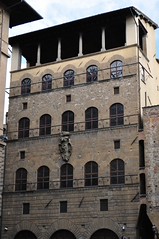
This is my third stay at the Hotel Davanzati, and yet somehow I’ve never visited the Palazzo Davanzati which is, quite literally, next door. I decide to go there first. With its lushly frescoed walls and wood beam ceilings, is a wonderful surprise. Yes, the hours are limited, which likely explains why I haven’t visited before, but the admission is cheap and the collection of furnishings, ceramics, and lace is magnificent—a time capsule, really, of Florentine life in the 15th and 16th centuries, at least for those families fortunate enough to be in the merchant class.

When I emerge an hour later, the pavement outside is still slick and wet as I turn from Via Porta Rossa onto Via Calimala. I walk past Piazza della Repubblica and its brightly colored carrousel and stop at Gilli to look at the window display. There’s an attractive selection of candy boxes in the shape of Florence’s cathedral dome, baptistery, and bell tower, but none that could survive uncrushed in my crowded suitcase at the moment.

My next destination is the Palazzo Medici Riccardi, where I’m going to see a famous cycle of frescoes by Benozzo Gozzoli in the “Chapel of the Magi.” It’s another loose end left over from a previous trip’s itinerary. It’s a small space with limited access, which leads to a line of visitors downstairs, but it’s well worth the wait. The colors are rich and vibrant, and the scene is breathtaking in its detail. Ostensibly, Gozzoli depicts the procession of the Three Kings on their way to Bethlehem, but in a nod to his patron, the work is set in a rich Tuscan landscape, filled with wildlife and crowded with the faces of Florentine noblemen in their finest clothes. Some even believe that Casper, the youngest of the kings, is a portrait of Lorenzo de’ Medici, who would later become a patron of the arts in his own right to luminaries such as Leonardo da Vinci, Sandro Botticelli, Domenico Ghirlandaio, and Michelangelo Buonarroti.

After two museums in a row, I’m ready to go shopping, I stroll through the San Lorenzo street market, but see little to tempt me. When I can’t find anything I like at Peruzzi, either, I decide to try the venerable Scuola del Cuoio, a leather school in the friary at Santa Croce.

I haven’t been inside of the basilica itself since my first trip to Florence in 2008, when the entire apse was filled by a skyscraper of scaffolding. Surely, the work must have been completed since, so I decide to make a return visit along the way. Except that it hasn’t been completed, not even close. I think about the number of years it took to restore the campanile in Venice, or Bernini’s “Fountain of the Four Rivers” in Piazza Navona in Rome, and recall my conversation with Tommaso about Italian politics and how hard it is to get anything done in Italy.

The wallets at the leather school are simple and beautiful, just what I had in mind. I pick out a bifold in lambskin for my Dad in a deep chocolate brown, and I’m surprised at the register when the clerk tells me they would be happy to monogram it for him free of charge. She sends me back to a row of ancient looking worktables where I meet a cheerful young man who places the letters I need in a branding iron and holds it over a flame, before pressing it vigorously into a piece of gold leaf on the inside of the wallet. It’s the perfect gift and I can’t thank him enough.

By the time I leave, the sun has brightened considerably and the late afternoon temperature is rising. I decide to stop by the hotel for Happy Hour and to drop off my bag from the Scuola del Cuoio. Afterwards, I grab a light dinner at La Bussola and then take a slow walk up to the Duomo and back, stopping to watch an artist create a copy of Vermeer’s “Girl with a Pearl Earring” in chalk on the street.

Florence, ItalyI’m standing on the Ponte Santa Trinita when the street lamps turn on at half past nine. There’s a musician with an accordion nearby playing a medley of “Somewhere over the Rainbow” and “It’s a Wonderful World.” As I listen, I watch the color drain from the sky over the Ponte Vecchio, as if consumed by the fiery orange of the sunset dying behind me.

I’m thinking about how much I love Italy, and how glad I am to have come back to Florence, in particular. This place really is quite something.

Wednesday, June 4, 2008

The sky outside is feigning blue this morning. I want to be optimistic, I really do, but the weather report is ominous, and for that reason I mistrust my eyes. Nervous about the order of my itinerary, which today was to include a day trip to Pisa and Lucca, I decide after breakfast that it’s time to appeal to a higher power. I must ask Fabrizio.

Behind the elegant painted desk in the lobby of the Hotel Davanzati lies command central. While Fabrizio multitasks by checking a series of Italian websites on one computer screen, I wait and amuse myself by staring at the other. It’s displaying a picture of this very room. I can see the same striped drapes and Oriental rug. There is only one difference between this virtual world and the real one (aside from the perpetual threat of rain in the latter). On screen, Scooby Doo is dancing!

Chuckling, I look up in time to see Fabrizio’s face as he scans the other monitor, and it betrays a slight grimace. “Ahhh… let’s not look at that,” he says. It must be bad. Although the forecast shows no sign of improvement, my day trip can wait until tomorrow. With plenty of museums to explore here in Florence, it might as well.

The first stop on my amended route is the San Marco monastery. It is here in the 15th century that a Dominican friar known as Fra Angelico created small devotional frescoes on the otherwise stark dormitory walls, depicting scenes from the life of Jesus Christ. His most famous work, “The Annunciation,” shows a seated and demure Mary greeted by the angel Gabriel, revealing to her that she will give birth to the Son of God. This is the image at the top of the stairs, and I am able to capture it at a distance before I see the now familiar “No Photography” signs on the landing. Back goes the camera into the bag…

Up close, the scene is even more charming. Gabriel’s wings are bold in color and look as though they were constructed from the plucked feathers of a peacock. Mary’s hands are crossed at the waist as if to feel for signs of life within.

For the next hour, I follow a serpentine pattern into and out of each cell, leaving only when the rowdy passengers from a tour bus disturb the silence.

I follow Via Cavour down to San Lorenzo and roam the street market, looking for bargains on leather goods, and then drift through the Mercato Centrale to admire the produce. The Medici Chapels are here in the square, too, and I am eager to see the interior of the octagonal dome I spotted from the top of Giotto’s belltower on my first day in Florence. Alas, with a jungle of scaffolding reaching from floor to ceiling, the “Chapel of the Princes” is reminiscent of Santa Croce, but far worse since it’s stuffed into a much smaller space. The “New Sacristy,” with its sculptures by Michelangelo, is the only saving grace, enough at least to defend the cost of admission.

As the lunch hour passes, I again take stock of the weather. The sky is blue and seems determined to remain so, but I’m still not convinced. I make a return visit to “Caffé le Logge” for a sandwich and chocolate tart and eat both while walking across the Ponte Vecchio to the south bank of the Arno. I desperately want to see the city skyline from Piazzale Michelangelo and hiking there in the rain just won’t do. I decide to seize the opportunity now, before the next storm hits.

It never does. Against all odds, the day stays clear and bright, with a pleasing canopy of cumulous clouds.

I enjoy the walk along the river, but as I turn to the right and head uphill, my legs begin to burn. By the time I reach the long, steep steps that lead to square, I have to stop more than once to catch my breath.

Still, the view from the top is stunning. From a distance, the architectural details of the city melt into harmonious shades red and yellow. Like the brush strokes in an impressionist painting, the impact from afar is greater than the sum of its parts.

With the storage card on my camera much fuller than when I arrived, I lumber back down the hill in the direction of the Palazzo Pitti. Along the way, here is what I ponder:

Itineraries can be a wonderful thing, as long as they are flexible enough to allow for spontaneity. Deciding to spend the day in Florence was spontaneous, born perhaps of a perceived necessity, but it was spontaneous nevertheless. Of course, the trouble with spontaneity is that it can lead someone to do silly things.

Take this afternoon, for instance. I made a decision to visit Piazzale Michelangelo in the early afternoon to avoid rain that never came. But now I want to attend vespers at San Miniato al Monte, where the local monks sing in Gregorian chant. That has created an awkward a space of time between 2:30 and 5:30 PM. A quick look at the map suggests that my best option for filling that time is the Palazzo Pitti and the adjoining Boboli Gardens. The map, however, represents a flat, two-dimensional space. I am standing on a hill — a very large hill — and marching down it now will necessitate another climb back to the same place later. Quite dumb when you think about it, but apparently I have neither patience nor foresight.

By the time I reach the grounds of the Palazzo Pitti, I am understandably tired. I decide to see the royal apartments and then lounge in the garden for a nice, long while. But as it turns out, I can’t buy a ticket for the royal apartments alone, or for the garden alone, or for that matter, for the two of them in combination. The powers that be have decided to bundle the admission of each with a distinct array of small museums that I have no interest in or time to see. This seems to be a different, and less advantageous, arrangement than the one described in my guidebook, but there is nothing much to be done. I opt to pay ten Euros for a ticket that gives me admission to the Boboli and Bardini Gardens, as well as a costume gallery and porcelain museum.

Once I am past the ticket booth, the security desk, and a second ticket taker, I am let loose onto the grounds at last. I don’t, however, know where to go. As in most museums in Italy, the price of admission does not include a map or floor plan. And as it turns out, the garden is nestled into the same hilly landscape I just finished climbing to the east. This makes it impossible to see what’s at the top of a hill without actually going there. Random wandering seems to be the only option.

For the next hour, I give this my best shot on tired legs. I am hoping to find a beautiful flower bed or a lovely fountain with a bench nearby. But the use of the word “garden” in this context seems ill-applied. From what I can see, it appears to be a forest on a hill, much of it in a natural (read: unkempt) state. The Medici may have been great patrons of the arts. It seems they were not, however, patrons of flowers. I recall seeing a postcard for sale in the gift shop by the entrance showing a single pink rose. Now I feel like demanding its location.

There are three things of value to a tourist – time, energy, and money. To me on this particular afternoon, the Boboli Gardens offend all three. My frustration ebbs away only when I stop for a pair of pastries at the Open Bar Café on Via de’ Bardi. Oh, why is it that food is such solace for the soul?

At least after today’s marathon, I don’t have to worry about the calories.

I arrive at San Miniato al Monte with enough time to tour the church thoroughly before vespers. It’s a beautiful space, well lit by the afternoon light streaming in through the small elliptical windows set high into the walls of the nave. The service, however, is being readied in a more austere crypt below.

By the time I note the placement, most of the seats are already filled by teenagers, chatting loudly amongst themselves. Several are bent over on the floor collating sheet music. For a moment, I am puzzled, but then as I watch an adult gesticulate to one of the Benedictine monks, I decide that they must be an impromptu choir, intent on singing, but uninvited all the same.

The monk seems to have agreed to something, but seeing their bags cast widely across the benches, he directs them to move their things into the corner. They do, and then file into line in front of the altar. They sing one song, which isn’t terrible, but then push their luck by reforming for another. At this point they are cut off by a tremendous baritone from behind, soon joined by others in the collective intonation of Gregorian Chant. Looking rather peeved, the teenagers gather their bags and stomp off, not bothering to stay for the actual service.

Many people don’t, actually. Aside from a handful of Florentines for whom this is the local parish church, tourists seem to come and go, treating it with less respect than a typical concert or theater event. By the time we make the sign of peace, I am the only stranger left and those around me greet me warmly in Italian and shake my hand.

The tourists who left early, including those impertinent teenagers, have been rude and disrespectful, which is crime enough. But in their haste they have also missed out on something special. In the gentle texture and rhythm of the chant, in the community of neighbors, and the deep connection to the traditions of the past, there is serenity. Fleeting, perhaps, but easy to miss in the rush of modern life, even for those on holiday who spend too much time obsessing about how much money it costs to wander through a garden.

For me, it lasts long through the sunset I watch from the terrace of Piazzale Michelangelo, back down the hill, along the river, and across the bridge where Claudio is singing tonight. All the way back to the hotel in the dark.