Thursday, May 29, 2008

I blink at my wristwatch and can’t quite believe it. Against all odds, my flight is going to arrive into Fiumicino on time at 8:45 AM. This is a surprise given (in my experience) the general and combined incompetence of Philadelphia International Airport and U.S. Airways.

Gratified, but tired nevertheless, I stumble with the rest of the passengers through passport control and then baggage claim before meeting a driver from Rome Cabs, which I pre-booked online some weeks ago. He’s holding a sign with my surname, but it’s preceded by the title “Mr.” instead of “Ms.” My brain is still wakening, so that’s close enough for me. The driver, however, seems genuinely pleased by the slight misunderstanding. He introduces himself as Maurizio and he is a credit to the reputation of Italian men everywhere, charming and flirtatious.

Our immediate departure is complicated by my desire to do two things before I leave the airport: buy a Roma Pass and extract Euros from an ATM machine. The first is a matter of convenience, the second of necessity. After all, Maurizio has to be paid. He is, however, remarkably unconcerned about this as he carries my suitcase happily through the international arrivals hall in Terminal C.

We discover that the kiosk that sells the Roma Pass is not yet open for the day, and that the Bancomat across the aisle is likewise out of service. So far, we’re batting zero for two, but Maurizio assures me that I’ll be able to buy a Roma Pass along the Via del Corso easily enough and that there are plenty of cash machines in the city. Not to worry.

He talks and tells me stories all the way from the airport to my hotel near Piazza Venezia. The journey takes longer than I expected and, in fact, becomes something of a private guided tour. I have never been to Rome before and he tells me that she is two different cities—one by day, the other by night. I ask him to explain, and when he does, I see his eyes brighten, framed in the rear view mirror. “Rome by night,” he says, “is magic.”

Somewhere between our stops at cash machines two and three (two simply spit my card out without explanation), Maurizio and a swerving Vespa nearly collide. The guy on the Vespa has some anger management issues and pounds on the hood of the car. Heated words are exchanged, as are gestures that transcend any language barrier. Maurizio assures me that everything is fine and continues to talk pleasantly to me in English as if this kind of thing happens all the time.

When at last he carries my bag into the lobby of the Hotel Hosianum Palace on Via dei Polacchi, he slips me his card. He wonders if I might meet him for dinner the following night. I am flattered, perhaps because I know how frightful I look after an overnight flight, or maybe it’s because I am going to mark a milestone birthday later this summer and Maurizio thinks I look young. Nevertheless, I decline and hope afterwards that I have done it gracefully. My time in Rome will be short and there is so much to see.

I recognize two passengers from my flight, waiting to check in. They introduce themselves as Ann and Mel from Denver and we chat pleasantly for a few minutes while our rooms are assigned. Our itineraries sound much the same, so I wonder if I’ll stumble into them again somewhere in the tourist crowds.

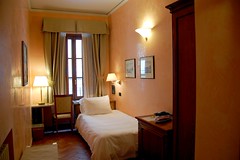
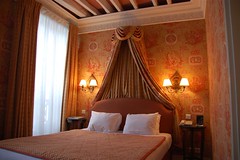
When I open the door to my room on the third floor, what I find is small and irregularly shaped, but beautifully appointed and utterly cozy. There is a twin size bed covered in a gold damask spread, a nightstand with minibar, a desk on which rests a flat-panel TV, and a wardrobe for hanging clothes with an electronic safe below. The ceiling is high, framed by an ornate crown molding. A single shuttered window opens onto a view of the narrow street below. Bellissimo!

By now, it’s lunch time and the gray sky outside is spitting rain. I buy a Roma Pass at the tourist information booth on Via del Corso, but given the weather opt for a change of plans and head not to the Colosseum and Roman Forum, but to the shelter of the Capitoline Museum instead. Getting there proves to be a battle of epic proportions. In zig zagging across the streets that merge into Piazza Venezia, I suddenly feel like I’m in a real life version of the old arcade game, “Frogger.” No one brakes for pedestrians, and the traffic signals seem little more than advisory. I stand there stupidly for a while, but when an Italian woman in business attire approaches the curb next to me and steps off without a moment’s hesitation, I leap forward to her right, using her as a shield between my own body and the steel of oncoming traffic. She is Moses parting the Red Sea. The traffic does not come to a complete standstill, but it folds itself neatly around us as we walk. It’s a brilliant move, but one that should come with a disclaimer that reads: “Warning! Tourists crossing street must be accompanied by a citizen of Rome.”

Once I am safely delivered to the steps of the Victor Emmanuel II monument, I circle around it and climb Michelangelo’s long, sloping steps to the Piazza del Campidoglio. I devour a tomato and mozzarella panini at the museum café under a canopy on the terrace, and enjoy my first sustained view of the city. Afterwards, the museum itself is an unexpected delight. I pop in the earbuds to my iPod Nano and use the audioguide I downloaded in advance from the museum’s website to navigate from one room to the next. I see Romulus, Remus and the She-Wolf, the famous bronze statue of Marcus Aurelius on horseback, and various disassembled parts from the colossal statue of the Emperor Constantine that once stood by the Colosseum—a disembodied head, a foot, and a hand with the index finger pointing up, like one of those giant foam mitts you see at football games. I can just imagine ancient spectators chanting “We will, we will, rock you…” while watching gladiators and beasts engage in mortal combat.

It’s still raining when I leave the museum, but it does nothing to dampen my mood. I am falling in love with Rome already. I walk past the Colosseum, trying to visualize where Constantine once stood in narcissistic glory, then down Via San Giovanni in Laterano to the Basilica of San Clemente. It’s a perfectly lovely 12th century church, with a beautiful apse mosaic, but the layers of history underneath are even better—a 4th century Christian church with remnants of its original frescoes, and deeper still, the remains of a 1st century Pagan temple.

From there I wander slowly uphill to San Pietro in Vincoli. Here in a reliquary under the altar are the iron chains that bound St. Peter when he was imprisoned in Jerusalem. To the right is a monument to Julius II, the warrior pope who diverted Michelangelo from work on a more grandiose tomb to paint the Sistine Chapel. Due to declining funds and the pope’s own faltering reputation, the original plans were never fulfilled following his death in 1513, but Michelangelo’s statue of “Moses,” seated at the center, survives.

By now it’s late afternoon and the sky has cleared. On my way back to the hotel to rest up and change for dinner, I pause to watch a group of firemen rappel down the face of the Colosseum. It seems like a daring move. Someone in the crowd says that they are practicing for the big “Republic Day” parade, where they’ll unfurl a giant Italian flag. I wish I could be there to see it, but I have a reserved seat on a train to Florence first thing Monday morning.

For my first night in Rome, I settle on “La Polarolla” for dinner, near Campo de’ Fiori. It’s 8:00 PM when I arrive and with the time change and the local custom of eating late, I’m starved. But in my inaugural attempt at Italian dining I find myself drowning in food after just two courses. Antipasti, primi piatti, secondi piatti, contorno, dolci, caffé. How do they do it? The cannelloni is very good, as is the pollo porchettato (chicken with bacon and herbs), but I’m left with no room for gelato, which seems like a grave miscalculation.

After strolling around Campo de’ Fiori to walk off my dinner, I linger in Piazza Navona. Bernini’s “Fountain of the Four Rivers” is still under scaffolding, but in the darkness it hardly matters. With half flood lit, it’s still an impressive sight. I look around and see artists selling their wares and street vendors tossing glow stick rings high into the sky. Three tenors with guitars are singing a rousing rendition of “Funiculì, Funiculà” to the delight of diners at the “Caffé Dolce Vita.” The sweet life. That’s what la dolce vita means, and being here in Rome on this night, with the pulse of human existence all around me, I understand more than its literal translation into English.

Maurizio was right. Rome by night is magic.

Friday, May 30, 2008

This morning, I wake from a deep sleep to the persistent honk of my alarm clock. My muscles are stiff when I roll out of bed, but when I open the shutters overlooking Via dei Polacchi and crane my neck out the window, I see a promising blue sky, which renews my energy. On a morning such as this, it seems a shame to waste Euros on a taxi ride to Vatican City, and I’ve heard horror stories about the pickpockets on Bus 64. I have a 10:30 AM reservation for an official guided tour of the museums, but even after eating breakfast there is plenty of time to spare, so I decide to walk instead.

I turn left down Via delle Botteghe Oscure, stroll past a few ancient and incongruous pillars on the right, and run smack into a major Roman ruin. It’s Largo di Torre Argentina and it’s fascinating. The sunken square reminds me that the modern city of Rome has been elevated by layers of debris.

As I turn up Corso Vittorio Emanuele, I watch impatient Italians on motor bikes push through the streets as fast as the morning rush hour will allow. Shopkeepers are rolling up their doors. The sight of two little old ladies walking arm and arm makes me smile. Rome is a different city by day, but it’s wonderful just the same.

When eventually I reach St. Peter’s Square, turn right, and wind my away around the Vatican walls in search of the museum entrance, I begin to wonder where the infamous line is, the one people stand in for hours when they don’t have a timed reservation. I want to appear smug and self-satisfied with my computer printout in hand.

When I find the doors I realize that the line is no more than 40 or 50 people long. It barely wraps around the first bend in the wall. Nonconformist that I am, I’m tempted to join the queue and avoid the extra fee for the tour, but I don’t. I look for the line reserved for guided Vatican tours and show the guard my printed confirmation.

Once inside, I still have to go through security and pay for my ticket. But afterwards I am directed to a roped off reception area to wait with other visitors. We’re handed Whisper headsets so that we can hear the guide and a group of us are amused when she holds the microphone to her mouth and asks anyone who can’t hear to come up to the desk for assistance. After all, if you can’t hear her voice through the earphones, how are you supposed to follow her instructions?

In the end, it’s a good tour and lasts about two hours. We see courtyards, tapestries, and domes, even a room devoted exclusively to sculptures of animals. Our guide is knowledgeable and enthusiastic, but it’s easy to lose sight of her once we reach the more crowded rooms. I notice that the other tour guides around me are all holding silly objects in the air for their clients to follow: an umbrella, a paddle that looks like it came from a Sotheby’s auction, a large felt flower. We have nothing.

When we reach the map gallery, I think it’s so incredible, so captivating, that I linger a little too long taking pictures. At first, her voice cuts in and out as the signal fades. Then it disappears altogether. I have no choice but to follow the masses forward down what feels like a one way street. I know I’m getting close when I start to pick up bits of static and snatches of speech. It feels like I’m in a crowded swimming pool playing “Marco Polo.” Once inside the Raphael Rooms, I spot her at last, just as she starts to collect the headsets. She explains that we will visit the last room on our own. It’s time for the grand finale.

As everyone knows, there is a no photography rule in the Sistine Chapel. The reasons for this are muddled since photos are allowed everywhere else in the Vatican Museums. The explanations range from the perfectly understandable to the downright silly. On the understandable side, it is a place of worship and should be respected as such. Granted, a reasonable person might recall the story of Jesus and the money changers and decide that the souvenir shops scattered every ten feet throughout the museum threaten the sanctity of the place about as much as tourists snapping pictures, but I digress.

Somewhere in the middle of the spectrum is a desire to protect the frescoes from the damage caused by a million or more flash bulbs a year, and yet no one seems to be particularly concerned about that in the map gallery or the Raphael Rooms.

Then there is the stuff of urban legend — tales of the Japanese firm that paid to restore Michelangelo’s work in the 80s and 90s and how they cleverly acquired the copyright to the images along the way. As I follow the crowd toward the room, I overhear some tourists grumbling about how it’s all a conspiracy to get people to buy overpriced postcards and guidebooks in the gift shop afterwards.

Whatever the truth in that rumor, the sign over the entrance door is clear. Camera + red X = No pictures. I cannot in good conscience plead innocence to “The Rule” and so I slide the power switch on my Nikon D40 into the off position with a gentle click.

As soon as I enter the chapel, I find myself overwhelmed by two things: the crushing weight of the crowd and the breathtaking beauty of the ceiling. Actually, the first can’t even compare to the second in importance because everyone is looking up anyway. I feel the unnatural closeness of the strangers around me, but I do not see them. My eyes see nothing but Michelangelo’s narrative: Noah and the flood, the temptation of Adam and Eve and their expulsion from the Garden of Eden, God’s creation of Adam in the touch of two outstretched hands. Outside this place, in the pages of books, on coffee mugs, refrigerator magnets and computer mouse pads, the image is so familiar that it’s lost the power to impress. Here, I can feel the room pulse with energy.

After the initial sense of awe has subsided in my brain, I take in my surroundings and begin to realize that “The Rule” about photography is unenforced in the most spectacular fashion. I squeeze onto a bench along the wall and observe human nature as it takes its natural course.

There seem to be three main strategies employed. The first is a simple version of grab and run. One guy looks furtively around, snaps a quick picture under his arm, and moves nonchalantly away as if nothing happened. An old woman gets caught by a guard after taking her turn and tries to explain that she doesn’t speak Italian, and therefore didn’t know better. A teenager confidently points and shoots in utter disregard for the consequences. Sneak it, feign ignorance, or do as you darn well please. It’s simple, really.

Put it all together and the whole system works rather like a “Whack a Mole” game. The guards step in to stop one person from taking pictures, and three others use it as cover for taking their own.

The problem is that the penalty doesn’t seem too bad. There is no real disincentive. The guard who approached the old woman did not confiscate her camera, nor did he escort her to the door. He merely wagged his index finger back and forth saying “no, no, no” in the tone of voice you use to chastise a child who has done something that is in equal parts wrong and amusing.

This presents both a moral dilemma and a physical challenge. I feel swept away. Is this what people mean when they talk about the psychology of crowds? I can just see myself saying to the guard: “But you see, sir, everyone else in the room was doing it.” And he says: “What if everyone else in the room jumped off of the dome of St. Peter’s, would you do that, too”? At this particular moment, I think that I might.

I try to distract myself by listening to Rick Steves’ commentary on my iPod, but a sequence of thoughts begins to run through my head… My camera is still slung around my neck, but it’s getting heavy. It would feel good to rest it on my lap for a while as I sit. I wouldn’t want to rest it facing down, of course, because that might scratch the lens. Up would be better. But then it would be easy to bump the power switch with my hand, and if that happened I would be able to press the shutter, too. Accidentally, of course. These things happen. And how would I know, with the digital screen on the back of the camera hidden so completely from view?

Who am I kidding?

I do what needs to be done. As I leave, I look back over my shoulder at the “Last Judgment,” at Michelangelo’s depiction of the tormented, writhing bodies of the damned, and my moral compass kicks in at last. I am going to H-e-l-l. But at least I’ll have lots of company…

Mi dispiace.

After a quick lunch in the museum’s cafeteria, I head back around the walls to St. Peter’s Basilica, stopping only to look for “Pope-eners” in one of the souvenir shops along the way. When I see one, it’s actually a bit of a letdown. It’s a gold and silver bottle opener with Pope John Paul II’s likeness on one side and St. Peter’s on the other. It’s not as kitschy as I had hoped. It’s got a great name, though.

By now, it’s mid-afternoon and the security line at the basilica is short and efficient. I wonder at first if the sleeves on my blouse will be long enough to pass muster with the guards, but in comparing my own sartorial choices with those of my fellow travelers, I start to relax. Shorts, halter tops… don’t these people read the guidebooks? There is a strictly enforced dress code at St. Peter’s.

Yeah, and there’s a ban on photography in the Sistine Chapel.

Perhaps they both work the same way because a guy in front of me just got through with shorts on. His knobby white knees are totally exposed. I can’t decide whether he really doesn’t know about the dress code, or if he’s just playing it cool and hoping no one will notice. Eventually, they do. A guard comes scurrying up from behind, taps him on the shoulder, he shrugs and away they go.

Inside, St. Peter’s basilica is meant to be an impressive site, and it is. It’s dimensions are mammoth, self-consciously so as it turns out, because as I listen to another Rick Steves podcast he points out the Latin inscriptions on the floor that mark where other churches would fall if they were placed inside of St. Peter’s: St. Paul’s in London, the Duomo in Florence, St. Mark’s in Venice. It’s an amusing image, to think of the great cathedrals of the world as a giant set of Russian nesting dolls.

I enjoy seeing art in museums, well lit and perfectly placed at the optimal viewing angle. But it’s so much better to see it in situ, where it belongs, its context intact. Here, there is Michelangelo’s first Pietà and Bernini’s Gloria window made of transparent sheets of alabaster, not to mention a stunning array of mosaics so detailed they appear from the floor to be painted in oil.

I visit the crypt next to see the tomb of Pope John Paul II, then make my way back outside to join the line to the dome. I have a choice to make… Climb the whole thing, or pay two Euros more to take an elevator half way. I can’t get the extra coin out of my wallet fast enough!

Even with the elevator, it’s a challenging climb. As the dome slants in, so too does the head room available on the stairs. It’s a tight and awkward squeeze, but the view from the top is fantastic. My eyes fix on St. Peter’s Square and then trace Via della Conciliazione all the way to Castel Sant’Angelo, across the bridge with the angels all the way east to the Victor Emmanuel monument at Piazza Venezia, which looks like an oversized wedding cake. To the right of that, I spy the Colesseum.

After my descent, I limp into a shop nearby and reward myself on a job well done with a heaping dish of gelato: pistacchio and crema.

By now it’s 5:00 PM, but there is still plenty of time before dinner, and with the gelato holding my hunger at bay, I decide to visit the interior of Castel Sant’Angelo. It’s a long, slow climb up a dark interior ramp, but when I reach the terrace on top I can see the full length of the bridge, a bend in the river Tiber, and to the west, the dome of St. Peter’s. When I rest my hands on the windowsill to lean out, my fingers fall into the deep grooves of graffiti carved into stone. I wonder who BOTTESINIE was and what he thought about as he stood here. How long ago? One hundred years? Two hundred?

By the time I realize I left my beautiful tri-fold, laminated map of Rome somewhere in the castle, I’m already back on the bridge. The logic centers of my brain know that it might be possible to retrace my steps, to find and reclaim my map, but my legs plead for mercy. There is, after all, the long steady incline both up to and back from the terrace to consider. I decide to wing it instead. Tomorrow, I can always pick up one of the free paper maps they offer at hotels, but for now there is the immediate problem of dinner.

Weeks ago, it had seemed like a pleasant task to pick out restaurants from guidebooks and online discussion boards. Someone on Trip Advisor recommended “La Pollarolla” and that worked out well the first night. For this particular evening, I had highlighted a pizzeria called “San Marco.” I had even circled its location on my map with a marker. Now that I’m here, there is no map, no circle, no way of knowing where Via Tacito is.

I wander for a bit around Piazza Adriana and then stroll back over the Ponte Sant’Angelo as I formulate a game plan. It is only my second day in Rome, but already my determination to eat consistently good, authentic Roman fare is giving way to the reality of hunger and exhaustion. I decide to go for something — anything — close by.

Desperation brings me to “Antico Caffé di Marte” on Via Banco di San Spirito. When I see the large poster by the door showing pictures of the various dishes they serve, I know I’m in trouble. It’s a tourist trap with a capital “T.” I figure that as long as I’m here I might as well go all the way and order a Coca Cola Lite… with ice. I remind myself that I’m going to hell for taking that picture in the Sistine Chapel, anyway. How much further can I slide?

Ultimately, the pizza margherita isn’t very good. In fact, it’s dry as a bone, but the insalata caprese is fine, made with nice, fresh ingredients. By the time I finish, it’s approaching nine o’clock and I feel energized again and ready to position myself for some night shots.

An hour later, I’m satisfied that the pictures I’ve taken of Castel Sant’Angelo and St. Peter’s Basilica have turned out well. Both buildings are beautifully floodlit and after the sun set the sky had deepened into a rich cobalt blue. I decide to head back to the hotel, but because of the descending darkness and the fact that I still don’t have a map, I opt for the safety of a taxi instead. Although, as it turns out, safety is a relative thing.

I walk to the taxi stand in front of St. Peter’s. The driver at the front of the line doesn’t speak any English, and Via dei Polacchi is a tiny little street, so it takes some time for us to reach a mutual understanding of my destination. Once we do, the car is off like a dart down Corso Vittorio Emanuele. The guy is like Mario Andretti at the Indy 500. I peer over the front seat and see that we’re going 100 kilometers per hour. I figure that’s about 60 miles per hour. Pretty fast for the center of town. The best part comes when Mario beeps his horn preemptively at all of the intersections, just in case someone is foolhardy enough to try to cross in front of him. When we arrive outside my hotel minutes later, he gestures triumphantly up at the sign and says “Via dei Polacchi!”

Indeed.

Saturday, May 31, 2008

It’s another glorious morning in Rome and this one begins with a sumptuous breakfast on the rooftop terrace of the Hotel Hosianum Palace, included in my room rate. With the dollar as weak as it is, I feast long and well on eggs and bacon, cornetto and cappuccino.

It’s 9:30 AM by the time I reach the Roman Forum, a site I deferred on Thursday due to rain. Rick Steves is my companion again as I enter from Via dei Fori Imperiali with my Roma Pass and iPod in hand. At this hour, the air is cool and breezy and my walk through the ruins of ancient Rome, from the Arch of Titus to the Temple of Saturn, up the Palantine Hill and back, is as pleasant as pleasant can be. As I stand staring at the spot on which Julius Caesar’s body was cremated following his assassination, something deep in the corner of my brain stirs. “Friends, Roman, countrymen, lend me your ears. I come to bury Caesar, not to praise him.” Eleventh grade English, ingrained after all these years. The bard and Mr. Yerger would be proud.

I have to navigate through a pressing crowd and a persistent band of Gladiators next to reach the Colosseum. Do I want a bella foto with them, they ask? No, not really. Not for what they charge.

The line for pass holders is comparatively short and within ten minutes time I’m standing on the upper level of the arena looking down. It’s mammoth in size, but familiar in shape and structure. It’s like any modern sports complex, but without the product placement. When I see Ann and Mel there, too, we’re surprised yet again by the chance encounter and use the occasion to snap pictures for one another.

From here, I take a long, slow walk north through the historic center of Rome. I have a 3:00 PM reservation at the Borghese Gallery, but figure I have plenty of time to get there. I stop to wonder at the Pantheon and its giant oculus, break for gelato in Piazza Colonna, then move on to the Spanish Steps, where I’m disappointed to see that scaffolding still surrounds the obelisk at the top. It’s a stark column of gray steel, like a miniature skyscraper, obscuring the façade of the church of Trinità dei Monti.

It’s from the top of the Spanish Steps that I first notice a problem. On many levels, the free paper map in my hand is a poor substitute for the laminated, tri-fold, beauty I lost at Castel Sant’Angelo. In particular, I see now that it fails to mark the location of the Borghese Gallery. Either the museum is beyond the northern border of the map, or it’s hidden behind an ill-placed advertisement for the Castel Romano designer outlet mall!  I don’t know which. Remembering that the gallery is located in the Villa Borghese, I follow the first sign for that I see, which leads me left. As it turns out, this is a mistake. A big, honking mistake.

Once in the lush surroundings of the park, I ask a couple sitting on a park bench for directions. They point me down a long gravel path, past a playground and a carousel. From there, I spot a sign pointing towards the Galleria Borghese, which I follow in premature elation. I spy another sign that takes me in another direction, then another, and another. By the time I reach my destination at last, I’m cranky, exhausted, and very nearly late. By brain tells me that I’ve walked about three miles from the Colosseum, but to my aching body it feels more like twenty.

Walk there. What a dumb idea.

The staff at the Borghese Gallery understand human nature well. They must be determined to avoid the scene at the Sistine Chapel, because they make visitors check their bags and cameras at the door. What’s left of my belongings—my wallet and the storage card from my Nikon D40 for safe keeping—are placed in a clear plastic bag for all to see. They also insist on a reserved time slot that lasts no more than two hours. No crushing crowds here.

I rent an audioguide and join the queue outside, along with a boisterous group of young nuns. As we filter through the rooms, I have a hard time shaking them and their behavior is becoming more and more distracting. I’m trying to appreciate Canova’s neoclassical masterpiece of Paolina Borghese as Venus Victrix, but one of the nuns decides to jump up on an empty pedestal, sit there, and swing her feet. When our eyes make contact, she quickly hops down and looks away, but laughs just the same. A few minutes later, I see a baseball cap hanging from the outstretched hand of another sculpture. And, of course, there are the nuns, giggling harder than ever. I’m tempted to report them to security, but when I enter the room with Bernini’s “Apollo and Daphne,” I’m struck dumb. It’s stunning, more delicate and expressive than anything I saw at the Louvre last year. It looks like it was molded out of wax instead of marble, as if it would be soft and hot to the touch. I wouldn’t dare, of course, but I bet I could get one of the nuns to do it for me!

About halfway through the Correggio exhibit, my energy gives out at last and I decide to call it a day. I’m relieved to find a taxi nearby and ride it all the way back to my hotel, where I take a nice, long nap in my air conditioned room.

By dinner time, I feel somewhat revived. Determined to stay close to home, I turn right out of the hotel lobby instead of left. Left is the direction that brings me within yards of Piazza Venezia; right takes me to a whole other world. These are the charming streets and alleyways that border and then sink slowly into the heart of the Jewish Ghetto. There, just around the corner from my hotel, I stop to eat at “La Taverna degli Amici.” I order a house specialty, fiori di zucca (fried zucchini flowers stuffed with ricotta), followed by bombolotti with cheese and bacon. I feel a long way away from that tourist trap near the Ponte Sant’Angelo. This is how I imagine Roman food should taste, with fresh, seasonal ingredients, simply prepared.

Afterwards, still enjoying the night, I follow a steady stream of people towards the Trevi Fountain, which in reality is a massive wall of marble fronted by a pool of aqua blue. I stand with my back to the water, facing the masses, and toss a coin over my shoulder, then several more. Whether it be the stuff of legend or Hollywood movies, I’m not taking any chances. I want to ensure a return visit to Rome someday. Soon.

As I head back to the hotel, I take a slow and circuitous route that allows me to pause in front of the Pantheon one last time. There is a young man performing in front of an appreciative crowd. He trades off between violin and voice, moving from what sounds like the “Flight of the Bumblebee” to a stirring rendition of “O Sole Mio,” and finally “Che Sera.” With deliberate disregard for the exchange rate, I reward him gladly and well.

This is magic, after all.

Sunday, June 1, 2008

When I wake up this morning, I’m conscious of the fact that it’s my final day in Rome. I’ve planned a side trip out along the Appian Way and getting there requires a ride on the Archeobus, which departs from Termini Station. There is no way I’m walking this time, so I buck up my courage and plunge into the Rome metro system instead. Until now, I haven’t used the transportation portion of my Roma Pass. I’ve heard too many horror stories about scam artists, pickpockets, roving gypsies, and graffiti. The London tube? Perfectly delightful. The metro in Paris? Piece of cake. But Rome? Perhaps it’s all in my head, but it seems unsafe and intimidating.

I walk to the Colosseo stop, validate my pass, and wait for a Line B train to Termini Station. When it arrives I almost laugh aloud. It’s so encrusted with graffiti that the passengers can barely see out the windows. I can honestly say that Rome has exceeded my expectations in so many ways! It’s not just graffiti, but graffiti on steroids, some of it quite interesting and nearly beautiful.

The journey itself is uneventful, over in minutes.

Outside the station in Piazza dei Cinquecento, I exchange my computer confirmation for a boarding pass and begin to wait. When it comes, the Archeobus is a strange lime green creation, like a bus with the roof gently scooped off, open-top but single deck. On board, it’s the usual stuff — a pair of low quality, brightly colored ear phones, monotonous commentary in the language of your choice, and a connection so marred by static that you can only hear every other word anyway. Convenience is what this is all about. I want to see the Catacombs of San Callisto and the official directions are daunting, involving the metro and two bus lines. The Archeobus delivers me directly to the door.

I’m able to catch a tour in English as soon as I arrive, and soon I’m enthralled by the guide, who happens to be a Catholic priest and a control freak. Father Rocco likes to position people just so, and is prone to giving elaborate instructions on who should move where to maximize space and visibility. We are both teachers, he and I, and I like this about him.

As we move from an outdoor pavilion into the tunnels underground, I see that he’s donning a heavy, quilted jacket — a parka, really. This seems to worry others, too. How cold is it in there? As it turns out, not cold at all. At least to me. I think it’s hot outside. It’s cool and refreshing down under, but then again I’m from Vermont, where much of the year I aspire to any temperature above freezing.

In the end, it’s an exceptional tour, the best I’ve been on since verger Ian’s at Westminster Abbey in the summer of ‘06. Father Rocco makes it so. He’s brilliant and I’m disappointed when he cites a study that shows that people only remember 10% of what they learn from guides. I’d like to absorb it all. History and religion is a fascinating mix.

When I leave San Callisto, I pick up the first Archeobus I see along the Appian Way. It’s only after I board that I realize it’s heading in the wrong direction, back to Rome instead of further along the route towards the aqueducts. Que sera, sera. I decide to stay put and use the extra time to see some other sites on my list.

I hop off at Santa Maria in Cosmedin, near the Circus Maximus, and snap a quick picture of “La Bocca della Verità,” or Mouth of Truth. It’s a carved stone face that was featured in the 1953 movie Roman Holiday with Gregory Peck and Audrey Hepburn. Legend has it that it bites off the hands of liars. Still in willful denial about that picture in the Sistine Chapel, I decide not to press my luck by inserting my own.

From there, my free paper map shows me that I’m not far from Piazza Cavalieri di Malta, where my guidebook says there is a “secret keyhole” in a door that reveals a charming view of St. Peter’s. This is off-the-beaten path stuff and I decide to make it my mission to find it. When I do, I realize with some amusement that it’s darn near the center of the beaten path! There’s a small crowd queuing in front of a worn green door. The line never seems to shorten because everyone presses their camera lens to the keyhole, and everyone frowns at the screen afterwards in disappointment before making their way to the back of the line to try again. I decide to call it good enough on my second attempt. It’s a tough shot that requires manual focus, a steady hand, and a strong zoom. I think I managed two out of the three.

So far, it’s been an interesting and eclectic day, so I decide to continue on the same theme. I sit for a while in a charming park on the Aventine Hill at Viale Nino Manfredi. Then I walk back to Piazza Venezia and on a lark decide to take the elevator to the top of the Victor Emmanuel monument to enjoy the view. I stop for a late lunch of gnocchi pomodoro at “Vecchia Roma,” and head back to the hotel for what has become my traditional afternoon siesta.

By early evening I’m back out on the street again, this time walking across the Ponte Garibaldi. At a souvenir stand just over the Tiber, I spot a row of boxer shorts sporting vertical stripes of red, white, and green to match the Italian flag. In the center, portions (um) of Michelangelo’s “David” have been cleverly inserted. It’s funnier even than the Pope-ener.

I’ve arrived in Trastevere. Several years ago I heard a “soundseeing” tour of this largely residential neighborhood, recorded on a vibrant Sunday morning by a Dutch priest, Father Roderick Vonhögen. From the sound of church bells ringing at Santa Maria in Trastevere to his description of the smell of fresh baked bread, I was transfixed. Now, I am here to see it with my own eyes.

It is… well, underwhelming. The architecture is impressive, but for the first time I am appalled by the amount of graffiti that I see.

The basilica, however, is lovely. It is one of the oldest parish churches in Rome, and some believe it is the first church in the world where Catholic mass was celebrated openly. I stop on the portico to stare at fragments of carved marble embedded into the walls, taken from various tombs in ancient Rome. On the inside, there is another stunning mosaic in the apse, but my favorite is a statue in the rear of the church of St. Anthony of Padua, shown holding the child Jesus. Into his arms and at his feet, parishioners have tucked hundreds of prayers, written on folded scraps of paper. If St. Peter’s is a testament to the wealth and prestige of the Catholic Church, this is proof of its relevance in the everyday lives of the faithful.

For dinner, I head back over the Tiber to a pizzeria called “Gino ai Funari.” The waiter is an elderly man with boundless energy and a personality to match. When, halfway through, I add an insalada mista to my order, he curtseys and winks. When I decline dessert he gives me a wave of his pinky finger, paired with a hearty laugh. The place is slowly filling with Americans. I know this because I can hear them ordering their cans of Coca Cola Lite. I’m beginning to think that Gino is nipping our collective share of the vino.

My final task in Rome is to take the perfect picture of the Colosseum, illuminated at night. I’m later than I’d like and trying to move quickly down the sidewalks that line the Via dei Fori Imperiali is not easy. The grandstands placed there for Monday’s parade have created a huge bottleneck. As I listen to one couple talk, strolling two abreast, hand-in-hand, I come to the realization that while Italians drive fast, they walk very, v-e-r-y slowly. I’d like to ponder that contradiction, but for now I’m chasing the light.

In the end, all is well. I snap away happily until the last trace of blue leaves the sky. I have done all that I had hoped to do in Rome, and enjoyed it immensely. Veni, vidi, vici. I came, I saw, I conquered.

And now it is time to sleep.

Monday, June 2, 2008

I’m up early for one last breakfast on the rooftop terrace. Of my hotel’s many fine qualities, I think I like this private garden best of all. Good food, beautiful flowers, and a glorious view. What better way to start the day? But on this morning, the gray sky and light drizzle overhead seem to match my mood. I’m excited to get to Florence, but sad to be leaving Rome behind.

With luggage in hand, I take another wild taxi ride, this time to Termini station where I have a reserved seat on a 9:00 AM Eurostar train. It’s Republic Day in Italy and the streets at this hour are largely devoid of their normal rush hour traffic. It gives my driver all the more room to careen around corners at breakneck speed, as he navigates a detour away from the day’s parade route. By the time I arrive, well before departure, I feel dizzy and a little seasick.

I keep a vise-like grip on my bags until the train has left the station, then I sink back into the seat and allow the gentle rocking of the cars to soothe my head until we arrive at Santa Maria Novella on time an hour and forty minutes later.

After another short taxi ride, I’m standing on the curb at the foot of a flight of stairs that leads to a small elevator which spills out into the lobby of the Hotel Davanzati — a necessity that is far less troublesome than it sounds. In my best faltering Italian, I ask the man at the front desk if he speaks English. “No, no,” he says, shaking his head impatiently. I panic. Then his face breaks into a wide and generous grin. “Just kidding!”

This is Fabrizio and this is the moment I know beyond all doubt that I am going to love this place.

Fabrizio shows me to my room, a charming single with a view overlooking Via Porta Rossa. Afterwards, he hands me my reservations for the Uffizi Gallery and the Accademia, walks me through a map highlighting all of the major attractions, circles the location of the best gelateria in town — bless his heart — and invites me to a complimentary happy hour, complete with candlelight and prosecco. Now that’s what I call service!

It’s raining steadily by now and I don’t feel much like trudging out into the wet. For an hour or so I curl up in my room and use the laptop provided to post some pictures on Flickr for friends and family back home. I’m feeling nostalgic already.

Since the Capitoline Museum had been my refuge from the weather in Rome, I decide to use the Museo dell’Opera for the same purpose here in Florence. I see some very cool wooden models for the façade of the Duomo, an unfinished Michelangelo Pietà, nearly swallowed up by an inconvenient crowd of French tourists, and finally, Ghiberti’s original bronze panels for the baptistery doors.

Having seen the genuine article, I next walk out to admire the copies that stand in their place in Piazza del Duomo. Michelangelo once called them the “Gates of Paradise,” so impressed was he in their use of linear perspective. However, when I enter the interior of the octagonal structure and my eyes feast on the lush mosaic ceiling, I don’t at first notice a benevolent Jesus with arms outstretched, or the choir of angels overhead. Instead, I fixate on a disturbing image of Satan munching on the naked torso of an unrepentant sinner. Others are meeting an equally unpleasant fate in the jaws of snakes, lizards, and giant beetles. This is, unmistakably, another variation on the punishment of the damned at “The Last Judgment.” It’s a surreal and frightening image, one that might look at home next to a painting by Salvador Dalí or Max Ernst. Remembering that ill-gotten picture of the Sistine Chapel, I cringe.

Satan and his minions notwithstanding, this is an incredible space. By now, it’s mid afternoon. The clouds are starting to break and rays of slanted sunshine are streaming through the room’s narrow windows. When the glass tiles on the ceiling capture the transient light, they shimmer and glow as if lit internally by the flames of a hundred candles.

Back in the piazza, the exterior of the adjacent cathedral dwarfs the baptistery in size and splendor, crowned as it is by Brunelleschi’s magnificent dome. But unlike its neighbor, the interior here is largely a disappointment. I find it sober and bare, as if so much money was spent on its striped veneer of white, green and pink marble that nothing was left for interior decoration. Even the 16th century frescoes that circle the dome seem like an uninspired and redundant choice. I see nude men pushed by horned creatures into the fiery pit of Hell and know that the subject is — once again — “The Last Judgment,” only this time, through repetition, it has lost the power to shock. I sigh in exasperation, convinced that this scene must have been the obsession of every Renaissance artist.

It’s four o’clock and the steadily improving weather is an encouraging sign. I do a quick comparison of the lines to climb the dome and Giotto’s belltower, and decide to go for the latter. Compared to St. Peter’s basilica in Rome, where the spiral stairs were narrow and confining, this is a relatively easy climb of 414 steps. The view from the top is a full 360 degrees overlooking a sea of red tiled roofs. Based on what I’ve seen in guidebooks, I spot San Lorenzo and the Medici Chapel to the north, the Palazzo Vecchio to the south, Santa Croce to the east, and the church of San Miniato al Monte in the far distance on a hill across the Arno.

Back on the street below, I decide, as in Vatican City, that the Herculean effort involved in such a climb is worthy of reward. I pull out Fabrizio’s map with its ink circle around the intersection of Via de Calzaiuoli and Via dei Tavolini and make a beeline for “Perché No!” Why not? That’s the literal translation of the name, but it seems a reasonable attitude to take with several hours left before dinner. The combination of peach and pear gelati I order is perfection itself, the best I have ever had.

I head back to the hotel for a rest, then to the happy hour underway in the dining room. By now I have decided to trust Fabrizio’s recommendations on all things implicitly. I would gladly eat at the local McDonald’s if he felt it worthy of culinary attention, but he directs me to Trattoria al Trebbio for dinner instead. It’s a small place, tucked into the intersection of three narrow streets near the church of Santa Maria Novella. As an antipasti, I enjoy a tasty, if somewhat monochromatic, salad of pear and pecorino cheese, and for my main course, a plate of tagliatelle with portabello mushrooms. With Fabrizio’s help in making the reservation, I have snagged the last seat on the patio and for this I am grateful.

After dinner, I stroll down to the River Arno and watch the sunset from Ponte Santa Trinità. The midday rain has given way to a glorious sky that deepens into a rich azure blue just as the sun recedes behind the horizon. At 9 PM, the street lamps lining Lungarno Acciaiuoli spring to life and I turn to see the Ponte Vecchio and its twin below reflecting into the still water. It’s a more beautiful bridge than I imagined, one that has probably changed little since the days of Vasari and the Medici, or the fictional lovers in Forster’s A Room with a View. In the book, after returning to England, George Emerson falls into a disagreement with the dreary Mr. Beebe on the subject of coincidence. “It is Fate that I am here,” persists George. “But you can call it Italy if it makes you less unhappy.” For me these past five days, fate and Italy have seemed very much entwined.

I walk along the river until I reach the bridge itself. The butchers and fishmongers of the medieval city are long gone, replaced by jewelers whose wooden doors and wrought iron hardware at the close of day resemble a row of pirates’ treasure chests. When I turn to glance up Via Porto Santa Maria I can see the top of Brunelleschi’s dome peeking out above a sea of neon signs. The sound of music, however, pulls my attention back to the bridge and to the man who stands under the center arch, guitar in hand, serenading the crowd. His name his Claudio Spadi and he is, without doubt, the most gifted street musician I have ever heard. As he transitions easily between unfamiliar Italian songs and popular American ballads, each more pleasant than the last, I can’t believe that people with far less talent win recording contracts on reality TV, while this guy sings for his supper on the Ponte Vecchio behind a sign that reads: “Be generous. Every coin is blessed… this is my job.”

Come to think of it, given the view, he may have the better deal.

As I wind my way back to the hotel, I am distracted by the roar of a very different kind of music. I follow the sound to Piazza della Signoria where I find neat rows of seated spectators and a military band playing under the loggia. It’s still Republic Day, after all, and this must be part of the local celebration. A copy of Michelangelo’s “David” stands to the left in a position that makes it seem like he is listening in rapt attention, his work of slaying giants done for the day.

As the strains of the last march leave the air, the conductor turns to the audience and his right arm snaps into an impressive salute. He gestures to the musicians, who stand in unison, red and white plumes projecting from their bicorne hats. Like the minstrel on the bridge, finding them here has been an unexpected delight.

I wonder if Maurizio has ever been to Florence?

Tuesday, June 3, 2008

This morning when I open the heavy wood shutters in my room and look down on Via Porta Rossa, I can see scattered drops of rain making puddles in the street. I decide that this matters little since I plan to spend the bulk of the day in museums anyway.

After a hearty continental breakfast, I head off past the colorful leather belts and bags of the Mercato Nuovo to the Uffizi Gallery. The line at this hour is short, but I’m relieved nevertheless to have a reserved entry at 9:00 AM. I barely have time to distinguish the living statues on the street from the real ones in the niches along the square when I’m ushered into the museum.

There are four long flights of stairs to be conquered before reaching the U-shaped gallery, and as I climb, I fish my iPod out of my pocket to queue up another of Rick Steves’ Italy audio tours. By now, his corny sense of humor and persistent puns are wearing thin. After all, this is a man who in jest refers to Botticelli’s masterpiece, “The Birth of Venus,” as Venus on the half shell. But the quality of the actual commentary is quite good and as I see it, every Euro I save on official guides can be put to better use buying gelato.

When, halfway through, he quotes a poem by Michelangelo that says “souls will never ascend to heaven until the sight of beauty lifts them there,” all is forgiven. From now on, Rick can crack as many clichéd jokes as he likes. That line alone is inspiration enough. Here in the Uffizi on a Tuesday morning in June, surrounded by some of the world’s finest art, I feel about as close to heaven as I have ever been.

After buying a variety of souvenirs from the museum gift shop, I decide to drop the bag off at my hotel and stop for a quick lunch at “Caffé le Logge” along the way. From an array of freshly prepared sandwiches in the glass case, I select one with prosciutto and porcini mushrooms on focaccia bread and throw in an apple tart for good measure. As I sit inside at a small round table and eat, I watch a pair of elderly (and apparently very frugal) American ladies share a panini and cappuccino between them. When it comes time to pay the bill — which amounts to little more than five Euros — they raise their voices in protest. The price, they say, is not as advertised. In their minds, they have been cheated and they are determined to let everyone in this small shop know it.

I understand what they do not, that meals eaten sitting down, as opposed to standing at the bar, come with a small service charge, or coperto, attached. But given the vehemence of their complaint, I would rather not intervene to explain this. Coward that I am, I hang my head and pretend not to hear.

When I walk to the cashier minutes later to settle my own bill, it’s less than I expected. The manager, I think, is trying to avoid another scene. I’d like to tell him that it’s OK, that I enjoyed my meal and would like to pay for the seat I used, but he doesn’t speak English and I am at a loss in Italian. I drop a few extra coins on the table instead before I leave.

Outside it’s still spitting rain. I have a 4:00 PM reservation at the Accademia, but with several hours to spare and the Bargello museum already closed for the day, I hoist my umbrella over my head and walk to the Basilica of Santa Croce instead.

I know that much of the church’s interior is under restoration, but even so I’m unprepared for the sight of so much scaffolding. It covers nearly the entire East end of the church, including the altar and apse. At least the most notable tombs lining the nave are unobstructed by construction. I pause in front of monuments to Galileo Galilei, the mathematician and astronomer, and Niccolò Machiavelli, author of a famously shrewd treatise on power known as The Prince. But my real interest in visiting Santa Croce is to pay homage to the bones of Michelangelo Buonarroti — sculptor, painter, architect, and poet. His tomb is a beautiful fusion of all these disciplines, with a fresco above and allegorical figures below.

From here, I explore the small side chapels that flank each side of the apse, stopping first in the Bardi to admire a 13th century altarpiece depicting scenes from the life St. Francis, but longest in the Cappella Castellani to marvel at its detailed frescoes. By the time I reach the sacristy with its ancient ceiling of exposed wood beams, I’ve long forgotten about the scaffolding around the corner.

One my way out, I remember to visit the attached “Scuola del Cuoio.” It’s a famous leather school created by the Franciscan friars of Santa Croce. Their products are meticulous and handcrafted out of lambskin and other more unusual pelts, including, deer, ostrich, python and alligator. I can’t afford their handbags (or much of anything else), but I do come away with a miniature version that doubles as a keychain and change purse.

The Accademia is my last major stop of the day. As at the Uffizi, my reservation allows me to skip the queue outside, which despite the lateness of the hour runs halfway down the street. It’s an unassuming building, covered in graffiti and surrounded by tacky souvenir shops. Without the trademark crowd in front I might have unwittingly walked right by.

The star attraction here is not the picture gallery or the museum of musical instruments, but the original and unequalled masterpiece that is Michelangelo’s “David.” To get there, I walk down a long corridor, where unfinished “Prisoners” stand as stone sentries. It is a path that leads to the most recognizable sculpture in western art. The plaster cast I saw several years ago at the Victoria & Albert Museum in London cannot compare, nor can the replica I stood next to last night in Piazza della Signoria.

There are the usual signs posted in the gallery and a vigilant guard on hand, but I see several tourists seek pictures on their cell phones just the same, with David’s posterior being a particularly popular shot. As for me, I have had enough time to reconsider my rule breaking in the Sistine Chapel. My camera stays put in my bag. Although, when I buy an uninspired postcard in the lobby on the way out, the photographer in me knows I could have done better.

Back at the hotel, the sporadic rain that has fallen throughout the day has turned into a downpour. Determined to stay close by, I follow Fabrizio’s advice and have dinner at “La Bussola,” a cozy restaurant just down the street. Hungry without my usual afternoon gelato, I devour a plate of bruschetta pomodoro and a pizza made from local ingredients, including fresh pecorino cheese from Chianti and Tuscan wild boar salami.

When I have to resort to my umbrella for the short walk back, I know beyond doubt that Claudio won’t be singing on the bridge tonight, not in this weather.  Without that as an incentive to press on, I head to bed early.

Wednesday, June 4, 2008

The sky outside is feigning blue this morning. I want to be optimistic, I really do, but the weather report is ominous, and for that reason I mistrust my eyes. Nervous about the order of my itinerary, which today was to include a day trip to Pisa and Lucca, I decide after breakfast that it’s time to appeal to a higher power. I must ask Fabrizio.

Behind the elegant painted desk in the lobby of the Hotel Davanzati lies command central. While Fabrizio multitasks by checking a series of Italian websites on one computer screen, I wait and amuse myself by staring at the other. It’s displaying a picture of this very room. I can see the same striped drapes and Oriental rug. There is only one difference between this virtual world and the real one (aside from the perpetual threat of rain in the latter). On screen, Scooby Doo is dancing!

Chuckling, I look up in time to see Fabrizio’s face as he scans the other monitor, and it betrays a slight grimace. “Ahhh… let’s not look at that,” he says. It must be bad. Although the forecast shows no sign of improvement, my day trip can wait until tomorrow. With plenty of museums to explore here in Florence, it might as well.

The first stop on my amended route is the San Marco monastery. It is here in the 15th century that a Dominican friar known as Fra Angelico created small devotional frescoes on the otherwise stark dormitory walls, depicting scenes from the life of Jesus Christ. His most famous work, “The Annunciation,” shows a seated and demure Mary greeted by the angel Gabriel, revealing to her that she will give birth to the Son of God. This is the image at the top of the stairs, and I am able to capture it at a distance before I see the now familiar “No Photography” signs on the landing. Back goes the camera into the bag…

Up close, the scene is even more charming. Gabriel’s wings are bold in color and look as though they were constructed from the plucked feathers of a peacock. Mary’s hands are crossed at the waist as if to feel for signs of life within.

For the next hour, I follow a serpentine pattern into and out of each cell, leaving only when the rowdy passengers from a tour bus disturb the silence.

I follow Via Cavour down to San Lorenzo and roam the street market, looking for bargains on leather goods, and then drift through the Mercato Centrale to admire the produce. The Medici Chapels are here in the square, too, and I am eager to see the interior of the octagonal dome I spotted from the top of Giotto’s belltower on my first day in Florence. Alas, with a jungle of scaffolding reaching from floor to ceiling, the “Chapel of the Princes” is reminiscent of Santa Croce, but far worse since it’s stuffed into a much smaller space. The “New Sacristy,” with its sculptures by Michelangelo, is the only saving grace, enough at least to defend the cost of admission.

As the lunch hour passes, I again take stock of the weather. The sky is blue and seems determined to remain so, but I’m still not convinced. I make a return visit to “Caffé le Logge” for a sandwich and chocolate tart and eat both while walking across the Ponte Vecchio to the south bank of the Arno. I desperately want to see the city skyline from Piazzale Michelangelo and hiking there in the rain just won’t do. I decide to seize the opportunity now, before the next storm hits.

It never does. Against all odds, the day stays clear and bright, with a pleasing canopy of cumulous clouds.

I enjoy the walk along the river, but as I turn to the right and head uphill, my legs begin to burn. By the time I reach the long, steep steps that lead to square, I have to stop more than once to catch my breath.

Still, the view from the top is stunning. From a distance, the architectural details of the city melt into harmonious shades red and yellow. Like the brush strokes in an impressionist painting, the impact from afar is greater than the sum of its parts.

With the storage card on my camera much fuller than when I arrived, I lumber back down the hill in the direction of the Palazzo Pitti. Along the way, here is what I ponder:

Itineraries can be a wonderful thing, as long as they are flexible enough to allow for spontaneity. Deciding to spend the day in Florence was spontaneous, born perhaps of a perceived necessity, but it was spontaneous nevertheless. Of course, the trouble with spontaneity is that it can lead someone to do silly things.

Take this afternoon, for instance. I made a decision to visit Piazzale Michelangelo in the early afternoon to avoid rain that never came. But now I want to attend vespers at San Miniato al Monte, where the local monks sing in Gregorian chant. That has created an awkward a space of time between 2:30 and 5:30 PM. A quick look at the map suggests that my best option for filling that time is the Palazzo Pitti and the adjoining Boboli Gardens. The map, however, represents a flat, two-dimensional space. I am standing on a hill — a very large hill — and marching down it now will necessitate another climb back to the same place later. Quite dumb when you think about it, but apparently I have neither patience nor foresight.

By the time I reach the grounds of the Palazzo Pitti, I am understandably tired. I decide to see the royal apartments and then lounge in the garden for a nice, long while. But as it turns out, I can’t buy a ticket for the royal apartments alone, or for the garden alone, or for that matter, for the two of them in combination. The powers that be have decided to bundle the admission of each with a distinct array of small museums that I have no interest in or time to see. This seems to be a different, and less advantageous, arrangement than the one described in my guidebook, but there is nothing much to be done. I opt to pay ten Euros for a ticket that gives me admission to the Boboli and Bardini Gardens, as well as a costume gallery and porcelain museum.

Once I am past the ticket booth, the security desk, and a second ticket taker, I am let loose onto the grounds at last. I don’t, however, know where to go. As in most museums in Italy, the price of admission does not include a map or floor plan. And as it turns out, the garden is nestled into the same hilly landscape I just finished climbing to the east. This makes it impossible to see what’s at the top of a hill without actually going there. Random wandering seems to be the only option.

For the next hour, I give this my best shot on tired legs. I am hoping to find a beautiful flower bed or a lovely fountain with a bench nearby. But the use of the word “garden” in this context seems ill-applied. From what I can see, it appears to be a forest on a hill, much of it in a natural (read: unkempt) state. The Medici may have been great patrons of the arts. It seems they were not, however, patrons of flowers. I recall seeing a postcard for sale in the gift shop by the entrance showing a single pink rose. Now I feel like demanding its location.

There are three things of value to a tourist – time, energy, and money. To me on this particular afternoon, the Boboli Gardens offend all three. My frustration ebbs away only when I stop for a pair of pastries at the Open Bar Café on Via de’ Bardi. Oh, why is it that food is such solace for the soul?

At least after today’s marathon, I don’t have to worry about the calories.

I arrive at San Miniato al Monte with enough time to tour the church thoroughly before vespers. It’s a beautiful space, well lit by the afternoon light streaming in through the small elliptical windows set high into the walls of the nave. The service, however, is being readied in a more austere crypt below.

By the time I note the placement, most of the seats are already filled by teenagers, chatting loudly amongst themselves. Several are bent over on the floor collating sheet music. For a moment, I am puzzled, but then as I watch an adult gesticulate to one of the Benedictine monks, I decide that they must be an impromptu choir, intent on singing, but uninvited all the same.

The monk seems to have agreed to something, but seeing their bags cast widely across the benches, he directs them to move their things into the corner. They do, and then file into line in front of the altar. They sing one song, which isn’t terrible, but then push their luck by reforming for another. At this point they are cut off by a tremendous baritone from behind, soon joined by others in the collective intonation of Gregorian Chant. Looking rather peeved, the teenagers gather their bags and stomp off, not bothering to stay for the actual service.

Many people don’t, actually. Aside from a handful of Florentines for whom this is the local parish church, tourists seem to come and go, treating it with less respect than a typical concert or theater event. By the time we make the sign of peace, I am the only stranger left and those around me greet me warmly in Italian and shake my hand.

The tourists who left early, including those impertinent teenagers, have been rude and disrespectful, which is crime enough. But in their haste they have also missed out on something special. In the gentle texture and rhythm of the chant, in the community of neighbors, and the deep connection to the traditions of the past, there is serenity. Fleeting, perhaps, but easy to miss in the rush of modern life, even for those on holiday who spend too much time obsessing about how much money it costs to wander through a garden.

For me, it lasts long through the sunset I watch from the terrace of Piazzale Michelangelo, back down the hill, along the river, and across the bridge where Claudio is singing tonight. All the way back to the hotel in the dark.

Thursday, June 5, 2008

As I lay tucked in bed this morning with the shutters drawn, I consider my situation. I have two days left at the Hotel Davanzati and I had hoped to make two day trips, one to Pisa and Lucca by train, and other to Siena by bus. I have deferred as long as I could based on the unseasonable and increasingly unpredictable weather, but this truly is the end of the road. Whatever happens, I will have to make the best of it.

With a sense of resolve and the anticipation of disappointment, I flip the latch on the shutters and pull them back away from the window. As I lean out to get a better look, the cobblestones on Via Porta Rossa appear little more than damp, and the sky overhead is showing patches of blue. Hallelujah, hallelujah.

I don’t exactly know why it’s so important to me that I see these places bathed in sunlight. Like any traveler, I’ve experienced my fair share of rain. I do have an innate and nonsensical tendency to worry about the weather, but it rarely disrupts my plans in the end. Heck, I survived the torrential downpours that fell across England last summer, and had a mighty good time in spite of it all.

But Italy is somehow different. Anyone with any common sense expects dreary weather in Britain. It’s all part of the mystique. Is it even possible to imagine Brontë’s Wuthering Heights without the windswept moors and the dark, foreboding sky? Yet when it comes to Italy, and Tuscany in particular, the image in my mind’s eye is quite the opposite, constructed from picture postcards and pieces of Hollywood film. That book by Frances Mayes that they turned into a movie was called Under the Tuscan Sun, after all, not Under the Tuscan Rainclouds. I’ve been sold a bill of goods and I am here to collect!

I am confident all the way through my bowl of cereal and two breakfast pastries, optimistic on the walk to Santa Maria Novella train station where I buy a ticket to Pisa Centrale, and hopeful as the train pulls away and heads west, shortly after nine. Halfway there, sitting behind a young Italian woman who talks fast, loud, and incessantly on her cell phone, I notice dark clouds creeping in across the sky.

By the time we arrive, every trace of blue has been swallowed up by the storm. It’s raining so hard and the wind is so fierce that on the long walk to Piazza dei Miracoli, my umbrella is wrenched inside out. I take refuge first in a doorway and then, along with a host of other wet and weary tourists, in a gift shop facing the square.

When it becomes clear that the situation is unlikely to change any time soon, I run across to the ticket counter and buy a pass that allows me to enter five major sites: the cathedral and baptistery, two small museums, and the Camposanto. I pass on climbing the famous “Leaning Tower,” not only because it’s expensive, but because I just might slide off the side to an untimely death in this weather.

I enter the Museo dell’Opera first, and after looking out of the window to observe two things—first, that the tower really is smaller than one would expect, and second, that it really does lean—I pass the time pleasantly, surrounded by beautiful works of art, including a case of illuminated manuscripts written in square notation for Gregorian chant.

Heading clockwise around the square I stop next at the Museo delle Sinopie, which displays the preparatory drawings that were used to create the frescoes on the walls of the Camposanto. These were discovered underneath only after much of the structure was destroyed during an Allied bombing raid in World War II. Then come the baptistery and the cathedral itself, or “Duomo.”

It’s a lovely Romanesque church begun in 1093, but the central pair of bronze doors in front has been removed for restoration and the space covered with unattractive sheets of unpainted fiberboard. When a woman steps in front of me to take a picture, I reposition myself so that I can use the span of her multicolored umbrella to block it from mine. When life gives you lemons… make lemonade!

I enter the Camposanto last, eager to see the restored frescoes that were once damaged in the war. It’s a cemetery made up largely of stone sarcophagi. There is a large rectangular cloister with delicate stone tracery on the windows, and a grassy central courtyard, planted on the periphery with roses of pink, red, and yellow.

The frescoes that stand in relief against the brick wall are fragments to be sure. They are snatches of scenes that once depicted “The Ascension” and “The Crucifixion,” along with other Bible stories. But they are beautiful just the same, with attention paid to the small details of life that I find so appealing. In one, two carpenters use a cross-cut saw to slice boards from from a larger beam. In another, a woman in a brocade gown of pink and blue holds a squirming dog on her lap, as it gently bites her finger. And finally, there is St. Michael the Archangel, who stands with sword in hand at the center of what can only be described as “The Last Judgment.”

I should have seen that coming! How many does that make this week?

Still, my penance may be over at last because as I wind my way back out to the cloister and across the courtyard, I spot a feeble ray of sunshine coming from the sky overhead. The storm has passed, the clouds are breaking.

It’s 2:00 PM by the time I arrive in Lucca on a direct train from Pisa San Rossore station. I haven’t eaten lunch yet, so I’m starved. For me, the first order of business isn’t to admire the city’s fine medieval walls, which I pass under at Porta San Pietro. Instead, it’s to find my way to a restaurant called “Buca di Sant’Antonio,” which I had read about online. The problem is, the only map I have is one produced on my inkjet printer at home and the morning’s rain has reduced it to a smeared and sodden mess. As it is, I have no hope of finding Via della Cervia. I would ask someone for directions, but the streets at this hour are eerily quiet.

Opting for the safety of numbers, I decide to head towards Piazza dell’Anfiteatro instead. It’s the main public square, a discernable blob on the map, and there are bound to be dozens of restaurants nearby. When at last I reach a curved section of wall, I know that I’ve arrived. I follow it to the left and enter through a deep gate lined with bicycles.

Inside, the piazza follows the oval imprint of an ancient Roman amphitheater. I stand and admire the jigsaw architecture and the uniform colors of the space — red tiled roofs above, shades of yellow stucco with green shutters below — before sitting down to eat under the awning at “Roma Bar.” I’m told that the pasta with sage butter is gone for the day, so I settle for tortellini and a mozzarella and tomato salad instead.

Once my stomach is comfortably full, I head off to find the Torre Guinigi, which as it turns out, doesn’t require a map at all. As I head south, away from the piazza, I can see the brick tower, with its famed oak trees on top, looming high above the surrounding neighborhood.

The climb up is an easy one, on wide stone stairs. From here, under a canopy of green, the city of Lucca lies at my feet, surrounded by the Tuscan hills. I can see the oval pattern of the Piazza dell’Anfiteatro, and behind it a striking mosaic on the façade of the Basilica of San Frediano. When my eyes drift down to the jumble of rooftops below, I discover a message scrawled in chalk that reads: WHERE IS THE HAPPYNESS?

Perhaps it’s an existential question, a plea for understanding. Maybe it’s nothing at all. In the here and now, however, I know my answer and it’s Italy.

Back on the street, it’s late afternoon and Lucca has awakened from its official midday slumber. The shops have reopened and tourists are beginning to file into Via Fillungo. I stop at Moka Bar for two scoops of gelato — lemon and pineapple — which I eat while window shopping.

I make my way back to Porta San Pietro and climb the steps there to reach the top of the wall. I decide to walk as far as my legs will take me, past the Cathedral of St. Martin and the botanical gardens. As I go, I hear the persistent “ching, ching” of bicycle bells. This comes not just from children who seem to delight in ordering others out of the way, but from everyone, despite the ample width of the gravel path.

Cyclists clearly take priority over pedestrians, and they are more ubiquitous here, and more dangerous, than Vespas in Rome. An extended family whizzes past and no sooner does the father ask the grandmother how she’s faring, then she topples over onto the grass, striking her head on the ground. I stop and offer the use of my cell phone to call for help, but thankfully she seems fine, just a little dazed.

About half way around, I climb down from the wall and meander through the center of town, back to where I began, past boutiques and bookshops and store windows filled with pastries, past the church of San Michele in Foro. By now, the sky has turned a brilliant shade of blue, made deep by the setting sun.

When I reach Piazza Napoleone, I stumble into a raucous celebration in honor of the local Carabinieri, Italy’s military police. Flags of red, white, and green are flying from every window, but oddly enough the song the band is playing is none other than “Stars and Stripes Forever.” It is an odd juxtaposition of the foreign and the familiar.

I’m tempted to linger and to watch. But it’s getting late and I have a train to catch.

On the journey back, in a nearly empty car, I lean my head against the window and watch the world go by. My iPod is in my lap and a track from Il Postino is playing in my ear. The morning’s rain seems a long way away.

It’s been a good day, after all.

Friday, June 6, 2008

It’s a glorious morning, cool and bright, and here I am heading south to Siena on a SITA bus at ten past nine. Tomorrow I leave for Venice, so I’m determined to make the most of my final day by spending it in this quintessential Tuscan town.

The ride is short and uneventful and when we disembark at Piazza Antonio Gramsci, I follow the wisdom of the crowd through the narrow streets of the city, assuming the destination for most is “Il Campo,” the main public square.

It is, and I enter through a bottleneck at its northwest corner. From here, everyone is pausing to take pictures and the pedestrian traffic has come to a standstill. From my position, sandwiched between two buildings, looking in, I’m struck not by the harmony of the architecture, or the grandeur of the Palazzo Pubblico with its sharply cut battlements and soaring bell tower, but on a more elemental level by geography itself.

Maps, even those with well-intentioned contour lines, can do little more than suggest elevation in a two-dimensional space. There is no substitute for seeing a place in person, and for feeling the swell of land beneath your feet. I’ve seen photographs of this square, of course, mainly aerial views that highlight its unique fan shape, with spokes of grey stone contrasted against brick, converging at a single point in front of the town hall. But while the view from above is remarkable, it’s also deceptive. In person, the square slants dramatically forward, like a flattened funnel, and I imagine that water in a rainstorm must converge at the bottom as it would in a giant drain. Not that I’m hoping for rain, of course!

This is the site of the famous Palio, a horse race held twice every summer in which riders on bareback careen around the piazza, its pavement softened by dirt for the occasion. The slope lends the whole affair an even more treacherous air.

I follow the route along the perimeter of the square and stop at the base of the Palazzo Pubblico. According to my guidebook, the building is best known for its 14th century frescoes depicting “The Allegories of Good and Bad Government.” That’s a subject I know something about, so I decide to take a peek, stopping first to capture a vertical view of the bell tower framed by the walls of the courtyard.

When I find the room at last, I think, ironically, that looks much like a secular version of “The Last Judgment.” On one wall a ruler presides over an orderly society, flanked by female figures representing virtues such as temperance, prudence, and peace. On another, a horned figure with pointed teeth embodies Tyranny. He is surrounded by counterparts in vice, including cruelty, treason, and war. A bound figure lies helpless at his feet, while the scales of justice hang cut above his head. It’s surely effective, but not exactly subtle.

Fond as I am of panoramic views, I climb the Torre del Mangia next. From the top, I look down upon a lively crowd, some seated in neat rows at café tables, others lounging in the square. I gaze at curving brown streets that remind me of the Burnt Siena crayons I knew as a girl, all the way out to a sea of rolling hills dotted by small churches and convents.

By the time I reach the ground again it’s time to break for lunch. In a stroke of genius, I settle on “Ristorante La Campane,” where my seat on the patio allows me to enjoy the passing scene of shoppers below. I order a chicken and avocado terrine to start, which I later decide has more shape than flavor, and then a plate of ravioli stuffed with pear and cheese, topped with melted pecorino and cracked black pepper. In every mouthful, this is perfection itself. I rake my memory trying to remember if I’ve ever had a better pasta, and come up empty. This is it.

Unfortunately, I reach my epiphany just as a street musician approaches with a violin in tow. Her efforts are clumsy and cruel to the ear. While I dine on such a dish, it is interesting that I should be subjected to such noise. It is an assault on the senses, from both extremes on the continuum.

Later, she comes onto the terrace and moves from table to table, begging for tips. Normally sympathetic to such gestures, I turn away and notice that she has been refused by all. Slyly, I wonder if the real intent was for us to pay her to stop.

I spend the rest of the afternoon wandering aimlessly through hilly streets, up to the Duomo and down to the convent of San Francesco.  Along the way, I enjoy slow scenes of Italian life — the color of laundry hanging out of windows, of flower boxes perched on windowsills, and of bicycles leaning against archways and alleys. For a snack, I forgo the typical gelato in favor of local delicacies, including a variation on fruitcake known as panforte, and a chewy almond cookie called ricciarelli.

When I claim a spot in the Campo to rest my feet and eat the pastries in my bag, I’m startled by the feel of something wet on back of my head. I look to the birds circling above, certain I’ve been their victim. But a woman nearby points to an old man instead and makes a gesture to suggest that he is crazy. He has a water pistol in hand and he is laughing as he uses it to chase pigeons around the square. Perhaps she’s right, but on a lazy summer day such as this, I envy the idea and its execution.

By early evening, my time in Siena has come to an end. I take the SITA bus back to Florence and the Hotel Davanzati, where I find that a light rain has once again descended. Not to be undone, I revisit “La Bussola” for another round of pizza, and then make one final turn through the streets on foot, stopping by Piazza del Duomo, where the baptistery is beautifully lit from within. From there I head south towards the Ponte Vecchio, which is lonely and silent, and finally to the Mercato Nuovo to place a coin in the mouth of Il Porcellino, and to rub his well-worn snout. As in Rome at the Trevi Fountain, tradition holds that this will ensure my return to the city someday.

I wonder when that will be.

Saturday, June 7, 2008

This morning, as I enjoy one last breakfast at the Hotel Davanzati, I’m taking stock of things. I do a quick count in my head and realize that my adventure in Italy now has reached its tenth day. I have seen the ruins of ancient Rome, the art of the Renaissance in Florence, and now it is time to head to the sea.

Fabrizio is kind to call me a taxi, and soon enough I’m stowed comfortably aboard the 10:38 AM Eurostar train to Venice. With “The Minstrels on the Bridge” singing sweetly in my ear, I watch the shifting terrain out the window, waiting for the causeway that connects the mainland to the island. I purchased Claudio’s CD that night on the Ponte Vecchio, from a stack propped against the lid of his guitar case. Copying the tracks to my iPod using the laptop in my room was the morning’s last minute inspiration, and it makes the time in transit pass quickly.

At a quarter past one, we arrive at Santa Lucia Railway Station, which is flat, industrial, and nondescript — an exercise in mid-20th century mediocrity. Walking out the door, however, is something else entirely. It’s like entering a wardrobe and finding the world of Narnia on the other side. This is the Venice of my imagination, and the Grand Canal is bustling with motor boats, water buses, and gondolas.

As I roll my suitcase down the steps in front of the station, I breathe deeply and allow the salt air to fill my nostrils and lungs. There is much to take in, but there is also business to be done.

At a kiosk to the right, I buy a 72-hour travelcard and learn through observation how to scan it on the machine before entering the Vaporetto. I count the stops carefully and disembark at the third, San Stae, and follow the directions printed on my itinerary to the Hotel al Ponte Mocenigo.

It’s a lovely place, small and intimate, and my single room just around the corner from the lobby desk is exactly the same. There is much to admire here — elegant furniture painted in shades of green and gold, and a Venetian oil painting in an antique frame hanging on the wall — but my stomach is growling and I’m eager to explore. With little pause, I make my way back to the Vaporetto and head in the direction of St. Mark’s Square.

Riding a water bus down the Grand Canal is an interesting experience, to say the least. Despite the risk of collision, I’m surprised to see the boat zigzag from one stop to the next, docking first on the right, then the left. At midday, it’s also heaving with passengers and their mountains of luggage. These two things in combination are bound to lead to chaos and confusion. Halfway down the route, past the Rialto Bridge, a pretentious and overdressed couple waiting for their stop on one side suddenly realizes that it’s about to come on the other. They push their way through in a panic, dragging a quartet of suitcases the size of small ponies and weighing nearly as much. There is something of the ridiculous about them.

The Vaporetto begins to slide back from the pier just as they reach the gate. They lock eyes on the attendant, pleading for help, but he shrugs and shakes his head with more than a hint of amusement. With the energy born of frustration, they push their bags over the side and tumble out after them onto the dock. As I watch the woman’s stiletto heel slip predictably into the gap between the boards, I smile just a little, too.

It doesn’t last long. When the Vaporetto makes its final turn under the Accademia bridge, I can see the scaffolding on the dome of the Salute church looming ahead. There is a crane poised overhead and a monstrous wall of white that extends all the way to the tip of the peninsula. I was prepared for the sight of this in advance, and yet somehow not.

Renovation projects are a reminder of the effort required to hold nature at bay. After all, the city of Venice, perched precariously on its ancient pilings, is in constant battle with the elements. I know this, but I’m disappointed all the same when the Salute scaffolding is followed shortly after by the sight of Roger Federer’s face on a giant Rolex ad in St. Mark’s Square. Then there’s the work being done to the east of the Moors’ Clock Tower, and to the façade of the basilica.  There is netting on the spires to the left, and scaffolding above the center door, near the famous bronze horses. Finally, and worst of all, construction on the base of the campanile has fenced off a large corner of the piazza itself. I rotate miserably for a few minutes, taking it all in, before deciding that, like in Pisa, I’ll just have to get creative with my camera angles.

I walk north of the square, along the Merceria, and grab a late lunch at a small café. I spend the rest of the day wandering aimlessly through tiny alleyways in a deliberate attempt to get lost. Within two or three turns I have succeeded beyond all expectations! Occasionally, I see comforting signs that read “Per Rialto” and “Per San Marco,” but for now I’m content to let fate and fortune be my guide. I follow canals, climb over bridges, and window shop for Murano glass. The charm of the city is proving irresistible.

By 8:00 PM I’ve somehow come full circle, arriving back in St. Mark’s Square, and this time my eyes look beyond the construction and I see the beauty for what it is.

In what will prove to be both blessing and curse, I decide to have dinner nearby at “Ristorante All’Angelo.” I’m tired and it’s convenient. There is one small table left in front, and when the waiter directs me there I find myself sandwiched between a chain-smoking, Middle Eastern couple on my left, and a pair from Holland on my right. It’s a warm night and the quarters are close. It’s impossible not to overhear, and then join, entire conversations. On one side, the Dutch are trying to engage me a conversation about politics. On the other, there is a show of good natured bickering about love and obligation. It’s all so entertaining that I’m distracted from the menu. For sake of simplicity, I wind up ordering a prix fixe translated into English: a tasteless bowl of pasta pomodoro and a Greek salad.

Before long, those on the left introduce themselves. She’s from Syria, he’s from Egypt. They have a long distance relationship and agree to meet in exotic locations three times a year. But she complains to me that he’s not romantic enough, a pronouncement that has him rolling his eyes in mock exasperation. As a woman, she wants me to intervene on her behalf. I say he should take her on a gondola ride. He looks skeptical. Turning to her with a sly smile, I say that if it doesn’t work out, maybe she could go home with the handsome gondolier instead. She likes this idea. He doesn’t, but it seems to have the desired effect.

By the end of the night I’ve learned two things: One, that I should never order food from a Menu Turistico again, unless I’m in the mood for overpriced, uninspired fare; and two, when pressed, I’m perfectly capable of discussing international affairs while simultaneously giving advice to lovelorn couples. Who knew? Of course, maybe those skills are much the same.

Afterwards, I walk back to St. Mark’s Square, where the orchestras are in full tilt under a crescent moon. I watch as an audience of uncertain loyalty claps and cheers and moves in unison between “Caffé Florian,” “Ristorante Gran Caffé Quadri,” and “Café Lavena.” Each group of musicians takes its turn, conscious of the others. The arrangement is simple — two violins, an accordion, a clarinet, string bass, and piano — but the sound they produce here under the stars is lovely, a combination of sentimental waltzes and lively folk dances. In this duel of orchestras, where bows cut the air in place of swords, “Caffé Lavena” surely wins the night with its rendition of Andrea Bocelli’s Con te Partiro. I’m familiar with the lyrics and it means “Time to Say Goodbye.” That will come soon enough. For now, I’m enjoying the moment.

It’s late when I begin to wind my way back to the hotel on foot. The lights from shop windows are fading fast, and soon it will be difficult to find my way through the unfamiliar streets. Still, I linger on the bridge outside of “Trattoria Sempione” to enjoy the scene. Gondolas are departing just below, and for a moment I wonder if I might see my Middle Eastern friends again, locked in a romantic embrace, or at least sitting grimly side by side. This thought is interrupted by a squeal of delight. In an open window of the restaurant, facing the canal, I spy two children, a boy and a girl. As each gondola passes by, they lean out between the ivy and the flower boxes and yell “Ciao!” to its passengers, then fall back into their seats and giggle. I watch them repeat this over and over, and every time it is the same greeting, the same fit of laughter.

It seems to me that we are in agreement, the three of us. Venice is enchanting and it is irresistible.

Sunday, June 8, 2008

This morning, I’m eating a relaxed breakfast in the courtyard of the Hotel al Ponte Mocenigo. I have a map of Venice spread out before me on the table, alongside a cappuccino and a warm croissant filled with apricot jam. This is the only day on which I’ve imposed any kind of structure. I have a 9:55 AM reservation for a “Secret Itineraries” tour of the Doge’s Palace, a 3:00 PM tour of the Moors’ Clock Tower, and an 8:30 PM ticket to see La Traviata at “Musica a Palazzo.”

Instead of walking, I take the Vaporetto the length of the Grand Canal, and step off at San Marco. A line has already formed at the palace door, but my printed confirmation allows me entrance past the guards, where I’m given a red sticker to wear and a bench on which to sit and wait. It’s a small group in the end, and we all seem to enjoy the privilege of slipping past the normal crowds into more private chambers and passageways behind locked doors.

Our guide is surprisingly young, but well informed. She has a knack for telling stories with the right mix of historical accuracy and narrative suspense. She tells us all about the civic and political history of the city and its “Council of Ten,” and she takes us to where the most delicate administrative tasks were performed, in an attic space far removed from prying eyes. We walk through the Chancellery, where walls of cabinets once contained secret documents, to the Torture Chamber in which prisoners were hung by their arms from ropes, across the infamous “Bridge of Sighs,” and into the prison itself to see the cell once occupied by Casanova, and from which he made his daring escape.

Afterwards, I have plenty of time to spare. The sky is clear and bright, so I decide to seize a prime photo opportunity. I buy a ticket for the campanile and ride its elevator all the way to the top. By now, my legs are used to climbing hundreds of tight, spiral steps. The dome of St. Peter’s, Giotto’s bell tower in Florence, the Torre Guinigi in Lucca, and Torre del Mangia in Siena — these were athletic challenges, worthy of the view and the reward of gelato afterwards. In comparison, this is such a painless journey I almost feel like I’ve not earned the right to enjoy it. Almost, but not quite.

From here, I can see the full length of the piazza, from the Correr Museum at one end, to St. Mark’s Basilica on the other, with its cluster of Byzantine domes. There are neat rows of café tables below, scattered souvenir stands, and flocks of pigeons that menace tourists in search of crumbs. In every direction, there is a visible coastline in the distance beyond a maze of red tiled roofs. It’s there that cruise ships lie in wait for the day trippers to return.

Once back in the square, I decide that tradition is more important than reward. I buy a dish of a gelato from the window at “Gran Caffé Chioggia,” and in the shade of the terrace consume a scoop each of chocolate and hazelnut. Then, in the sudden urge to shop, I make a turn around the square, where I buy a colorful strand of beads and a matching bracelet from Antica Murrina.

At three o’clock, the ticket to the clock tower I reserved online turns into an unexpected private tour. No one else has booked the slot. I enter with the guide through a narrow green door just below the arch and can’t believe my good fortune. We have free reign of the place for the next hour and she allows me to create my own “secret itinerary” on the spot, pausing wherever I like to ask questions and take pictures.

I’m able to look out through a porthole just below the dial that displays the signs of the Zodiac. I can see past the basilica, where the lines are long, towards the lagoon and its twin granite columns, the winged lion of St. Mark on the left, St. Theodore and his crocodile on the right. Further on we pass the clock mechanism and the two rotating wheels that display the hours and minutes of the day, one in Roman numerals, the other in Arabic. Climbing higher, we stop to appreciate the original three Kings that once bowed and tipped their hats to Mary and the baby Jesus, but now perform only on Ascension. Finally, when we reach the top, I’m able to stand next to the two bronze giants — known as “Moors” — who take turns striking the bell with their mallets. At a cost of twelve Euros, this must be the great unsung bargain of my entire trip to Italy!

The remainder of the afternoon passes quietly, with no particular agenda. For dinner, I stop at a restaurant on the Dorsoduro side of the Accademia Bridge and linger to enjoy an improbably grand view of the Grand Canal. A brazen sparrow is watching me intently. As soon as I finish with my vegetable pizza, he lands on my plate and takes off with a bit of crust in his beak.

Although I’m reluctant to head indoors on such a lovely night, I’ve reserved a seat at a performance of La Traviata at “Musica a Palazzo.” It’s a just a short stroll away, back over the Accademia Bridge and beyond Campo Santo Stefano, where I’m delayed by watching a troupe of singers and dancers performing in folk dress. The entrance to the place is unmarked and difficult to find. I make the required turn at the church of Santa Maria Zobenigo, go over the bridge, and along a small canal past the awning of “Agenzia Ippica,” which offers off-tracking betting on horse races. Still, I have to walk by twice to locate the proper door, and meet a confused couple doing the same.

Inside, the theater is as intimate as the location is obscure, lit entirely by candles. It is indeed an old palazzo, and as the scenes of the opera shift, so too do the performers and the audience. We begin on folded chairs in the hallway, move to a drawing room, and then finally for the death scene, to a bed chamber.

The quality of the production is impressive, given its size. There are three characters supported by musicians on violin, cello, and piano. It is true that, at first, both the casting and the costuming seem odd. Alfredo’s blue oxford shirt and tweed jacket make him look more like a college professor than a young nobleman, and the baritone who plays his father appears young enough to be his son. But there are also clever touches, apparent only because the performance is taking place feet away, rather than far removed on stage. When Alfredo throws money at Violetta at the end of Act II, in an outburst of spite that recalls her days as a courtesan, I’m surprised to see it’s U.S. dollars, which given the exchange rate these days, seems like even more of an insult. The bastard!

By the end of the night, talent and atmosphere have combined to draw me into a unique experience. On my way back to the hotel on the Vaporetto, I find myself humming the chorus of Verdi’s “drinking song.”

Be happy, the wine and the singing
And laughter beautify the night
Let the new day find us in this paradise

For two more days, at least, it will.

Monday, July 9, 2008

This morning, I am slowly making my way through the streets of San Polo, across the Rialto Bridge, heading north to a long expanse of shore known as Fondamenta Nuove. For the past two days, I have traveled mainly along narrow canals and alleyways. Even at its widest point, the Grand Canal is no more than the length of a football field, and in most places along the Vaporetto’s route, it is far less. It feels good to be out in the open air.

From here I can easily see the island of San Michele and its walled cemetery, but today’s destinations are the three lagoon islands that lie further out to sea — Murano, Burano, and Torcello. The first is best known for glass-making, the second for lace, and (I suspect) the third and furthest away for being seldom visited by tourists.

I board a No. 41 ferry to Murano and fall into conversation with an elderly Brit on the way out. It’s a short ride, less than fifteen minutes, and on his helpful advice I disembark at the Museo stop, the fourth of seven in the boat’s loop around the island before returning to the city.

I take a quick stock of my surroundings and come to the conclusion that Murano looks much like a smaller and simplified version of Venice, with its own arched bridges and Grand Canal.

I walk along the quay past the glass museum, intending my first stop to be the Basilica of Santi Maria e Donato, but stop to admire a mammoth sculpture in the adjacent square, an abacus with hollow beads of marbleized glass. It’s mid-morning on a Monday, and when I enter the church itself, the space is dark, quiet, and cool. Built between the 7th and 12th centuries AD, the architecture is part Byzantine, part Romanesque. The apse shows the “Madonna at Prayer,” surrounded by gold, but for me the highlight is the finely cut floor, a mosaic of richly colored marble tiles that form interlocking geometric patterns, winged beasts, and other fantastical creatures.

I cross the bridge to the far side of the canal and browse the shops along Fondamenta Andrea Navagero. No trip to Murano is complete without a visit to a glass factory, so I pick one at random and drop by for a free tour. In the heat of the furnace, the craftsmen work quickly and deftly with molten glass that is roughly the texture of salt water taffy, shaping it eventually into an opaque pink sconce. I’ve enjoyed watching and I’m careful to leave a tip in the basket before I go, but I’m less pleased by the unrelenting salesman who follows me afterwards into the showroom. He turns the subtle art of browsing into an uncomfortable, high stakes game of cat-and-mouse. I manage to shake him off only by stepping back outside.

For a while longer I wander the streets, down to the lighthouse, then up Fondamente Venier where I pick a small bar for lunch and eat a panini among the locals.

I need to pace the day well, so by 1:30 I’m on a Laguna Nord (LN) ferry en route to Burano. It’s a beautiful day, clear and warm. I don’t feel much like spending the afternoon indoors, so once there I bypass the “Museum and School of Lacemaking” in favor of a long, slow turn through the island’s fishing village. The main shopping district is overflowing with cheap quality imports, with Venetian masks and machine made lace that defy that island’s history and traditions. And when I see the canal that runs down the center, perfectly framed by flagstone sidewalks on either side, the entire setting reminds me of a well-tended theme park.

The streets that lay beyond are a riot of color, lined with simple houses painted in improbable shades of blue, orange, green, purple, and red. Flower pots rest on window ledges, laundry hangs to dry, and nearly every front door stands ajar, covered only with a striped curtain that catches the breeze, as a sail might on a boat.

Still, as I roam, I can’t help but notice that there are no people at work, or children at play. Those I meet on the streets look as I do because they carry the same cameras, the same maps. At midday, hundreds of boats are unemployed, moored along canals and covered by tarps. An overturned tricycle and kicked-off shoes give indications of life, but it’s no where to be seen.

I’ve been told that Monday is wash day in Burano. But then again, everyday seems to be wash day in Italy. I’m beginning to think that it’s all a bit of a scam — that the Italians are fluffing their clothes in big electric dryers, and that they hang a few well worn and color-coordinated items outside on clotheslines to satisfy the tourist trade. If there is one thing a tourist can’t resist, it’s a picture of an Italian street with a bicycle leaning against a doorway, or laundry hanging out the window. For entertainment on Burano, I have a sneaking suspicion that they watch us descend upon their village with cameras slung around our necks and they roll their eyes and laugh, hoping we’ll eat and buy some trinket in town when we’re done admiring their underwear.

In the end, I wonder if authenticity is in the eye of the beholder. Here on Burano every bend in the road follows a canal that leads to the sea. Every turn introduces an artistic composition of light, color, and texture. It exists, but is it real? How much is genuine, how much manufactured? Does it even matter when the end result is so captivating?

I consider this as I make my way back to the pier, and as I go I start to notice the quiet noise of a TV set through an open window, and the muffled sound of voices within. I think the real Burano is hidden, lying in wait for the day trippers and their prying eyes to go home for the night.

It’s late afternoon by the time I arrive on Torcello, and the short jump to get here on the “Linea T” ferry belies a striking difference in landscape. There is a brick walkway that leads away from the dock, but much of the island seems to consist of open fields and undisturbed wetlands. I follow the path to a cluster of old buildings that includes two magnificent churches side-by-side — Santa Fosca, which is low and round, and the more conventional Santa Maria Assunta, with its solitary bell tower. Both are primitive, peaceful and calm, far removed from the opulence of Venice and its madding crowd.

I’m back in the city in time for dinner. I had planned on stopping at “Osteria da Alberto,” a favorite with fishermen and foodies alike. My map tells me that it’s close to Fondamenta Nuove, but even with the address at hand it costs me thirty minutes of frustration to find the place, and when I do I’m not eager to try dried cod or squid boiled in its own ink. This, I suppose, is the downside of authenticity. I decide to press on, feeling tired and a bit desperate.

In the ancient world, it was said that all roads would lead to Rome. Here in Venice, all roads lead to St. Mark’s Square, eventually. And so it goes.

At this point in my travels, I am reluctant to admit the truth, which is that while I’m not ready to embrace the unusual, I am growing tired of the monotony of Italian cuisine. I would gladly give the remaining Euros in my wallet for a decent meal of Chinese food, or Thai, or Indian. But go anywhere in the vicinity of St. Mark’s Square and the choices are slim.

I do some comparison shopping and weigh my options. I can pay either 20 Euros for a plate of spaghetti alla carbonara, or 11 Euros. But it’s still spaghetti alla carbonara. Figuring that I may as well pay less, and gain a view, I settle for dinner at “Pizzeria Ristorante ai Falciani,” next to the basilica. The food is on par with Angelo’s — which is to say, mediocre — yet instead of arbitrating a romantic dispute, I’ve somehow ended up as a captive audience to darker drama. There is a seagull intent on murdering a pigeon. I do my best not to look, but a mother and daughter dining nearby are keeping up a loud and running commentary.

Two nights ago, I watched a small band of protestors fight for the rights of pigeons in St. Mark’s Square. Their banners are tied still to the railing at the base of the winged lion. In Italian, German, French and English it says: “The pigeons in Venice do not have to starve.” Apparently, the same is true for seagulls.

Determined to end the night on a happier note, I walk to the Rialto Bridge and set up my tripod on a dock downstream, one that extends out into the canal for an unobstructed view. It is a quintessential scene. From here, I watch a steady stream of gondolas pass, each bathed in the inky blue of night.

Many believe that Venice will disappear someday, that it will sink into the sea or succumb to rising waters. Others believe that the threat is more immediate. After all, expanding tourism is both a blessing and a curse. It creates a vibrant local economy, but one that is difficult for ordinary Venetians to afford. The exorbitant cost of housing and the necessity of constant repair are driving people away, back to the mainland. Without its residents, what would Venice become — a ghost town, or even worse, a theme park?

As I’ve done all day, I ponder the meaning of authenticity. Surely it’s constructed of language, culture, and skill, of glass-making and of lace.  But what about smaller pieces of history and tradition? I think about the gondoliers in their striped shirts and straw boaters, and about the pigeons that roam St. Mark’s Square in defiance of their enemies, both natural and man-made.

In the Venice of the future, can’t there be room for us all?

Tuesday, June 10, 2008

This is my last day in Venice and my last breakfast in this lovely courtyard. Tomorrow I’m leaving early for home. The day will be given over to a series of small, logistical decisions. What time should I leave the hotel? How long will it take to get to Piazzale Roma? Where do I catch the express bus to the airport? Will my flight be on time?

For now, I would rather think of other things. I make a mental list. I haven’t seen the interior of St. Mark’s Basilica, or the Frari Church, or the view from San Giorgio Maggiore. I haven’t been on gondola ride, or tasted a Bellini, and for that matter, I haven’t had a decent meal. I have one final day to put things to right, to leave nothing undone.

The basilica comes first, but I’m torn between taking the Vaporetto down the Grand Canal or walking to St. Mark’s Square. I decide to go on foot, in part because I like watching Venetians go about their morning business, unlocking store fronts, or delivering crates of olive oil and oranges up and over bridges. It’s also because I never manage to go the same way twice, and I appreciate the element of surprise. The signs that read “Per Rialto” and “Per San Marco” are helpful to a degree, but often they point in two directions at once, creating endless combinations. Right, left, right. Left, left, right.

On one of my tramps through Venice I found a rare internet café, on another the perfect pattiserie. Each time, I resolved to return later, only to discover that they had disappeared into the mist like Brigadoon. I’m just not good at finding things, so I’ve resolved to discover them instead. The lack of intention makes all the difference in the world. It allows frustration to give way to serendipity.

So, on this particular morning, I enjoy a changing rotation of colorful storefront windows —exotic spices stacked into powdered pyramids, papier-mâché masks formed into the fanciful faces of cats, hedgehogs and owls, tiny fish suspended in blown glass aquariums of every size and shape, even a row of faces sculpted and baked out of pizza dough. I wonder what more there is to see, and I’m half tempted to spend the day finding out.

For several days now, I’ve passed the signs outside of St. Mark’s Basilica. There are a lot of No’s associated with entry, including no photography and no luggage. Concerned about their definition of the latter, in addition to the oppressive length of the line to get in, I decide to put one of Rick Steves’ favorite travel tips to the test. There is a free baggage check at the church of Ateneo di San Basso around the corner, and I stop there first to drop off my camera case. I’m skeptical that this will work, but when I show the tag to the guard by the exit, he immediately waves me through into the church. No line, no wait… unbelievable!

Actually, once inside I think that I should have reserved that word for the basilica itself. Some elements seem familiar, only enlarged and perfected. The gold mosaics overhead that begin in the atrium and spill out over every archway and dome remind me of the baptistery in Florence, while the intricate patterns underfoot are reminiscent of church floors on the islands of Murano and Torcello.

Admission to the basilica itself is free, but small charges for the chancel, treasury and loggia open doors to other wonders — the Pala d’Oro, a gold altarpiece constructed of enamel icons and encrusted with gemstones; an odd and extensive collection of chalices and reliquaries containing the blood and bones of saints; and the gilded horses of St. Mark, the prize of so many lootings over the centuries. In ancient times, some believe that the animals graced the Arch of Trajan. They are known to have been on display at the Hippodrome in Constantinople when they were taken by a Doge of Venice during the crusades. In 1797, they were stolen by Napoleon and removed to Paris to be placed on top of the Arc de Triomphe du Carrousel near the Louvre, but they were returned to Venice following the emperor’s exile in 1815. In the 20th century, they were hidden twice to escape the perils of war, first in Rome, then in Padua. Today, it is the threat of pollution that has driven them indoors permanently, replaced on the façade by a quartet of bronze replicas.

My visit has been a joy, absorbing most of the morning. After leaving the basilica, I glance toward the basin and see a mammoth naval warship anchored between shore and the island of San Giorgio Maggiore. It’s the L-9893 San Marco, a transport for the Italian marines. I’m not sure how likely it is to block the view from the campanile, so I decide to lie in wait. Instead of heading across on the ferry, I take a long stroll through the neighborhood to the east, down to the armory and back, before stopping for lunch at “Pizzeria Ristorante Ai Leoncini.” With my energy restored by a fresh chicken salad and the San Marco unmoved, I hop the Vaporetto back to San Tomà and walk to the austere Franciscan church of Santa Maria Gloriosa del Frari to see the tomb of Titian and several of his most beloved works, including “The Assumption of Mary,” behind the altar.

By the time I return to St. Mark’s Square it’s nearly 4:00 PM. That blasted transport is still stubbornly moored off-shore, but without the time or patience to wait longer, I head across the channel by boat.

The church of San Giorgio Maggiore is simple and elegant, designed by the 16th century architect Andrea Palladio, whose style later inspired Thomas Jefferson at Monticello. The interior artwork by Tintoretto and others is impressive, but my main purpose for coming is to savor the view from the campanile. After a short and solitary elevator ride, I reach a space far removed from the congested crowds. From my perch I can gaze in all directions, west past the one-armed statue on top of the cupola, over the monastery gardens, and out along the island of La Giudecca, or north to the city itself, where I see the face of Roger Federer on a Rolex ad peering out from behind the deck of the San Marco.

It’s a great view nevertheless. I hold no grudges against the Italian navy. Indeed, I hope that perhaps its crew is in port for a well-earned holiday. Before heading down from the bell tower, however, I make myself a solemn promise that should I ever grow rich, I will never, ever, buy a Rolex. And at Wimbledon this year, I might just find myself rooting for Rafael Nadal.

So far, it’s been a good day for tying up loose ends, and I’m about to tackle another. I’ve dithered on the gondola question for four days now. It’s hard to imagine leaving Venice without a going on a gondola ride, but it’s been difficult to commit to it as a solo traveler, knowing that the system works on fixed fees. To go on my own will cost the same eighty Euros as a group of six. My brain knows that it’s a steep price to pay for a half hour tour, but on my last night in Italy the regret of not going looms larger.

With that basic question settled, the next is one of location. There are gondola stations all over Venice, including here near St. Mark’s Square. But I have somewhere else in mind, if only I can find it. I want to revisit that scene on the bridge, the one where the children leaned out of the window of “Trattoria Sempione” and yelled Ciao! to the gondolas passing by. That’s where I want to go, and in something approaching a miracle, I actually find it again by looking along the road between San Marco and the Rialto Bridge.

The business arrangements are handled neatly. I confirm the price and discuss the general route before paying in cash, then one of the gondoliers kindly offers to take some pictures with my camera. The gondola itself is sleek and black, lined with red damask cushions trimmed in gold fringe. I lean far back, arms spread wide, and strike a pose intended to conform my comfort in opulent surroundings.

Within minutes, we’re on our way, Fabio and I, in a boat named Sabrina. I wonder at first if Fabio is a pseudonym, something cheesy and romantic chosen for the benefit of female passengers, but my gondolier in his red and white shirt seems too earnest and hard-working for such a trick. When I turn around and ask for permission to take his picture, he reaches for his straw hat to complete the effect.

The journey itself is better than I imagined. We pass through several small channels before reaching the Grand Canal, where we merge into the late-day traffic long enough to pass under the Rialto Bridge. From the water, the city looks different somehow, and the gentle rocking of the boat to the movement of the oar is calming. I may not aspire to great wealth in order to buy a Rolex, but to afford a gondola with my own private gondolier would be a perfectly wonderful thing.

By 7:30 PM I’m back in the San Polo neighborhood, just around the corner from my hotel. I have a long-standing dinner reservation at “La Zucca,” a tiny osteria at the foot of the Ponte del Megio. I’m disappointed to be seated in the back room, rather than at one of the canal-side tables out front, but fall into easy conversation with fellow travelers. To my right are Lynn and Alan, a gregarious couple from Bristol, England, and to my left, a pair of young Americans who have just arrived from Germany. In the end, we share around my copy of Eating and Drinking in Italy, compare notes on translation, and admire one another’s plates. I’ve picked a chicken piccata with rice for my main course, but the true standout is the “Flan di zucca,” a creamy pumpkin soufflé with aged ricotta cheese. At long last, I have eaten a good meal in Venice. It feels like a genuine accomplishment, something achieved through will and perseverence.

I decide to end the night at “Caffé Lavena,” sipping a Bellini under the stars in St. Mark’s Square. The accordion player reminds me of an enthusiastic game show host from the 1970s, perhaps Wink Martindale. The orchestra is in top form, and he is playing to the crowd, pleading for even louder cheers.

The waiter has served my Bellini on a silver tray with an unsolicited bowl of salty potato chips. It’s a nice touch, but with an obvious intent. At fourteen Euros for the cocktail and nearly six in cover charge for the music, I can’t afford to quench my thirst with a second drink. I push it gently away to avoid temptation.

For an hour or more I sit and listen, waiting I think for the orchestra to play “Con te Partiro,” as they did on my first night in Venice. This time it really is time to say goodbye, and not just to this beautiful city of canals, but to all of Italy — to Piazza Navona and the Sistine Chapel, to the Ponte Vecchio and San Miniato al Monte, to leaning towers and medieval walls, brick piazzas and soaring bell towers.

As I sit, I think, too, about how travel is filled with unexpected moments and fascinating characters, chance encounters with people you wish you could get to know better — Maurizio, Fabrizio, and Father Rocco, Mario the crazy cab driver, Fabio the gondolier, the mischievous nuns at the Borghese Gallery, the impromptu teenage choir in Florence, the bickering couple from the Middle East in Venice, the children yelling “Ciao” from a restaurant window. I lift my drink and toast them all.

Then, without waiting longer for a sign of farewell, I stand up and make my way back to the hotel in the dark. My thoughts are already turning to next year. I wonder where I’ll go?

Travelogue for England and France, 2007

Travelogue for England and France, 2007

If you are lucky enough to have lived in Paris as a young man, then whereever you go for the rest of your life it stays with you, for Paris is a moveable feast.

— Ernest Hemingway, A Moveable Feast

Welcome! This is an online travel journal for my August 2007 trip to England and France, which covers the following destinations:

  • London
  • Bath
  • York
  • Paris
  • Versailles

Also, you should know that while I’ve embedded some photographs into the entries, many more from my trip are available on Flickr.

Enjoy!
DLG

Monday, July 18, 2007

Here I am again, sitting at the airport waiting for a red eye flight to London. It been a year since my first trip overseas and with those memories still fresh in my mind, I am eager to get back. But as I sit and wait, 8:55 PM comes and goes. I remind myself that I am at the Philadelphia airport flying on U.S. Airways. What were the chances I would actually leave on time? Never good. As the minutes slide by I can’t help but mentally subtract from the time I’ll have tomorrow.

I can see the plane sitting at the gate. It’s tantalizing, and yet one hour passes, then two. The young boy sitting behind me (whose behavior has been far better than mine) is getting restless. He leans over to his Mom and announces that he would rather be in school than sitting here at the airport. He would rather be in school taking a test, he says, adding the second part slowly for dramatic effect. I tell him that I feel the same way and he grins.

Finally, as we board the details trickle in. When the plane arrived from Las Vegas no one on the ground crew remembered to hook up the ventilation system that keeps the cabin cool while the engines are off. No one else noticed either as the temperatures inside soared. That’s all been taken care of, we are assured. But actually I don’t feel assured. A mistake like that does not instill confidence.

Everywhere around me weary and defeated passengers stir, pull out their passports, and prepare to board. We come to the sinking realization that we have another long wait ahead of us when we hear the pilot’s voice on the intercom telling us we are number sixteen for takeoff. It’s midnight by the time we do.

Once in the air, I become conscious of the fact that I have fallen into some luck at last, and it is not inconsequential. I am sitting alongside of no one. It is a perfectly empty seat. I have hit the seating lottery! I can claim two seats, two pillows, two blankets as my own. I push up the armrest between and curl sideways across both. It is not exactly comfortable, but I doze off believing that things are finally looking up.

Thursday, July 19, 2007

I feel bleary-eyed when my plane arrives at Gatwick Airport in the morning. With the difference in time zones, I’ve lost track of exactly how late we are. As I munch on one of U.S. Airways’ stale pastries for breakfast, I begin to mentally revise my plans for the day. I will not have as much time in London as I had hoped.

Thankfully, the lines at the airport move quickly through passport control, and after a quick stop at a cash machine I am sitting aboard the Gatwick Express heading for Victoria Station. With the morning rush hour over, I consider dragging my luggage on the Tube for the three short stops it will take to get to Gloucester Road, but I sink into the back of a comfortable cab instead. When I arrive at the Millennium Bailey’s Hotel (the base for my adventures last year), it feels like coming home. I check in and find, unexpectedly, that my room is ready and waiting. I look at my watch and sigh. Yes, we really did arrive that late. 

My first stop is the Paul’s patisserie across the street. I pick up a bottle of water and a chicken sandwich and head to Berkeley Square for a picnic lunch. I want to find a house nearby and this is a good place to stop and check my map. Plus, it gives me a chance to turn on my iPod and listen to Bobby Darin croon about nightingales.

The address I’m looking for is close by at 5 Grafton Street. It was once the home of Margaret Alice Byron, a distant relative of the poet Lord Byron. When he died, the peerage passed to his cousin, Alice’s grandfather, George Anson Byron, who became the 7th Baron Byron of Rochdale, followed by her uncle (who died childless), and finally her brother, Frederick. I know this because I own the diary she kept from 1879-1882. She records her travels to places like Thrumpton Hall and Worksop Manor, but she considers London home. When I find the house, I am surprised by its simplicity. It is a stately, but understated, Georgian townhouse.

I stroll back to Green Park and pick up the Piccadilly line to Holborn. Sir John Soane’s Museum is just a short walk away at Lincoln’s Inn Fields. It is a quirky and cluttered place, preserved as it was at the time of Soane’s death in 1837. There are Hogarth paintings hidden behind folding screens, and a tombstone outside the Monk’s parlour that reads “Alas! poor Fanny!” As a tour guide explains, it does not commemorate the death of his wife, but instead that of her beloved dog. It’s a nice touch.

After leaving the museum, I wind through the streets of London to the “Old Curiosity Shop,” a 16th century building said to be the inspiration for the Charles Dickens novel. Further on, I come to the home of Dr. Samuel Johnson, who wrote the first comprehensive English dictionary. He, too, loved his pets. Among them was “Hodge,” who he once described as “a very fine cat indeed.” A bronze statue of Hodges, sitting on the famous dictionary with an oyster at his feet faces the house in Gough Square.

It seems only fitting on this day spent following in the footsteps of English writers that I should eat at Ye Olde Cheshire Cheese on Fleet Street. I catch a glimpse of the dome of St. Paul’s Cathedral before ducking into the darkness of the “Chop Room.” I see the long oak table where Dickens ate, the chair where Johnson sat, and a stuffed parrot named Polly, whose death was so grieved that an announcement was made on the BBC. As for me, I sit in the “Cozy Corner” and eat a chicken entrée finished off with sticky toffee pudding for dessert. I am happy, indeed, to be back in London.  

I arrive back at the hotel just in time to change for the theatre. Jet lag is starting to set in, but so is adrenalin. It will be interesting to see which wins out as I head to the Apollo Victoria to see “Wicked.” In the end, it is adrenalin by a nose. I yawn here and there, but not because of boredom. “Wicked” is fantastic and Kerry Ellis brings the house down. My seat in Row M of the Stalls is perfect, and so too is the night.

Friday, July 20, 2007

Today is the beginning of a very odd itinerary. I’m heading by train to York where I will spend the night. From there, I want to go to Bath, but the most efficient route returns me to London first. So, I go from London to York, back to London, then to Bath, and back to London before heading to Paris. It is one of those things that seemed like a good idea at the time. But with the need to change hotel rooms every night, I have grown skeptical of my own travel plans.  

I booked my London hotel through HotelDoorman.com and the rate includes a nice continental breakfast. After munching on a bowl of fresh fruit and a croissant, I head off to Kings Cross with my camera and a small (but surprisingly heavy) overnight bag. The Bailey’s Hotel has kindly offered to hold my suitcase until I return. Once at the station, I stand in line to validate my BritRail pass. Financially, it hardly seems worthwhile for the two roundtrips I plan make to York and to Bath, but I wanted maximum flexibility. I suspected weeks ago that my best intentions for early morning trains were likely to fall to the necessity of sleep. I was right. My itinerary says I will depart London at 7:30 AM. It’s more like 9:30 when I actually do. 

On the train to York, I make what I think is an interesting observation about manners: The British have a knack for turning unpleasant news into a polite, rhetorical question. I am sitting in an aisle seat next to a businessman whose unfurled newspaper covers both our laps.  His partner is sitting a few rows forward. She needs to discuss something with him. He gets up from his window seat, excuses himself and disappears. He comes back minutes later, and then repeats the cycle. After a few rounds of this, he leans over and says to me, “This is going to be quite a difficult trip, isn’t it?”  I realize that he means difficult for me, not for him. I close my eyes and think “Yes, it will.” 

Actually, with my iPod for company, it’s not half bad. The time passes quickly and before I know it I’m walking out of the train station towards York Minster. Its gray Gothic towers stand tall among a sea of red brick, which makes it easy to find my hotel. I am staying at the Guy Fawkes Hotel on High Petergate, opposite the cathedral. It’s a lovely old townhouse with a cottage in back, purported to be the birthplace of Guy Fawkes himself. “Remember, Remember the 5th of November, gunpowder, treason and plot?”  I do, from my trip to the Tower of London last year, which makes this an intriguing place to stay. The rooms all have names associated with the scheme to blow up Parliament, such as “Powder Keg” and “Treason.” I am staying in “The Plot,” a cozy little room on the second floor.

By now I am starving again. I want to eat at the Bettys Café in St. Helen’s Square for lunch, but the line is out the door and around the block. Remembering a fine meal I had last year at a Café Rouge in Windsor, I opt for a branch of the same here in York. It’s a bit chilly out on the patio, but I am grateful to see a few snatches of sunshine. I enjoy a “Tarte Paysenne,” filled with smoked bacon, mushrooms and cheese, before heading back to York Minster for an afternoon tour.

This is the reason I came to York, to see the Minster and its glorious stained glass windows. I fell in love with medieval stained glass last year when I saw fragments on display at the Victoria & Albert Museum in London. Here, the glass is where it should be, set into delicate stone tracery that rises high above the floor into fine Gothic arches. On a docent’s tour, I learn all about the history of the church and how difficult it is to maintain. For centuries cracks in the glass were repaired with additional leading. Those heavy lines gradually obscured the images by breaking them visually into smaller pieces. It also added weight, causing the windows to buckle. Today, glaziers can remove the glass piece by piece and bond the breaks with epoxy resin, but it is a slow and expensive process. Restoration of the “Saint William Window,” finished just last month, took ten years and more than £400,000 to complete. I stand at its base and marvel. I am looking up at a window that looks much as it did when it was new in the early 15th century. That’s worth every penny.

My last task at the Minster is to climb the 275 steps to the top of the central tower. The stairs, which turn in a tight spiral, are steep and narrow. I begin to feel tired and dizzy, and use the ancient graffiti carved into the walls as an excuse to stop and catch my breath. In the end, the view of red rooftops in every direction is beautiful (even under increasingly cloudy skies), but I am even more impressed by the humorous “grotesques” that populate the tower’s façade. They remind me of the faces in the Chapter House downstairs and I smile. The Middle Ages were anything but dark.

With my feet back on firm ground, I take a nice slow walk to the Shambles, York’s oldest and most famous street. Once used as a butcher’s market, it’s now lined mainly with souvenir shops. It’s quaint and incredibly narrow, and the overhanging second stories of several half-timber buildings nearly touch in the center. My department chair back home was born and raised in York. Apparently, he was a bit wild in his youth and used to drive his car down the middle of Shambles. Now that I’m here, I don’t know which is harder to imagine, a car careening down this tight little street, or my boss actually doing it. He’s quite a proper English gentleman. Or so I thought!

After a quick turn around Clifford’s Tower, I circle back to the Minster in time for Evensong. The resident choir is on summer holiday, but I feel lucky that a guest choir from Abbey Gate College is here to stand in. Their combined voices are extraordinary! I always enjoy the architecture of cathedrals like this, but tours are no substitute for experiencing the space for the purpose in which it was intended.  

When I return to Bettys for dinner, I find that the line to get in is manageable at last. While reading several books about the Minister I purchased in the gift shop earlier, I feast on a warm spinach and chicken salad and fresh raspberry lemonade, with several delectable petit fours for dessert. The atmosphere is lively, but relaxed, with a pianist playing in the background.

By 10 PM I am so tired that I long to go to bed early, but a moment later I change my mind and wander out into the misting rain. The night air is cool and crisp, and street lights reflect in the puddles that have started to form in between the cobblestones that run down the center of the Shambles. Aside from a stray tourist here and there, the city is empty and quiet, the shops all closed, weekend revelers not yet disgorged from the pubs. By the time I wind my way back to the hotel an hour later, I feel quite at peace in the world.

Saturday, July 21, 2007

It’s still drizzling this morning, but I am up early and ready to go. My nephew and I have been reading the Harry Potter series together for years and today is the release of the seventh and final book. I flip on the TV in my room while I dress and see an interview on the BBC with a child psychologist. She’s giving advice to parents on how they can help their children cope with the darker elements in the book. I wonder what they know about the plot and begin to worry that Harry’s a goner.

The “full English breakfast” must have been invented for mornings like this. The eggs, bacon, sausage, mushrooms, tomato, and baked beans the hotel serves warm my stomach well. With an umbrella in hand, I walk around the corner to the Borders bookstore in St. Helen’s Square. There’s a large display of Harry Potter books, and blessedly no line in sight. I buy the adult version and glance at the epigraphs before heading back out into the rain. They are ominous. Good lord, she really is going to kill him off.

For now, Harry’s fate at the hands of Voldemort will have to wait. My first stop is the Merchant Adventurers’ Hall. It’s a beautiful building with a first-rate audio tour. From there, with the fog lifting and the rain tapering off, I seize my best chance to walk the walls. I start at Micklegate Bar and head clockwise toward the Minster, over Lendal Bridge, past Bootham Bar, ending at Monk Bar. It’s a bit slippery and I wonder about the lack of railings. In the United States, surely, this would have led to some whiny lawsuit by now! But the views are stunning and I come to the realization that this weather suits York well.    

After a warm cup of chai tea at a local café, over which I devour the first chapter of Harry Potter and the Deathly Hallows, I reluctantly head back to the hotel to gather my things. Because it’s so near the station, I stop by the National Railway Museum for an hour or so, but finally set off on a train bound for London.

Onboard I sit by the window in group of four seats. A young man is directly across from me, and a mother and her daughter are in the aisle seats next to us. The young man says he’s going to Boston this fall. I think Boston, Massachusetts. I look up from Harry Potter and tell him that it’s a wonderful city. He’ll have a good time. He says no, it’s a town called Boston in Lincolnshire, but am I from the America? I am. All three chime in. What’s Florida like, they ask? Hot, I say. How about Texas? Even hotter. They think this sounds wonderful, which I suppose makes sense given the dreary weather. They ask why I’ve come to the UK and seem surprised to learn that I did it on purpose. Why would I want to go on holiday here, they ask? I think, why would I want to go to Florida? For the first time, I truly understand what it means to say that the “grass is always greener on the other side of the fence.” I suppose we all just want to be somewhere else for a while.

Back at the Millennium Bailey’s Hotel I run into a problem. My keycard won’t work. I fiddle with it for a few minutes before heading back down to the front desk. The desk clerk is cheerful and kind and follows me upstairs. Afraid of embarrassment, I pray that the door will not open for him. It doesn’t. I stay put while he goes back downstairs for another card. At last the door opens and my eyes are delighted to see that it’s a Club room, a complimentary upgrade for being a repeat customer. My nose, however, is less thrilled with the strong odor of cigarettes. I joke with the desk clerk about the hotel’s non-smoking policy and the fees they impose for non-compliance. I want someone to be billed £200 for this. He offers to call someone to sanitize the room. I’m skeptical because the smell is strong and it will take at least an hour. He says that they can give me another room, but it will have to be a standard double.

I’m already running late. I have to eat dinner and get to the theatre by 7:30. He understands and offers to deliver my luggage to a new room while I’m gone. He’s sorry about the Club room, but I smile and tell him somewhat sheepishly that I will be back in London for one last night on Monday, so perhaps he can upgrade me then. He promises that he will.

For dinner, I decide to go to an Italian restaurant called “Il Posto” near the Victoria Palace Theatre. I have a Caesar salad and spaghetti Bolognese. I snap a picture of my plate, which arouses the curiosity of the owner. I explain that I am keeping a photo diary of my trip, and I’ve come because his restaurant was recommended by various Trip Advisor members. He seems genuinely pleased. He is proud of his food and hands me a business card.

When I arrive at the theatre to see “Billy Elliot” I see that the Theatre Monkey website has once again given me great advice. My seat in Row F is perfect, and so is the show. There is a constantly rotating cast of young Billys. Mine is Travis Yates, a 13-year old from Middleton. I’ve seen the movie, but the musical is absolutely fantastic! I laugh until my sides hurt as the cast sings “Merry Christmas Maggie Thatcher” wearing giant Thatcher heads made of foam rubber, and find a lump in my throat at the end when Billy walks away up the center aisle, suitcase in hand. 

When I get back to the hotel late, I find a smoke free room with my suitcase safely stowed in the corner.

Sunday, July 22, 2007

Oh, bloody hell. When I get home I really must commit myself to learning a greater variety of British swear words. What little I know I learned watching “Billy Elliot” last night! More would certainly come in handy. Take this morning, for instance. I’m groggy from my late night at the theatre and the cumulative effect of three days of solid walking, but I am determined to make the 9:07 AM train to Bath. Actually, my original plan was to take the 7:37, but even I know that is sheer folly. I stumble across the street to the Gloucester Road tube stop only to find that the District and Circle line trains are not running, which means trouble if I’m going to get to Paddington Station on time. For a moment, I consider my options. “I could take the Piccadilly line to Green Park and then transfer to…”  But that would take time. I opt for a taxi instead. The driver gets me to the station with time to spare, but I can’t believe what this is costing me. Nearly $25 dollars. 

Once inside the station, I check the departure board and all is well. The train is on time. Engrossed once again in Harry Potter, I look up when I hear the crowd groan a few minutes later. The train has been cancelled. Not late… cancelled. I listen in as angry customers approach the service desk. It’s something about lack of staff. I hang my hopes on the 10:07. When it finally arrives the crowd is even larger and more unruly. I have my rail pass in hand, but no reservation. I count heads, the seats are limited. As soon as the track number is put on the board, people dash madly to the train. I do the same. It feels like a descent into The Lord of the Flies. Panting, I collapse into the first unoccupied seat I find and rejoice for it.  

By noon, I’m in Bath at last and ready to put my troubles behind me. But trouble is not yet ready to let me go. I walk out of the station to face the glories of Bath, to see Georgian architecture at its finest. Instead I see a construction zone. Not just any construction zone. This looks like something out of World War II, the Blitz perhaps. An entire city block has been razed. All that remains is rubble. I check my directions to the hotel: “Exit station walking left along Dorchester Street to end of buildings, go around building…” OK, the building is gone.  “…over bridge, under viaduct, through subway and turn right.” Here is where things go seriously wrong. I head up the hill and look for the comfort of a street sign that says Wells Road, but see nothing. No street signs at all. I stop and ask a group of men standing outside a pub for directions. They point further up the hill and tell me to keep going. By now my legs are burning and I’m grumbling audibly about the “8 minute” walk from the train station advertised on the hotel’s website. Were they carrying luggage when they timed it? I don’t think so. It dawns on me that the men outside the pub are probably laughing by now. They have sent me seriously off course. A kindly woman points me back down the same hill.

After a 30 minute odyssey, I find Oldfields at last. I tell a sympathetic woman manning the front desk of my plight and she says “That’s not good, is it”? It’s another rhetorical question and it reminds me of the businessman on the train to York. I smile for the first time in hours. 

With a bacon, leek and cheese pasty and a bag of chips in my stomach I feel refreshed, my optimism renewed. I sit eating on a park bench by the Bath Abbey watching a changing selection of street performers. When I’m done I buy a ticket for the City Sightseeing bus at the tourist information office and pick up the “Skyline” loop to the Prior Park Landscape Garden.

I stand at a top of the hill looking down into the valley, toward the Palladian bridge and an impossibly perfect herd of cows. I stop to catch my breath, not because of the climb, or even because of the morning’s stress, but because it’s just that beautiful. I follow the path down through the woods until I come to the foot of the valley, circle around the pond and walk slowly to the bridge itself. I stop to read the graffiti carved into the stone pillars and wonder what it was like the day J.D. was here on the 26th of May, 1810. I feel that I am not just miles away from the rest of the world, but centuries as well. In my head, I imagine I am Lizzy Bennet hoping for a chance encounter with the infuriating Mr. Darcy.

Back in Bath, I transfer buses to continue on the main “City Route.” There is live commentary and on the way to the Royal Crescent the tour guide tells us about the wealthy people who made Bath fashionable in the 18th century. As an aside, he improvises a line about Americans and how we are all rich, too, aren’t we? Well, no we’re not. But there’s that rhetorical question again.

As we move on it becomes clear that Bath is justifiably proud of their connection to Jane Austen, but the more I listen to stories about where she lived, the stranger it all seems. By the time we get to the Gravel Walk, where Anne and Captain Wentworth finally declare their love for one another in Persuasion, I remember with irony that Jane disliked Bath a great deal. And so did Queen Victoria, we are told. After a critical reception here in 1819, she did not return to the area again until her Diamond Jubilee in 1897 at which time she instructed the coachmen to draw the curtains on her carriage, lest she see the city again.

Here in the 21st century, the sun is shining and the day is long. Despite the opinion of these two fine women, I find that I like Bath very much indeed.

I end what has become a lovely day with a quick visit to the Fashion Museum, dinner at the Pump Room restaurant, and a late trip to the Roman Baths which by now are illuminated by torch light. I head out of town and back up the hill on tired legs, glad to find the hotel easily this time, even in the dark.

Monday, July 23, 2007

Rain, rain go away. It’s raining in Bath this morning. Pouring down rain. For Britain this is not exactly news. It’s been raining all summer. There is flooding everywhere. But as a tourist I am ensconced in my own little world. It is rude and narcissistic, I know, but the weather is interfering with my plans.

As in York, the full English breakfast I have at Oldfields warms my stomach, but this time there is no avoiding the messiness of the situation. If I walk into Bath for the day I will have to walk back up this bloody hill. I had planned to leave my bag at the train station, but the desk clerk tells me they no longer have left luggage facilities. Would I like to leave my bag at the hotel instead? They could arrange to have a taxi drive it down to the station later. This sounds quite odd to me. My bag riding alone in the backseat of a cab. I decline. But I can’t carry it either. The circumference on my travel umbrella is quite small, and putting the bag on my shoulder means it will immediately soak through. I decide to rest on the laurels of yesterday afternoon and take an early train back to London.

By afternoon I am back, for the third and final time, at the Millennium Bailey’s Hotel. My friend at the front desk has come through for me in spades. I am directed to a palatial Club room on the 3rd floor. It is so large I could do cartwheels down the center. Well, theoretically at least. I have not done a cartwheel since I was twelve. I love upgrades.

I venture out briefly, first to the gift shop at Kensington Palace to pick up a DVD I regretted passing up last year, called “Tales from the Palaces.” My second stop is at Starbucks for a chai frappuccino. It’s raining in London and Harry’s final adventure beckons. Drink in hand, I spend most of the afternoon curled up on the couch in my hotel room reading.

By 5:30 PM, things are getting intense. The Battle for Hogwarts is raging, but it’s time for me to head off to the Lanesborough Hotel for afternoon tea. When I made my reservation weeks ago I was told that the Conservatory would be closed for renovations, but I am delighted to find that it is not. I am escorted to a choice seat facing the center of the room and I anticipate an elegant experience similar to one I enjoyed at the Ritz last year. Alas, it is not. A server delivers a meager looking tea tray with a few tiny pastries and sandwiches. At first, I expect it to be refreshed, but it is never is. The service is not just indifferent, it is almost non-existent. I guess after they won the UK Tea Council’s top prize in 2005, they stopped trying. It’s among the most expensive meals of my trip, but the only truly disappointing one.

I spend my final night in London watching “Les Misérables” at the Queens Theatre on Shaftsbury Avenue. Perhaps it is because of the comparisons I draw to “Wicked” and “Billy Elliot,” or because I am fighting off hunger following that dreadful tea, or maybe it’s because I finish reading Harry Potter and the Deathly Hallows moments before the curtain rises and my mind is reeling, but it is my least favorite of the three. It’s very good, of course. Nothing on the London stage is ever bad. But it does not captivate me in the same way as the others.

On my way out of the theatre I realize that I’ve been in this city off and on for five days and I have still not seen Big Ben. In a light rain I walk to Trafalgar Square and stand for a good long while at the base of Nelson’s column looking down Whitehall. The view satisfies some small part of me and I say goodbye to London.

Tuesday, July 24, 2007

Today, I am Paris bound!

I am up at the crack of dawn to catch a taxi to Waterloo Station where the Eurostar will carry me to the Gare du Nord. I try to sleep on the train, but it’s hard. There is a gaggle of teenagers in Carriage 3 and while I cannot place where they are from, boisterous behavior knows no language and requires no further understanding. They have clearly come from some bonding event, like summer camp. Before long, they are singing at the top of their lungs. I think again of the businessman I met on the train to York. That line seems to follow me everywhere I go.

After a few disorienting moments at the station, I find a cash machine and the kiosk that offers tourist information. I buy everything that occurs to me, but should have made a list. I get a 6-day Paris Museum Pass and a ticket for the l’Open bus tour. I forget all about the “forfait loisirs” for Versailles from the RATP counter, a critical mistake that will follow me later.

As I contemplate all of the French signs around me, I feel my courage wane. I won’t try the RER just yet. I’ll get a cab to the hotel instead.

I am staying at the Hôtel des Grands Hommes in a “superior” room facing the Panthéon. I booked it months in advance on the hotel’s website at a special summer rate. Seeing it now, I cannot believe my good fortune. It’s stunning! My room is small, but it’s exquisitely decorated with fine furniture, an open beam ceiling, and upholstered walls in a Toile de Jouy fabric. This is a boutique hotel in the truest sense of the word. There is none of the bland and uniform decoration typically found in chain hotels. As I look around, the daze that descended on my brain at the Gare du Nord suddenly lifts and I realize truly that I am in Paris

For the rest of the afternoon I sit on the top deck of the l’Open bus and snap pictures of places I have long known but never seenNotre Dame and the Louvre, the Arc de Triomphe and the Eiffel Tower. I stop at an Orange shop by the Madeleine and buy a French SIM card for my mobile phone. I’m traveling solo and am aching to call home to share this with someone.

I eat dinner at “Le Luxembourg,” a brasserie on the Boulevard St. Michel near the Luxembourg Gardens. By now I feel more relaxed and take my best stab at speaking French, something beyond the obligatory “bonjour” and “merci.” Granted, it’s not much beyond, but the waiter seems to recognize that I mean well.

For dessert, I stop at Dalloyau next door and buy my first pistachio “macaron.” It’s like sheer heaven in cookie form. I wonder if I could make these at home, but I know the answer to that question. Not in a million years would they taste this good.

On the way back to the hotel for the night, I gather up my courage one last time and ask for a Carte Orange at the Luxembourg RER station. I printed out the text months ago. I even downloaded the pronunciation from the AT&T speech lab on the internet. I want to get it right. And, buoyed by my relative success at dinner, I do. But I never thought about what would happen next. The gentleman behind the counter asks me a question. I panic. I don’t understand what he says and do my best to explain, in French, that I do not speak the language well. He becomes frustrated with me and starts saying “finis, finis” over and over again. At first I think he is finished with me, that he has run out of patience and wants me gone, but I gradually realize that he is trying to explain something about the Carte Orange. It’s ending soon. He doesn’t think I should buy it. I want to explain to him that I need it for just one week, but that’s beyond by abilities. I nod appreciatively at him and hope he understands. It must be a difficult job, dealing with tourists all day.

Wednesday, July 25, 2007

After yesterday’s whirlwind tour, it seems only right to begin my real exploration of Paris where Paris began, on the Île de la Cité, one of two small islands in the very center of the city. After an easy walk from my hotel, I am standing outside of the Palais de Justice which serves as an inauspicious entrance to Sainte-Chapelle. My museum pass allows me to bypass by the ticket line and head straight for the security checkpoint.

Once inside, I appreciate the lower chapel, but the upper chapel… well, there are hardly words to describe how glorious it is. Compared to York Minster, St. Paul’s or Westminster Abbey, it feels small and intimate. Here, there are no cross-cutting transcepts, just a single nave in Gothic style. Built in the mid-13th century over a span of six short years, it was intended to house the relics of Christ’s passion, including the “Crown of Thorns,” for which Louis IX paid an exorbitant sum of money to the emperor of Constantinople. It is said that one item alone cost three and a half times more than construction on the chapel itself. Today, the remains of the crown rest in the Notre Dame cathedral, while the fame of Sainte-Chapelle lives on in the quality of its medieval stained glass.

My guidebook tells me that this space was once described as “one of Heaven’s most beautiful rooms,” and in looking around under a painted canopy of cobalt sky and gold stars, I believe it. There is scaffolding in the apse for restoration work, but it does little to distract.

In clockwise direction, the windows illustrate the biblical story from the Book of Genesis through Revelations. I spy the panel in which Cain kills Abel, and a graphic beheading from the Book of Kings with a face rendered in red glass to suggest a profusion of blood. Absorbed by the play of light and color, I feel faith and art and the violence of history merge seamlessly into one.

After leaving Sainte-Chapelle, I walk toward the Cathédrale Notre-Dame de Paris and the bronze star embedded into the cobblestones in front. I am standing at “point zéro,” the official center of the city, the place from which all distances are measured. I claim a seat outside at Aux Tour de Notre-Dame, a large café next to the cathedral. I have my first genuine “pain au chocolat” and a glass of orange juice while soaking up my surroundings.

By the time I head into the church, the square in front is bustling with tourists. I am approached by a gypsy who nervously glances about before showing me a note on a slip of paper, written in English. Wary of pickpockets, I move quickly inside.

In The Hunchback of Notre-Dame (1831), Victor Hugo described this church as “a vast symphony in stone,” but one with a sad and difficult history. Tempus edax, homo edacior. Time is a devourer; man, more so. “[I]t is difficult not to sigh, not to wax indignant,” he wrote, “before the numberless degradations and mutilations which time and men have both caused the venerable monument to suffer, without respect for Charlemagne, who laid its first stone, or for Philip Augustus, who laid the last.” During the French Revolution it was converted into a Temple of Reasonmuch of the original stained glass was broken, the interior plundered, the statues beheaded. The popularity of the book was its salvation, inspiring Violet-le-Duc’s extensive restoration of the cathedral in the mid-19th century.

It is an awe-inspiring space, classic in its proportions. There are two long naves lined with small chapels that intersect in a cross, with rose windows at both ends of the transcepts. It was here that the tragic Mary, Queen of Scots was wed to a man to whom she had been promised since the age of five, here that Joan of Arc was canonized as a saint, here that Napoléon Bonaparte seized the crown of France from the Pope’s hands and placed it on his head himself to become emperor. Hugo was right. I look around at the statuary and the stained glass windows, both restored in painstaking detail. “Each face, each stone of the venerable monument, is a page not only of the history of the country, but of the history of science and art as well.”

After a brief walk through the archeological crypt under the cathedral (where nearly all of the commentary is in French) I move on to the Conciergerie. It is the ancient prison where Marie Antoinette and so many others were kept during the Revolution before their execution at the blade of the Guillotine. I read Antonia Fraser’s biography of the much-maligned Queen before coming here and now that I have it makes me sad. So much damage to so many lives.

In the early afternoon, I measure the length of the line to climb to the bell tower of Notre Dame. It’s long, but I decide to take a chance. The day is clear and visibility will be good. I stand there leaning against the wall for an hour and a half, moving mere feet at a time, with long intervals of nothing in between. I had planned to take a 2:30 PM “Paris Walks” tour of the two islands. Should I give up my place in line, or should I skip the walk? I decide to see it through. I have come this far. I am within twenty souls of the entrance when a woman comes out with a handwritten sign. The towers will be closed for the next two hours.

The translation is quickly passed from one tourist to the next like a round of “whisper down the lane” and soon those in line begin to scatter in disgust. Much of the afternoon has been wasted. There is nothing to be done. I think that perhaps I could find the tour group and join them late, but I decide to satisfy my hunger instead.

I order a ham and cheese crêpe from a street vendor next to the cathedral, half way down the Rue du Cloître Notre-Dame. There is a steady line, but the man behind the counter is unfazed as he swirls the batter with a small wooden mallet and flips it gently over from one griddle to the other. I linger just to watch him work. He must make a hundred crêpes or more every day, and yet he seems intent on making each his very best. When I finally bite into mine, he asks me how it is in broken English, a genuine smile upon his face. Très bon, I say, and mean it.

By the time I cross the bridge to the Île Saint Louis a few minutes later, my crêpe has vanished into my stomach and I am already thinking about dessert. The legendary ice cream shop La Maison Berthillon is, as usualin one of the sad ironies of Parisian lifeclosed for the summer. But thankfully there are Berthillon signs everywhere in the take-out windows of cafés. I stop by “Le Flore en l’Île” and order a double cone of pistachio and raspberry which I eat while window shopping up and down the island’s quiet streets.

Eventually, I cross over to the Left Bank and browse the stalls that line the Seine, opposite Notre Dame. The “bouquinistes” offer an eclectic mix of second-hand books, antique prints, and modern souvenirs. I’ve seen old photographs of Paris and the view is wonderfully the same. I drop by “Shakespeare & Company,” a bookshop once frequented (albeit in a different location) by American ex-pat writers of the “Lost Generation,” such as James Joyce, Ernest Hemingway, Gertrude Stein, and F. Scott Fitzgerald.

Further down I cross over the Pont Neuf and laugh at the odd faces (or “mascarons“) that hang like ornaments on the side. My destination is one of the great museums of the world.

When I arrive at the Louvre through I.M. Pei’s infamous glass pyramid, the “no photography” signs are turned backwards facing the wall. To my surprise and temporary delight, hundreds of people are snapping happily away. In some rooms, so many flash bulbs burst I feel like part of the paparazzi chasing a Hollywood movie star.

I plan to return to the Louvre again later in the week, but suspect that the crowds will be smaller in the evenings and so I decide to hit some highlights now: the “Venus de Milo” and “Winged Victory of Samothrace,” Delacroix’s “Liberty Leading the People” and, of course, Leonardo’s iconographic “Mona Lisa.”

In the Denon wing on a Wednesday night, watching people watch the Mona Lisa is a fascinating study of human behavior. All attention in the room is trained on a single fixed point, the other works of art unnoticed and abandoned. The crowd presses in toward the center, its momentum checked only by a tenuous section of nylon rope. Unable to see above the crowds, people stretch their arms high and I see her image refracted onto the screens of dozens of cell phones and digital cameras. I find that my own self-interest in taking pictures conflicts with a deep understanding of why they banned photography in the Louvre in the first place.

There is subtle pushing and shoving under the watchful eyes of the guards. Parents put their hands on their children’s backs and press them forward. The kids look mortified. In a jumble of various languages, I hear them beg their children to stand still for just one more picture. One more. The kids clearly don’t believe it, and neither do I.

And then there are those who want only to have their picture taken in front of her. They jockey for position and attempt to clear the crowds around them for a clear view. Of them. Some never bother to look at the painting at all. It is as inanimate as the Eiffel Tower. A backdrop which exists only to prove that they were in Paris. 

I think of these distractions and about a song Christine Lavin sings called “Two Americans in Paris“:

We run the length of
one more cavernous hall
a knot of people has gathered
round a certain painting
on that wall
you push me toward the front
of the reverent crowd
yes it’s her, I know that smile
can we leave now?

But you whisper
“Look the Mona Lisa
look at that face”
but I’m thinking
of the waiting cab
and flying back home to the States

You hold me by the arm
say “count to twenty-five
don’t miss this opportunity
it makes me feel alive”
but I’m looking at my watch
I’m telling you we must go
but you can’t release your grip
you shake your head “No”

“Look at the Mona Lisa
stare at that face
I will do the counting for you
just stand here in place”

un
deux trois

quartre cinq six sept
huite neuf dix onze douze treize
quartorze quinze seize dixsept dixhuite dixneuf vingt
vingt-de-un vingt-deux vingt-trois vingt-quartre vingt-cinq

I start to count myself, but it’s hard in this crowd.

Out of nowhere, two little girls in identical green dresses and pale pink shoes squeeze under the rope line. With the guard’s permission, they stand alone in front of the painting and stare. Innocent of the madness around them, one crosses her arms on the wooden railing and rests her chin upon it, as if contemplating the mystery of Mona Lisa’s smile. Perhaps they are counting, too.

Thursday, July 26, 2007

This morning I am determined to try again for the bell tower of Notre Dame. It opens at 9:30 AM and I am there a full half hour early. When the gate unlocks I am among the first to climb slowly up the 387 stairs to the top. In the novel The Hunchback of Notre-Dame (1831), Victor Hugo tells the story of the deformed Quasimodo who is deafened by the sound of these bells. It is here, far above the streets of Paris, that he lived his life among the gargoyles. With my own eyes I see the 13-ton bell in the South Tower, known as “Emmanuel,” which survived the pillagers of the French Revolution, and the great stone beasts that ornament the façade. Some are intended simply to ward off evil spirits, while others have the more practical purpose of directing water off the roof into drainpipes. I think again of Hugo and of the melding of fact and fiction, of past and present.

The view of the city in all directions is grand. I spot the neo-Gothic spire of Saint-Chapelle and the ovoid dome of the basilica of Sacré-Coeur high on the hill in Montmartre. To the west, Gustave Eiffel’s iron creation towers over a tangled mass of rooftops, challenged only by Napoleon’s tomb at Les Invalides and the ancient Abbey of Saint-Germain-des-Prés.

Back down in the square in front of the cathedral I rest for while on a bench and watch a little girl chasing pigeons. She runs toward them, her arms extended, and laughs as they scatter in all directions.

By midday I am heading west along the Seine to the Musée d’Orsay. The St-Michel station on the RER line B is closed for renovations, so I walk instead along the quai. The distance is longer than I had expected and my feet are tired by the time I arrive.

The Orsay derives its name from the old train station it inhabits. Today, it holds one of the finest collections of Impressionist paintings in the world. For this reason, it does not surprise me that the line to get in is coiled tight and far out the door. I slip past it and use my Paris Museum Pass to enter off the Rue de Lille instead. Already on the second day I feel justified in the price that I paid.

My first stop is not the Monets on the top floor, but the museum’s restaurant instead. For lunch I order medallions of pork with tomatoes and gnocchi on the side in a room that is itself a work of art. I sit at a small table facing the Seine under a ceiling framed in gold leaf. There is a mural painted by Gabriel Ferrier in 1900 depicting the “Four Seasons,” from which a dozen crystal chandeliers hang. The food is fine, but somehow the view and the art make everything taste even better.

Before coming on my trip, I listened to the audiobook version of Ross King’s The Judgment of Paris, which is about the birth of the French impressionist movement. In it he contrasts the lives and careers of Edouard Manet and Jean-Louis-Ernest Meissonier. In a reversal of their reputations at the time, Manet is well known to us today, while Meissonier’s work lingers in obscurity. With my energy recharged, I am excited to set out and find Manet’s most controversial worksLe Déjeuner sur l’herbe” and “Olympiaand to see Meissonier’s meticulous “Campagne de France” as well.

The first two canvasses are prominent and easy to locate. I listen to the commentary on the museum’s audioguide, and from there I find myself wandering from room to room, pressing numbers into the keypad. After a lazy afternoon spent with Monet, Degas, Cezanne and Renoir, I head out into the sun. I am well down the Boulevard Saint-Germain when I realize I never did see Meissonier. It feels ironic and sad, but it’s too late to go back.

I stop walking to appreciate two literary icons, the Café Flore and Les Deux Magots, before heading inside the church of Saint-Germain-des-Prés. Dark and mysterious, lit almost entirely by candles used for worship, it’s a peaceful retreat from the traffic outside.

I am heading back to the hotel now and find it both convenient and pleasant to cut through the Luxembourg Gardens along the way. I come to the battered old carousel Adam Gopnik writes about in Paris to the Moon, the one where children use wooden batons to catch rings as they spin around on the backs of horses, camels and giraffes.

On this late mid-summer afternoon, the pond in front of the Palace is alive with miniature sail boats, rented from a nearby vendor. Sunbathers recline on lawn chairs next to potted palm trees, and a woman wearing what I can only imagine is a frog costume strides by without a hint of self-consciousness. I trust Ella Fitzgerald when she sings about “April in Paris” and the charm of spring, but the city in July is perfectly wonderful, too.

I pick up a caprese sandwich from “Pomme de Pain” along the Rue Soufflot and relax in my hotel room for a few hours before heading out into the “City of Lights.” This time of year it does not get properly dark in Paris until after 10 PM, an inconvenience that has me bordering on exhaustion. I put up my feet and flip on the TV. Before long I feel rested enough to venture out into the night.

I pick up the Batobus in front of Notre Dame and take it up beyond the islands. It loops around and follows the Right Bank past Hôtel de Ville to the Louvre. I take pictures of the museum with I.M. Pei’s glass pyramid in front, the light leaking gently through the triangular panes of glass. Back on the Batobus, I hop off again at the Eiffel Tower, just in time to capture the light show that sparkles for ten minutes at the top of every hour.

The Batobus has closed for the night. I will have to take the metro back and face the long uphill walk from the Maubert-Mutualité station to the Panthéon. But for now, the view in front of me is all that matters.


Friday, July 27, 2007

My first stop of the day is the massive building directly outside my hotel window, the Panthéon. An inscription in gold lettering above the portico reads: “AUX GRANDS HOMMES LA PATRIE RECONNAISSANTE.” To great men, the grateful homeland. This is the burial place of France’s favorite sons, its best loved national heroes—Voltaire, Jean-Jacques Rousseau, Victor Hugo, Émile Zola, Alexander Dumas, and many others. In 1995, when the great scientist Madame Curie became the first and only woman to be honored here, her remains and those of her husband had to be reinterred from the small town of Sceaux just outside of Paris.

It is a quiet space bathed with natural light from the rotunda, and with the exception of the young couples that congregate outside to kiss and watch the sunset over the Eiffel Tower each night, it seems to go largely unnoticed by tourists.

From there, I walk to another overlooked jewel of the Left Bank, the Musée National du Moyen Age. It is best known for a series of 15th century tapestries called “The Lady and the Unicorn,” but the museum’s collections also include important fragments of Gothic sculpture—the original apostles from the Sainte-Chapelle, and several heads from the statues of Notre Dame that were mutilated during the French Revolution. The latter were discovered thirty years ago in the basement of a Parisian bank and are thought to have been salvaged by an ardent royalist and then forgotten.

It is a pleasant and relaxed morning, far away from the maddening crowds. But things are about to get worse…

I am planning to head to Versailles tomorrow morning and given the closure of the RER line B between St-Michel and Les Invalides, getting there will be cumbersome. It will be easier, I think, to buy a combination rail and admission ticket, known as a “forfait loisirs,” today. Like the Paris Museum Pass, it not only saves money, it saves time by allowing pass holders to cut queues. But despite my best efforts in halting French, this is something I cannot manage to do, and I obsess by travelling from station to station. I am angry with myself for not buying a ticket when I had the chance the day I arrived. More than at any other time since I came to Paris, I feel helpless and lost, deeply aware of the fact that I am alone in a foreign country where I do not speak the language well. The feeling will pass, but for now it consumes me.

I finally end up back at the Gard du Nord, where I meet a sympathetic clerk at the Transilien ticket counter. She speaks excellent English. At last, I have what I need.

In looking at a map I realize that I am not terribly far from the famous Père-Lachaise cemetery. It is not a major item on my itinerary, but with some time to spare before the 2:30 PM “Paris Walks” tour of Montmartre, I decide to take the metro down for a brief look. I choose not a buy a guide at the entrance, so I walk somewhat aimlessly up and down the lanes. I know that an eclectic mix of famous people are buried here—Sarah Bernhardt, Édith Piaf, Frédéric Chopin, Jim Morrison, Marcel Proust, and Oscar Wilde—but I don’t know where. I wonder though, if in a country of brilliant minds, they are somehow considered “B list” stars, since they rest here and not at the Panthéon.

I grab two quick crêpes—one savory and one sweet—from a café across the street before heading to the Abbesses metro station to meet up with the tour. Together, we wander the back streets of Montmartre with a knowledgeable and enthusiastic guide. We see the studios where Van Gogh and Renoir painted, learn a bit about Saint Denis and his famous head, and are rudely interrupted by a well-dressed drunk who insists we should know him from the newspaper. We don’t.

Afterwards, I gaze down at the rooftops of Paris from the steps of Sacré-Coeur and circle through the artist’s square, where the paintings are mediocre at best. The sky is grey and when it starts to rain I take shelter in the funicular down to the base of the hill. When I see the carousel in Square Louise Michel, I am reminded of a playful scene in the movie “Amelie,” but I’m awakened from the memory by an insistent man who wants to tie a string bracelet on my wrist. Having read the Trip Advisors forums, I know this scam well. I cross my arms, refuse to make eye contact, and push quickly by. He yells after me, but does not follow.

Back at the hotel, I follow the advice of the desk clerk and go out for Italian food at “Casa Valentino” on the Rue Saint-Jacques, topped off with a delectable combination of crème and caramel ice cream from Amorino on the Rue Soufflot. There are so many places to eat in my neighborhood, and so little time left in which to explore.

I end the night with a surprisingly short elevator ride to the observation deck of the Tour Montparnasse. It’s a tall, nondescript skyscraper that looks awkward and out of place in the Paris skyline, but the view from the top conveniently removes it from sight. From here, all of Paris is at my feet. The night is dark and the glow of the Eiffel Tower, École Militaire, Les Invalides, and the Arc de Triomphe makes the city’s greatest monuments look like stars in some constellation; the “Little Dipper” perhaps, with Notre Dame at the end of its handle.

Saturday, July 28, 2007

I hear the unwelcome sound of rain as I wake this morning. It’s like Bath all over again. I think about the gardens at Versailles and the fountain show known as “Les Grandes Eaux Musicales,” and about the long walk from the palace to the Queen’s Hamlet I so want to see. For a moment, I consider pushing the trip to tomorrow instead, but I would rather not. I’m looking forward to the end of the Tour de France and would hate to have to rush back to the city to see it. Regardless of my hopes and expectations, the weather is what it is. At least I have my ticket in hand, and given how painful it was to obtain, I’m committed to making the most of it.

Because of the closure on the RER B between St-Michael and Les Invalides, I have to take the metro further west to connect to the line. I get off at Javel – André Citroën and finally realize what those dashed lines on the map mean. I have to climb the stairs out of one station, walk a fair distance down the road in the rain, and connect with the RER at another. It is not a promising start to the day.

The ride to Versailles on the double-decker train is short but eventful. A group of musicians comes onboard and passes through the car laughing and singing and playing the accordion. Their gaiety is infectious and I am glad to contribute when they pass the hat around. They have distracted me from watching the weather out the window, so much so that when we arrive at the station near the Château I am surprised to see that the rain has stopped and that sun is breaking through the clouds. Oh, hallelujah!

When I see the ticket line, all of the bitterness I feel about yesterday’s quest evaporates. My pass does exactly what it was intended to do and I slip neatly inside. A woman at the information desk hands me a map, and while I am eager to get to the gardens while the weather is good, the suffocating crowd makes it impossible to do anything but follow en masse through the state apartments. The “Hall of Mirrors,” reopened recently after a multi-year restoration, is beautiful, but it is hard to gauge the full effect of the room while surrounded by tourists on all sides.

When I break out into the gardens at last, it is (quite literally) a breath of fresh air. I am just in time to see the fountains spring to life at 11 AM and stand in awe at the effect, looking down the “Grand Perspective” from the Palace steps. Classical music plays in background and I pick out the familiar strains of Charpentier’s “Te Deum.” Oh, to have been royal in the days of the Sun King

I sit for a while on a park bench, listening to the music and watching people pass by. I chuckle as young women traveling together, regardless of nationality, snap pictures of one another. They are happy and unaffected teenagers enjoying a summer’s day, but once the camera turns on them they adopt their best model’s pose. “The Fountain of Latona” becomes a catwalk, and they pout their lips and cock their shoulders trying to look aloof in these magnificent surroundings.

For lunch, I stop at one of the garden cafés and order an omelet served with French fries. Afterwards, I stroll down to the “Fountain of Apollo” and bear right, away from the canal. I stop first at the Grand Trianon and then at the Petit before winding my way to the Queen’s Hamlet, a quaint little village built for Marie Antoinette.

In my travels, I do not use the word picturesque lightly, or quaint for that matter, but both apply here. In my head, I know this small collection of buildings is the equivalent of today’s Disneyland. Built to amuse the Queen, it is here that she pretended to be a milkmaid while tending to her flock of perfumed sheep. Still, I am utterly captivated by it. I would move in tomorrow if I could, even if they all turned out to be false exteriors like those used on movie sets.

Along with Sainte-Chapelle and the bell tower of Notre Dame, this day in Versailles has been one of the highlights of my trip to Paris. Never would I have imagined after yesterday’s woes and this morning’s rain that things could turn out so very well.

Back home in the Latin Quarter, I cap off the day by treating myself to a classic French dinner at “Le Coupe Chou,” where I feast long and well on marinated sweet peppers, boeuf bourguignon, and crème brûlée.